Rotational Resistance Theory
The rotational resistance torque arises from the unevenness of the contact pressure distribution in the contact area between rotating grains, or between a single rotating grain and a wall.
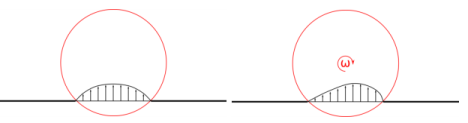
For example, for a stationary spherical grain sitting on a tabletop, the pressure distribution (normal contact force per unit area) in the soft-sphere model might look like the figure shown on the left. The pressure distribution is symmetric. However, when the grain is rolling as shown on the right, the pressure distribution becomes asymmetric, creating a net torque that opposes the rotation.
The rolling resistance is Mrot in Equation 3-2 and is implemented based on Ref. 5.
Constant Torque Model
Select the Constant torque model from the Rotational resistance model list in the physics interface’s Rotational Resistance section to apply the rotational resistance torque using the constant torque model. The rotational resistance torque in 2D is simply rolling resistance torque and is defined as
where
μr is the coefficient of rolling friction
τ =  Req|Fn|
 = (ωi − ωj) / | ωi − ωj | is the unit vector of the relative angular velocity of the grains
Req = RiRj / (Ri + Rj) for contact between the grains, Req = Ri for contact with the walls
Δt is the time step size
In 3D, the rotational resistance torque has two components rolling resistance torque and twisting resistance torque and is defined as
where
(3-23)
and n is given by Equation 3-5.
For Contact Force: Hertz–MD with Adhesion Model,
where Fc is given by Equation 3-22.
Varying Torque Model
Select the Varying torque model from the Rotational resistance model list in the physics interface’s Rotational Resistance section to apply the rotational resistance torque using the varying torque model. The rotational resistance moment in 2D is just the rolling resistance torque and is defined in an incremental way as
The incremental torque is calculated from the incremental relative rotation between two grains and the rolling stiffness kr
Here, kr relates to tangential spring coefficient kt and Req as
(3-24)
This choice sets the nominal rotational natural frequency due to rolling stiffness equal to the nominal rotational natural frequency due to the tangential or shear stiffness, leading to a well-behaved and well-damped rolling resistance mechanism without the need for any additional damping parameters.
The magnitude of the updated rolling resistance cannot be greater than the torque given by constant torque model
(3-25)
where
In 3D, the rotational resistance can be decomposed into two component, rolling resistance and twisting resistance
where krot is given by Equation 3-24, ωr, ωtw are given by Equation 3-23, and Mr is given by Equation 3-25.
For Contact Force: Hertz–MD with Adhesion Model,
where Fc is given by Equation 3-22.