Kinematics of Grains
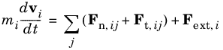
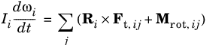
A grain has two types of motion: translational and rotational motion. These motions of individual grains are determined by the equations of the motion given by
(3-1)
(3-2)
where
m, I, v, and ω are the mass, moment of inertia, translational velocity, and rotational velocity of the grain, respectively.
Fn and Ft are the normal and the tangential forces during contact between grains i and j; for example, Contact Force: Hertz–MD (Mindlin and Deresiewicz) Model.
Ri = Rinij is the vector between the center of the grain and the contact point where the force Ft is applied, with Ri the radius and nij the unit normal vector along the line joining the center and point of contact.
Fext are all other external forces applied to the grain such as gravitational force.
Mrot is the torque due to rotational friction and resists the rotation of grain; see Rotational Resistance Theory for more details.
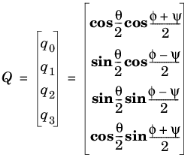
For the orientation of grain, a quaternion Q which is a vector in 4D space is used (Ref. 1). Assuming ϕ, θ, and ψ to be the Euler angles defined in the body-fixed frame, then the components of quaternions are related to Euler’s angles as
(3-3)
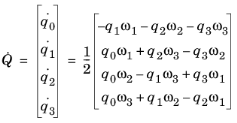
The angular velocity in the body-fixed frame can be then evaluated as
(3-4)
Newton’s second law of motion (Equation 3-1) is expressed as a set of coupled first-order ordinary differential equations with F as the total force:
Similarly, the rotational motion is given as with Γ as the total torque
and ω is calculated using Equation 3-4 in 3D, while in 2D it is calculated as the derivative of the orientation θ of grain: