|
•
|
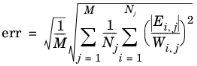
For Automatic, Sj is the average of |Ui,j| for all DOFs i for fixed j, times a factor equal to 10−5 for highly nonlinear problems (that is, where you have selected Automatic highly nonlinear (Newton)) or 0.1 otherwise.
|
|
•
|
For Manual, Sj is the value given in the Scale field. Sj is multiplied by a factor equal to 10−5 for highly nonlinear problems (that is, where you have selected Automatic highly nonlinear (Newton)) or 0.1 otherwise.
|
|
•
|
For Initial-value based, Sj is the average of |Vi,j| for all DOFs i with fixed j times a factor equal to 10−5 for highly nonlinear problems (that is, where you have selected Automatic highly nonlinear (Newton)) or 0.1 otherwise. Here, V = U0 is the solution vector corresponding to the initial value. In case all DOFs are zero for a particular field j, the total mean of |Vi,j| for all i and j is used instead.
|
|
•
|
 |
The (automatically damped Newton) nonlinear solver only checks the convergence criterion if the damping factor for the current iteration is equal to 1. The solver continues as long as the damping factor is not equal to 1 even if the estimated error is smaller than the requested relative tolerance.
|
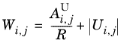
 is the unscaled absolute tolerance, and
  is the scaled absolute tolerance for field j. You can specify either of the absolute tolerances
  or
or  in the Absolute Tolerance section of the Time-Dependent Solver node’s Settings window. If you specify the latter, the scale factor Sj depends on the scaling method selected in the Method list in the Scaling section of the Dependent Variables node’s Settings window:
|
•
|
For Automatic, Sj is the average of |Ui,j| for all DOFs i for fixed j when the Update scaled absolute tolerance checkbox is selected. Otherwise, Sj is matrix based and only computed initially.
|
|
•
|
|
•
|
For Initial-value based, Sj is the average of |Vi,j| for all DOFs i with fixed j, where V = U0 is the solution vector corresponding to the initial value. In case all DOFs are zero for a particular field j, the total mean of |Vi,j| for all i and j is used instead.
|
|
•
|
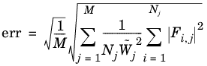
 using the following rules:
|
•
|
For Automatic, the weights
 are determined considering both the initial residual f0 and the residual after the first iteration f1 as f = 0.5|f0| + 0.5|f1|. are determined considering both the initial residual f0 and the residual after the first iteration f1 as f = 0.5|f0| + 0.5|f1|.  is the average of fi, j for all DOFs i for a fixed j. In case all fi, j are zero for that particular field j, the total mean of fi, j for all i and j is used instead. is the average of fi, j for all DOFs i for a fixed j. In case all fi, j are zero for that particular field j, the total mean of fi, j for all i and j is used instead. |
 based on f as above. Here f is considered as the base residual. In later time steps, the initial residual of the current step f0t and the residual after the first iteration of the current time step f1t will be considered together with the base residual f to determine whether the weights need to be updated for the current time step. The weights
  are calculated based on f = 0.5|f| + 0.5|f1t| (i = 0 or 1). The weights are updated as
  if the ratio
  /
/ or
or  /
/ for a field j exceeds the threshold defined in the Threshold for updating residual scale field in the settings for a Dependent Variables node or its Field subnodes.
|
•
|
|
•
|
With consistent initialization active, the base residual f and the weights
 will be calculated during the consistent initialization and recalculated after the consistent initialization finishes. will be calculated during the consistent initialization and recalculated after the consistent initialization finishes. |
|
•
|
When the weights
 for field j need to be updated, then the weights are updated for all fields solved for in the fully coupled solver or in the same segregated step. for field j need to be updated, then the weights are updated for all fields solved for in the fully coupled solver or in the same segregated step. |
|
•
|
For wave problems, the weights
 consist of two parts: the nonvelocity part consist of two parts: the nonvelocity part  and the velocity part and the velocity part  . The weights . The weights  are calculated using only the nonvelocity part of the residual f. The weights are calculated using only the nonvelocity part of the residual f. The weights  for the field j are defined to be proportional to the weights for the field j are defined to be proportional to the weights  as as 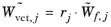 . The proportional ratio r is a fieldwise quantity and is defined as . The proportional ratio r is a fieldwise quantity and is defined as |
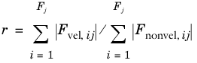
 are set to be 1 for the first iteration at the first time step. It is updated when the velocity part of the residual is nonzero for the first time. The velocity weights will be updated again when the nonvelocity weights are updated.
 is the value given in the