Use Copy Face (

) to make a copy a boundary mesh using a rigid body transformation with a scale factor.
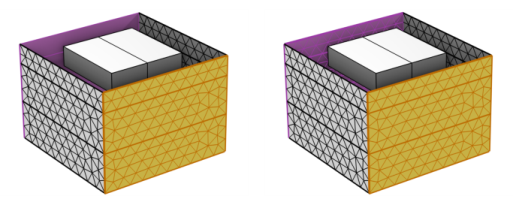
To add a Copy Faces node, select one or several meshed source boundaries and unmeshed destination boundaries, then choose one of the following:
It is possible to copy a mesh from one or several source boundaries onto one or several destination boundaries. The source (or their combination, if Single copy (all-to-one) is used) must be a connected set of exactly the same shape as the corresponding destination, up to a constant scaling factor. More precisely, the distance between any two geometry vertices on the destination is required to be the same, up to a constant scaling factor, as the distance between the corresponding geometry vertices on the source.
Click the Activate Selection button to toggle between turning ON

and OFF

selections. Select the boundaries to copy the mesh from in the
Graphics window.
Click the Swap Source and Destination button (

) to switch source and destination selections. Edge map is available to be switched, if provided.
Use the Smooth across removed control entities setting to smooth the transition in element size across removed mesh control entities. Choose
Automatic (default) to let the algorithm decide when to apply smoothing. If the domains adjacent to the removed mesh control entities contain tetrahedral (3D) or triangular (2D) elements only, the element size transition will be smoothed, otherwise not. Choose
On to always smooth the element size transition. For this option, you can specify the number of smoothing iterations in the
Number of iterations field. In the
Maximum element depth to process field you can specify the maximum element depth, from the removed control entity. Choose
Off to not smooth the element size transition.


 ) menu.