Introducing the Chemical Reaction Engineering Module
The Chemical Reaction Engineering Module is tailor-made for the modeling of chemical systems primarily affected by chemical composition, reaction kinetics, fluid flow, and temperature as functions of space and time. It has several interfaces to model chemical reaction kinetics: mass transport in dilute, concentrated, and electric potential-affected solutions; laminar and porous media flows; and energy transport.
Included in these interfaces are the kinetic expressions for reacting systems, in bulk solutions and on catalytic surfaces, and models for the definition of mass transport. You also have access to a variety of ready-made expressions in order to calculate a system’s thermodynamic and transport properties.
While a major focus of the module is on chemical reactors and reacting systems, it is also extensively used for systems where mass transport is the major process. This includes unit operations equipment, separation and mixing processes, chromatography, and electrophoresis. The module is also widely used in educational and training courses to explain chemical engineering, chemical reaction engineering, electrochemical engineering, biotechnology, and transport phenomena.
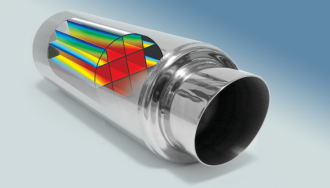
In addition to its application in traditional chemical industries, it is a popular tool for investigating clean technology processes (for example, catalytic monoliths and reactive filters) for applications such as microlaboratories in biotechnology and in the development of sensors and equipment in analytical chemistry.
An overview of the interfaces and their functionality can be found in
Chemical Reaction Engineering Module Interfaces
.