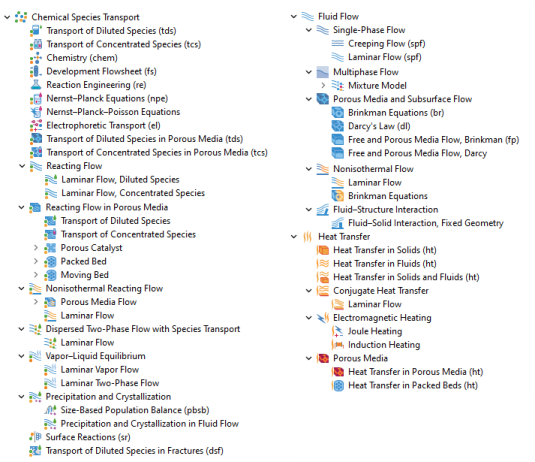
 Chemical Species Transport Chemical Species Transport |
|||||
 |
|||||
 |
|||||
 |
|||||
 |
|||||
 |
|||||
 |
|||||
 |
|||||
 |
|||||
 |
|||||
 |
|||||
 |
|||||
 Reacting Flow Reacting Flow |
|||||
 |
|||||
 |
|||||
 Reacting Flow in Porous Media Reacting Flow in Porous Media |
|||||
 |
|||||
 |
|||||
 |
|||||
 |
|||||
 |
|||||
 |
|||||
 |
|||||
 |
|||||
 |
|||||
 |
|||||
 Nonisothermal Reacting Flow Nonisothermal Reacting Flow |
|||||
 |
|||||
 |
|||||
 Dispersed Two-Phase Flow with Species Transport Dispersed Two-Phase Flow with Species Transport |
|||||
 |
|||||
 Vapor–Liquid Equilibrium Vapor–Liquid Equilibrium |
|||||
 |
|||||
 |
|||||
 Precipitation and Crystallization Precipitation and Crystallization |
|||||
 |
|||||
 |
|||||
 |
|||||
 Fluid Flow Fluid Flow |
|||||
 Single-Phase Flow Single-Phase Flow |
|||||
 |
|||||
 |
|||||
 Porous Media and Subsurface Flow Porous Media and Subsurface Flow |
|||||
 |
|||||
 |
|||||
 |
|||||
 |
|||||
 Nonisothermal Flow Nonisothermal Flow |
|||||
 |
|||||
 Heat Transfer Heat Transfer |
|||||
 |
|||||
 |
|||||
 |
|||||
 ) includes all of the tools required to simulate chemical reaction kinetics in well-defined environments. It sets up simulations of reversible, equilibrium, and irreversible reactions in volumes or on surfaces. You can study the evolution of species concentrations and temperature in controlled environments described by batch, continuous stirred-tank, semibatch, and plug flow reactors. Using the Parameter Estimation Study, multiple objectives may be optimized, and with the Optimization Module, additional methods become available.
 ) provides libraries of chemical reactions for use by other physics interfaces. It also provides kinetic expressions for reaction rates, reaction heat sources, and species transport properties to other interfaces. This interface is always created when a Reaction Engineering model is exported to a space-dependent model. As such, it serves as a reaction kinetics and material property provider to the space-dependent transport interfaces, such as Transport of Diluted Species.
 ) simulates transport of chemical species in a dilute solution. The concentration of one or several chemical species is solved for, and transport mechanisms such as diffusion, convection, and migration in electric fields are included. Transport and reactions of species in gaseous, liquid, and solid solutions can be modeled. This interface also supports transport in porous media such as porous catalysts and packed beds (possibly moving). Contrary to the Transport of Concentrated Species interface (
 ), the concentrations of the species modeled are assumed to not affect the properties of the solution.
 ) models chemical species transport by diffusion, convection, and migration in mixtures where transport properties, such as diffusion, depend on the composition of the mixture. This interface supports multicomponent transport models given by Fickian diffusion, a mixture-average model, as well as the Maxwell-Stefan equations. Similar to the Transport of Diluted Species interface, it also handles transport in porous media. It supports cases where either the solid phase substrate is exclusively immobile, or when a gas-filling medium is assumed to be immobile.
 ) includes a migration term, along with convection and diffusion mass transport, together with an equation that guarantees electroneutrality. Apart from species concentrations, the interface also solves for the electric potential.
 ) is a multiphysics interface for modeling transport of electrolyte species without the otherwise common assumption of local electroneutrality. This allows you to simulate charge separation typically arising close to an electrode surface, where electrolyte ions are attracted and repelled by unscreened excess charge on the electrode. The charge separation region, also called the diffuse double layer, normally extends a few nanometers away from the electrode surface into the electrolyte.
 ) is used to solve for the transport of species in water-based system subject to potential gradients. The species transported can be any combination of weak and strong acids and bases, ampholytes, and uncharged species. The interface supports dissociation equilibria for weak acids, bases, and ampholytes, as well as the water auto-ionization reaction.
 ) under Reacting Flow combines the functionality of the Single-Phase Flow and Transport of Concentrated Species interface.
 ) under Reacting Flow combines the functionality of the Single-Phase Flow interface with functionality of the Transport of Diluted Species interface.
 ) treats diluted reacting mixtures transported by a free and/or porous media flow. This multiphysics interface combines the functionality of the Brinkman Equations and Transport of Diluted Species in Porous Media interface.
 ) treats concentrated reacting mixtures transported by a free and/or porous media flow. This multiphysics interface combines the functionality of the Brinkman Equations and Transport of Concentrated Species interface.
 ) treats diluted reacting mixtures transported by a free and/or porous media flow in a catalytic reactor. This multiphysics interface combines the functionality of the Brinkman Equations and Transport of Diluted Species in Porous Catalysts interface.
 ) treats concentrated reacting mixtures transported by a free and/or porous media flow in a catalytic reactor. This multiphysics interface combines the functionality of the Brinkman Equations and Transport of Concentrated Species in Porous Catalysts interface.
 ) treats diluted reacting mixtures transported by a free and/or porous media flow in a reactive pellet bed reactor. This multiphysics interface combines the functionality of the Brinkman Equations and Transport of Diluted Species in Packed Beds.
 ) treats concentrated reacting mixtures transported by a free and/or porous media flow in a reactive pellet bed reactor. This multiphysics interface combines the functionality of the Brinkman Equations and Transport of Concentrated Species in Packed Beds.
 ) treats diluted reacting mixtures transported by a free and/or porous media flow in a reactive moving pellet bed reactor where pellet acts as reactant. This multiphysics interface combines the functionality of the Brinkman Equations and Transport of Diluted Species in Packed Beds.
 ) treats concentrated reacting mixtures transported by a free and/or porous media flow in a reactive moving pellet bed reactor. This multiphysics interface combines the functionality of the Brinkman Equations and Transport of Concentrated Species in Packed Beds.
 ) treats diluted reacting mixtures transported by a free and/or porous media flow in a reactive moving pellet bed reactor where pellet acts as reactant. This multiphysics interface combines the functionality of the Brinkman Equations and Transport of Diluted Species in Packed Beds.
 ) combines Chemistry, Transport of Concentrated Species in Porous Media, Brinkman Equations, and Heat Transfer in Porous Media interfaces to treat the reacting flow and reactions in porous media. The Heat Transfer in Fluids can take reaction heat and species enthalpy from Chemistry.
 ) combines Chemistry, Transport of Concentrated Species, Laminar Flow and Heat Transfer in Fluids interfaces to treat reacting flow. The Heat Transfer in Fluids can take reaction heat and species enthalpy from Chemistry.
 ) models dispersed two-phase fluid flow with mass transfer. The interface combines Mixture Model, Laminar Flow with mass transport in both the continuous phase and the dispersed phase. The interface can for example be used to model liquid-liquid extraction.
 ), under Precipitation and Crystallization, is used to model the population balance of particles in a fluid. Examples include crystals in a liquid, gas bubbles in a liquid, and droplets in a gas. The interface solves for the discretized size distribution of particles, with support for growth, nucleation, aggregation, and breakage terms.
  ), under Precipitation and Crystallization, is available in 0D. It is used to simulate precipitation of chemical species in a solution and to solve for the resulting size distribution of the precipitate. It couples the Reaction Engineering and Size-Based Population Balance interfaces.
 ), under Precipitation and Crystallization, is used to simulate precipitation of chemical species in a solution and to solve for the resulting size distribution of the precipitate. It combines the Laminar Flow, Transport of Diluted Species and Size-Based Population Balance interfaces.
 ), under Vapor-Liquid Equilibrium, is used to simulate evaporation and condensation to or from a vapor–liquid interface. It combines the functionality of the Single-Phase Flow Interface with functionality for mass transfer at vapor–liquid interfaces.
 ), under Vapor-Liquid Equilibrium, is used to simulate evaporation and condensation to or from a vapor–liquid interface, and to track the position of the interface. It combines the functionality of the Single-Phase Flow Interface with functionality for mass transfer at vapor–liquid surfaces as well as functionality for tracking a moving vapor–liquid interface.
 ) models reactions involving surface adsorbed species and species in the bulk of a reacting surface. This interface is used on a model boundary, and is coupled to a mass transport interface active on a model domain. The interface can be used together with the Reacting Flow interfaces, and the Electrochemistry interfaces. The Electrochemistry interfaces require the addition of one of the Battery Design Module, the Corrosion Module, the Electrochemistry Module, the Electrodeposition Module, or the Fuel Cell & Electrolyzer Module. Predefined expressions for the growth velocity of the reacting surface makes it easy to set up models with moving boundaries.
 ) is used to model solute species transported along fracture surfaces where the thickness is very small compared to the other dimensions. Geometries like these are often hard to mesh. In this interface the fractures are defined by boundaries in the model geometry, circumventing the need for a mesh in the thin dimension. The interface allows you to define the average fracture thickness and also the porosity, for cases when the fracture is considered to be a porous structure. Different effective diffusivity models are available for such cases. The interface includes support for transport due to convection, diffusion, and dispersion, as well as chemical reactions.
 ) is used to model flow at very low Reynolds numbers, in which case the inertial term in the Navier–Stokes equations can be neglected. Creeping flow, also referred to as Stokes flow, occurs in systems with high viscosity or small geometrical length scales, for example in microfluidics and MEMS devices.
 ) is used to model flow at low to intermediate Reynolds’ numbers, and often in combination with mass transport and heat transfer. The interface solves the Navier–Stokes equations and assumes by default that a flow is incompressible. This simplifies the numerical scheme and provides fast and efficient flow simulations. You can also choose to model compressible flow in which case the density may depend on pressure, composition, and temperature. The interface supports compressible flow at speeds of less than Mach 0.3.
 ) models two-phase flow including a continuous liquid phase and a dispersed phase consisting of liquid droplets or solid particles. The interface allows for mass transfer between the two phases.
 ) is used to model porous flow when the size of the interstices is larger; the Brinkman interface extends Darcy’s law to describe the dissipation of the kinetic energy by viscous shear, similar to the Navier–Stokes equations. The interface includes the possibility to add a Forchheimer drag term, which simulates viscous drag in very open beds where turbulent drag becomes important. Forchheimer drag is sometimes called Ergun’s equations. For very low speed flows or small geometrical length scales, you can also choose to neglect the inertial term (Stokes flow).
 ) is used to model fluid movement through interstices in a porous medium where a homogenization of the porous and fluid media into a single medium is done. Together with the continuity equation and equation of state for the pore fluid this interface can be used to model flows for which the pressure gradient is the major driving force. The penetration of reacting gases through a catalytic washcoat or membrane is a classic example for the use of Darcy’s Law.
 ) is useful for equipment that contain domains where free flow is connected to porous media, such as packed-bed reactors and catalytic converters. It should be noted that if the porous region is large in comparison to the free fluid region, and you are not primarily interested in results in the region of the interface, then you can always couple the Laminar Flow interface to the Darcy’s Law interface, to make your overall model computationally cheaper.
  ) provides such a coupling to model porous media flow connected to free flow domains. This multiphysics interface automatically couples the Laminar Flow interface with the Darcy’s Law interface over their common boundary.
 ) is primarily applied to model flow at low to intermediate Reynolds numbers in situations where the temperature and flow fields have to be coupled. A typical example is natural convection, where thermal buoyancy forces drive the flow.
 ) couples the Brinkman Equations interface to a Heat Transfer in Porous Media interface and automatically adds a Porous Material node under Materials in the model tree.
 ) interface can be used to model phenomena where a fluid and a deformable solid structure affect each other. The interface models situations where the displacements of the solid are assumed to be small enough for the geometry of the fluid domain to be considered as fixed during the interaction.
 ), Heat Transfer in Solids (
 ), Heat Transfer in Porous Media (
 ), Heat Transfer in Packed Beds (
 ), and account for conductive and convective heat transfer. These features interact seamlessly and can be used in combination in a single model.