The Morris sampling method is a special sampling method used for the Screening, MOAT UQ analysis. The Morris sampling is generated on a [0, 1]m hypercube and then mapped into the input parameter distribution. The MOAT method varies one input parameter at a time, where each input parameter is constructed to have a discrete number of values, called levels. The value at each level is in the set
[1/(n − 1), 2/(n − 1), …, 1 − 1/(n − 1)], where
n is the number of levels. The entire
m-dimensional input parameter space is discretized into an
n-level grid in each dimension. The data sampling starts by randomly selecting a base value, and each component in
x is sampled from the set
[1/(n − 1), 2/(n − 1), …, 1 − 1/(n − 1)]. Note that the base value vector is only used to generate other sampling points. The next sampling point is obtained by increasing or decreasing one component of
x by
Δ,
defined as
The choice between increasing or decreasing Δ is conditioned by
x still being in the [0, 1]
m hypercube. Starting from a base value,
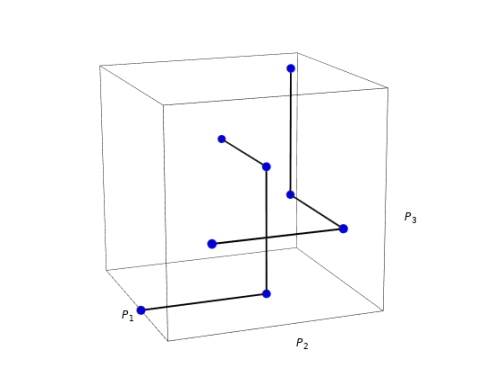
m sampling points are added by moving in one dimension at a time; the path following all the sampling points is called a trajectory. A schematic plot of two Morris trajectories of a 3D input space consisting of
p1,
p2, and
p3 is shown in
Figure 2-1.
The Uncertainty Quantification Module uses the sampling method designed in Ref. 3, which gives better coverage of the entire input parameter space. The method selects
r trajectories together in a way that is designed to maximize their dispersion in the input space. It starts with a large number of different trajectories and chooses the trajectories with the highest “spread”, which is defined based on the distances between the sample points in the trajectories.


