Selecting the Right Fluid Flow Interface
The Fluid Flow physics features included with the Subsurface Flow Module are used to characterize movements of liquids, gases, and other flowing media, such as molten rock. The physics interfaces are set up using terms like pressure and hydraulic heads, that are familiar to hydrologists.
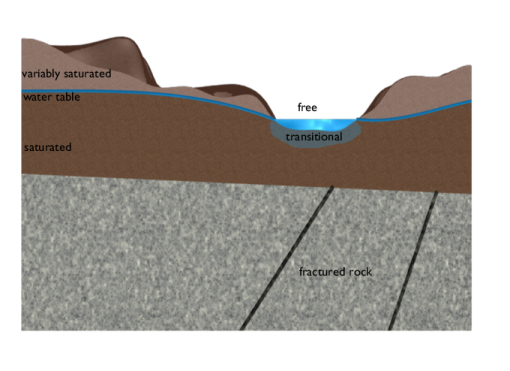
Figure 2-1:
Different areas of subsurface flow regimes.
Saturated porous media flow can be modeled through either Darcy’s Law or Brinkman’s extension to Darcy’s Law, depending on the size of the pores involved. If the pore is such that viscous effects to the fluid flow can be ignored, then Darcy’s Law can be used, and flow is described exclusively by the pressure variable. If the size of the pores is such that the fluid can impose momentum changes through shear effects, then the Brinkman equations are suitable. They solve for the same variables as the Navier–Stokes equations, but include terms that consider the porosity of the media the fluid is flowing through.
Read more
About Darcian and Non-Darcian Flow
and
Permeability Models
in the
Porous Media Flow User’s Guide
.
In variably saturated porous media flow (usually above the water table), hydraulic properties may change as fluids move through the medium, filling some pores and draining others. Richards’ equation is employed to model this type of flow, and the van Genuchten and Brooks and Corey formulations can be applied to take retention in the pores into account. Density, dynamic viscosity, saturated and residual liquid fraction, hydraulic conductivities, and storage models can be provided.
The Fracture Flow interface solves for pressure on internal (2D) boundaries within a 3D matrix and is automatically coupled to the physics describing the porous media flow in the surrounding matrix. This approximation saves you from meshing the actual fractures and the computational resources this entails. If a fluid happens to flow from one medium to the other (and back) in the same model, all of the porous media physics are automatically coupled to descriptions of free flow within the Subsurface Flow Module.
The Navier–Stokes equation describes free flow of liquid. In the above picture it is valid to model the flow in the river bank but it can also be used to model flow through the porous medium on the microscopic scale.
If more than one phase is present in the porous medium, such as in oil reservoirs, where also the Richard’s Equation is not valid the flow can be modeled using the Multiphase flow in Porous Media interface which couples Darcy’s Law with a transport equation for the phases.
Table 2-1:
Porous media Flow Interfaces.
Physics Interface
Flow Regime
Equation
Laminar Flow
Free Flow
Navier–Stokes Equation
Free and Porous Media Flow, Brinkman
Free flow and fast flow in porous media
Navier–Stokes Equation in free flow
Brinkman equations in porous media
Free and Porous Media Flow, Darcy
Free flow and slow flow in porous media
Navier–Stokes Equation in free flow
Darcy’s Law in porous media
Brinkman Equations
Fast flow in porous media
Brinkman equations
Darcy’s Law
Slow flow in porous media
Darcy’s Law
Richards’ Equation
Variably saturated porous media
Richards’ equation
Fracture Flow
Flow along surfaces of fractures
Darcy’s Law
Multiphase Flow in Porous Media
Flow of more than one fluid through a porous medium
Darcy’s Law
Transport equation for each phase
Two-Phase Darcy’s Law
Two-phase flow in porous media
Darcy’s law
Transport equation