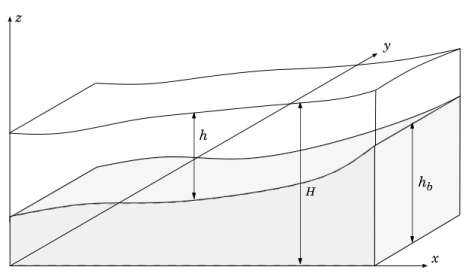
Figure 5-2 shows a typical configuration for the flow of fluid in a shallow layer. The upper boundary is referred to as the free surface and the lower boundary of the water layer is referred to as the bottom. The bottom height,
hb, is measured with respect to a reference
xy-plane placed at
z = 0 and it is assumed to be constant in time. The total height of the free surface is denoted
H. The height of the water layer is typically measured in relation to the bottom height and denoted
h. In dry regions,
h = 0 and
H = hb.
Assuming that the water depth h is much smaller than the lateral dimensions of the geometry, the vertical accelerations can be neglected,

, and
Equation 5-4 reduces to the hydrostatic pressure relation
The continuity equation is recovered from Equation 5-1 when assuming no penetration on both the free surface and bottom boundaries:
See Chapter 2 in Ref. 1 for more details.
Equation 5-6,
Equation 5-7, and
Equation 5-8 can be combined to express the shallow water equations in conservative form
qx and
qy are the components of the water flux in the
x and
y directions, respectively. The vector

can be obtained from the horizontally averaged velocity

as
 ) are
) are



 at the bottom.
 . Equation 5-2 and Equation 5-3 then reduces to