Introduction
The Subsurface Flow Module extends the COMSOL Multiphysics modeling environment to the quantitative investigation of geophysical and environmental phenomena. It is designed for researchers, engineers, developers, teachers, and students, and it suits both single-physics and multiphysics modeling. The earth makes up a giant laboratory filled with an unlimited array of basic physics and multiphysics interactions. Whether in concert or alone, these physical phenomena alter our access to important resources, affect the quality of the environment, and shape the ground beneath our feet.
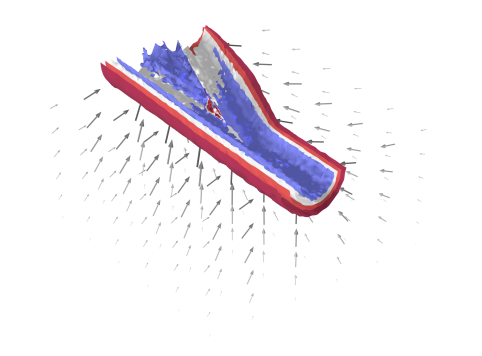
Isosurface plot of the fail function and Darcy velocity field (arrows) calculated from a poroelastic model for the branching junction in a multilateral well.
The contents of the Subsurface Flow Module are a set of fundamental building blocks which cover a wide array of physics questions. The physics interfaces it offers work on their own or linked to each other. They can also be coupled to physics interfaces already built into COMSOL Multiphysics, or to new equations you create. Because COMSOL Multiphysics removes the complications of writing your own code, it is our hope that you will use the Subsurface Flow Module as a springboard to investigate a rich variety of physics modeling.
The Subsurface Flow Module includes physics interfaces geared to earth-science investigations as well as a library of examples that address a range of problems. The available ready-to-run applications demonstrate a range of the included features, and also provide insight into COMSOL Multiphysics modeling in general. Each application comes with step-by-step instructions to reproduce it in the graphical user interface along with any data or additional files needed to build it on your own. Those who are unfamiliar with some of the equations or computational techniques included in the module should find the applications and the documentation extremely beneficial.
The physics interfaces, options, and functionalities in this module are tailored to account for geologic processes. The Heat Transfer interfaces, for example, include options to automate the calculation of effective thermal properties for multicomponent systems. The fluid flow equations represent a wide range of possibilities. Included are Richards’ equation, which describes nonlinear flow in variably saturated porous media. The options for saturated porous media include Darcy’s law for slow flow and the Brinkman equations where shear is nonnegligible. The Laminar Flow and Creeping Flow interfaces cover free flows at different Reynolds numbers. The module also treats the transport of chemical species and their reactions. The Transport of Diluted Species interface accounts for the transport of species in solid, liquid, and gas phases in free flow, saturated, and partially saturated porous media. A number of the examples in the application library link these physics interfaces together.