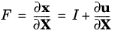
The deformation gradient F is in general defined as the gradient of the current coordinates with respect to the original coordinates:
Here ∇tu is the displacement gradient computed using the tangential gradient on the membrane surface,
N is the normal vector to the undeformed membrane, and
⊗ is the outer product of two vectors,
(a⊗b)ij = aibj. The tangential deformation gradient
Ft then contains information about the stretching in the membrane plane.
Since the tangential deformation gradient does not contain any information about the transverse (out-of-plane) stretch λn, it must be augmented by the normal deformation gradient
Fn to define the full deformation gradient. It is given by
where n is the normal vector to the deformed membrane. For anisotropic materials, the shear deformation gradient
Fs is also needed to define the full deformation gradient. It is given by
where t1 and
t2 are the tangent vectors on the deformed membrane surface. The full deformation gradient
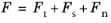
F is then computed from the sum of tangential, shear, and normal deformation
Note that Fs is only nonzero for anisotropic materials, otherwise
Fs =
0.
The Jacobian J is the ratio between the current volume and the initial volume. In full 3D it is defined as