Spring Material
When the Spring approximation is chosen, it is possible to specify a Spring material for the thin layer.
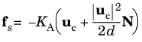
In the geometrically linear case, the spring force fs per reference area is computed as
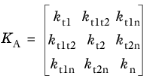
where KA is the spring constant. The spring constant can be a scalar or a matrix which components are the spring constants given with respect to the boundary system. When using the boundary system to specify the spring constants, this matrix reads.
See the Boundary System section for details.
For the geometric nonlinear case, the spring force reads
Loss Factor Damping
When the Spring approximation is chosen, it is possible to add Loss factor damping or Viscous damping to the spring material.
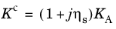
When using loss factor damping, a complex spring matrix is used to define the spring force. With an isotropic loss factor ηs, this means that
where KA is the constitutive matrix computed from the spring constants, and Kc is the complex constitutive matrix used when computing the spring force.
For a linear elastic material, this would be equivalent to multiplying Young’s modulus by the factor (1 + jηs).
It is also possible to give individual loss factors for each entry in the constitutive spring matrix, so that
Loss factor damping is only applicable in frequency domain.
Viscous Damping
Viscous damping causes a viscous stress proportional to the rate of strain in the material,
where ηb and ηv are the normal and shear viscosity coefficients, respectively.
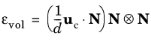
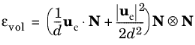
For the Spring approximation, only normal extension causes volume changes in the thin layer. The volumetric (normal) strain in the geometric linear case is computed from
and for the geometric nonlinear case from
In both cases, the deviatoric (transverse shear) strain reads
The viscous force is then computed for the geometric linear case from
and for the geometric nonlinear case from
Viscous damping can be used in both frequency and time domain analyses.