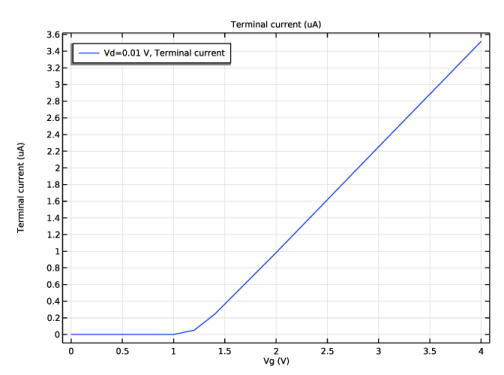
From the plot it is clear that the threshold voltage, VT, of the transistor is approximately 1.2 V. It is possible to compare this value with the theoretical value given by (S. M. Sze and K. K. Ng,
Physics of Semiconductor Devices, Wiley, Hoboken, New Jersey, pp. 305–306, 2007):
where dox is the thickness of the oxide and
εr,ox is its relative permittivity,
ε0 is the permittivity of free space,
εr,s is the relative permittivity of the semiconductor,
q is the electron charge and
Na is the acceptor concentration under the gate. The flat band voltage
VFB and the potential difference between the intrinsic level and the Fermi-level,
ΨB, are given by the following equations:
where Φm is the work function of the metal contact,
χ is the semiconductor electron affinity,
kB is Boltzmann’s contact,
T is the absolute temperature,
Nc is the semiconductor density of states in the conduction band and
ni is the intrinsic carrier density. The equilibrium electron (
neq) and hole (
peq) densities are given by:
Where Nd is the donor concentration under the gate. Note that these equations assume both complete ionization and Maxwell Boltzmann statistics (reasonable assumptions near the threshold condition). These equations give a threshold voltage of 1.18 V, in good agreement with the simulation result. Follow the steps below to compute the threshold voltage using the approximate formulas above.



 and choose 1D Plot Group
  .
. .
. click Replace Expression
  (it is in the upper-right corner of the “y-Axis Data” section — do not get confused with the same button for the “x-Axis Data”). In the menu, expand the tree to Model > Component1 > Semiconductor > Terminals, and then double click “semi.I0_2 - Terminal Current - A”.
 .
.
 .
.
 .
.