Identification of Whirl
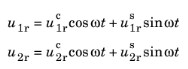
When the deformation of the rotor is observed in a corotating frame, the computed eigenfrequencies must be shifted to obtain the correct eigenfrequency from the analysis. This can be shown with the following consideration. Let u1r and u2r be the components of the displacement vector in lateral directions 1and 2 of the rotor. The axis of the rotor is chosen as direction 3. Then, the harmonic response of these displacements can be represented as
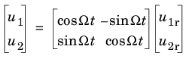
The components of the displacements observed in the spatial frame can be written as
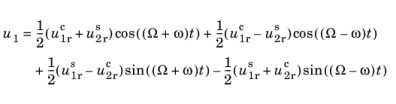
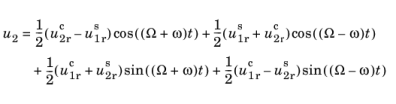
where Ω is the angular velocity of the rotor. After simplification, these components are
and
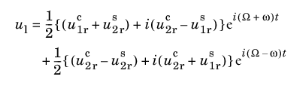
In the complex plane, the lateral displacement can be represented as ul = u1+iu2. After substitution, this becomes
(3-18)
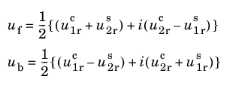
The motion is defined as forward whirl if it whirls in the rotor spinning direction, and as backward whirl if it whirls opposite to the rotor spinning direction. Therefore, the first term in Equation 3-18 corresponds to the forward whirl and the second term corresponds to the backward whirl. The lateral displacement can then be represented in terms of forward and backward components in the following way:
with
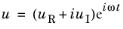
A solution from an eigenfrequency analysis is represented as
The real part is then
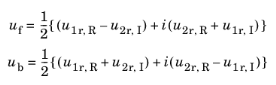
Therefore,
Hence, the forward and backward components can be expressed as
The lateral displacement in the complex plane can also be written as
(3-19)
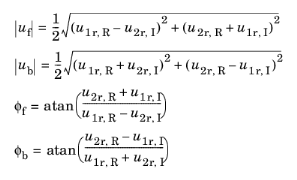
with
Equation 3-19 shows that the orbit of the rotor consists of the summation of two rotating vectors: one is a forward circular motion with an amplitude |uf|, and the other is a backward circular motion with an amplitude |ub|. When the forward amplitude is greater than the backward amplitude, the overall motion is forward. When the forward amplitude is smaller than the backward amplitude, the overall motion is backward. When both amplitudes are equal, the motion degenerates to a straight line. To summarize, you can classify the whirl based on the following criteria:
|uf| = 0: Backward circular planar motion
|ub| = 0: Forward circular planar motion
|ub| > |uf|: Backward elliptical planar motion
|ub| = |uf|: Straight line motion
|ub| < |uf|: Forward elliptical planar motion
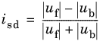
Quantification of this information can be done conveniently by defining a shape and directivity index in the following way:
As a result,
You can then classify the whirl using the following criteria:
isd = −1: Backward circular planar motion
1 < isd < 0: Backward elliptical planar motion
isd = 0: Straight line motion
0 < isd < 1: Forward elliptical planar motion
isd = 1: Forward circular planar motion
Usually, the entire rotor has either forward or backward whirl. However, it is also possible that the complete rotor can have mixed whirling, meaning the rotor can undergo forward and backward whirl simultaneously at different sections. Mixed whirling sometimes occurs in long flexible rotors supported by fluid-film bearings.