Effect of Deformation
The thickness expression obtained in the previous section only considered the motion at the center of the structure and bearing surfaces. In addition to this, both structure and bearing can tilt, bend, and radially expand. Such motion will also affect the film thickness. Therefore, the film thickness in general is a function of the axial and azimuthal coordinates. The effect of the radial expansion can be accounted for by updating the initial clearance profile including the effect of radial deformation of both the structure and the bearing. However, such radial expansions are going to be small, except for the case of thermal expansion. Here, thickness changes due to radial expansion or contraction is neglected. Also, a rotation of the flat or cylindrical structural surface about the bearing axis will not change the film thickness and should be excluded while calculating the film thickness. These considerations require the motion of the both the structure and the bearing to be split into three components:
The film thickness calculation will only include the effect of the relative motion of the centerline of the structure and the bearing. The motion of the centerline is determined by splitting the total displacement into the following components:
Tilting about local y and z axes: α and β
Bending deformation about local y and z axes: κy and κz
The total displacement can then be approximated in terms of these quantities as
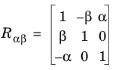
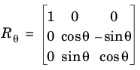
The total rotation matrix is the combination of axial rotation followed by tilting rotation R = RαβRθ. Axial rotation can be finite but tilting rotations are small. The components of these matrices given in the local bearing direction are:
and
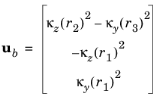
Bending deformation is assumed to have a quadratic variation in local coordinates:
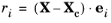
with
Parameters in the approximated expressions are obtained by minimizing the least-squares error between the approximated and actual displacement over the bearing surface.
Once the quantities uc, θ, α, β, κy, and κz are known, the part of the displacement which changes the film thickness can be written by removing the axial rotation:

Therefore, the film thickness expression should use the approximated displacement instead of the displacement only at the center:
The total velocity field of the structure and foundation is used as an input for the journal or collar velocity in the bearing.
The net force and moment due to the pressure distribution in the film then acts as a load on both the structure and the bearing surfaces.