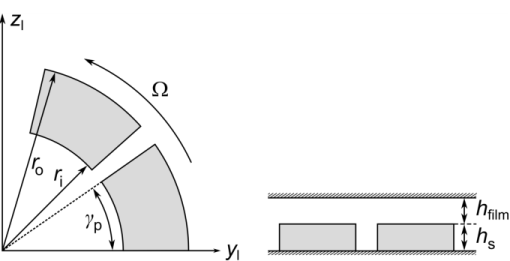
The arc angle, γp, defines the angle a pad spans in the circumferential direction while the inner and outer radii are given by the variable
ri and
ro, respectively. Like the tapered land bearing, the step bearing is available with two different groove configurations. One having a groove which makes a constant arc angle about the bearing center and another for which the groove width is constant. The geometries of the two different configurations are visualized in
Figure 7-23 and
Figure 7-24, respectively.
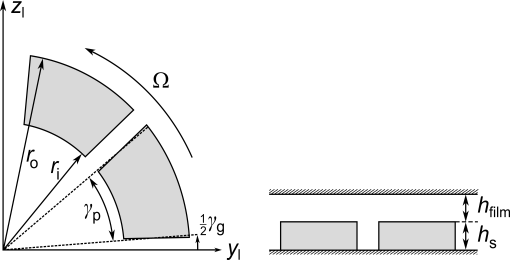
The step bearing can be considered as a simplified tapered land bearing. The geometry of the step bearing can be derived based on the expressions for the tapered land bearing. For the step bearing, it applies that the width of the inner and outer dam, that is, d1 and
d2, are zero. To have a parallel pad surface, it requires the tapered depth to be vanishing, that is,
hi =
ho = 0. Consequently, the film thickness is constant over the pad surface, which yields
hte =
hfilm. Finally, the film thickness in the groove area can be defined as the sum of the step height and the film thickness over the pad surface,
hg =
hs +
hfilm. This yields the piecewise expression for the film thickness of the step bearing with a constant arc groove