
Asperity Contact Forces
In the previous section, we considered the effect of asperities on the film flow. If the gap between the surfaces reaches the order of the height of the asperities, it is no longer possible to avoid the contact between these. This scenario is called a mixed lubrication condition. In this case, the total reaction force of the bearing is a combination of the reaction due to the film pressure and the pressure due to the contact between asperities.
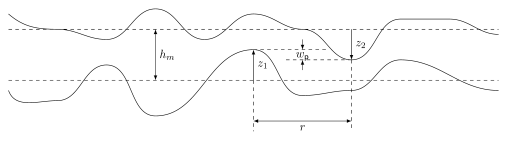
Figure 7-8: Asperity contact.
Based on statistical considerations for the asperity contact, the contact force as a function of mean film thickness and other statistical parameters for the asperity distribution is given as:
where
P(w,r): Contact pressure due to single asperity contact
η: Surface asperity density on the contacting surfaces
r: Offset between asperity peaks on both surfaces
z1, z2: Asperity peak heights above the respective reference surfaces
hm: Mean gap between the contacting surfaces
= z1 + z2 − hm − 2f(r/2): Interference of the asperity contact
A: Apparent area of contact
ϕ1, ϕ2: Distribution of asperity heights on respective surfaces
Since, the force between the pair of asperities will be a function of the combined height z = z1 + z2 rather than the individual heights z1 and z2, we can combine the individual distributions to give the sum of the distributions as ϕ0(z). The expected total force can then be written as
Now introduce wp = z − hm and define the integration over r in the above expression as
Then total force can now be expressed as
In the same way
and
If the asperities are assumed to be paraboloidal f(r) = r2/2r0, and 2f(r/2) = r2/4r0. Here r0 is the radius of curvature at the peak of the asperity. The Hertzian solution for a paraboloidal surface in contact is
and
Substituting these expressions in the average force-displacement relation, gives
where the square brackets in the above equation are the Macaulay brackets, indicating a positive parts operator. After performing the integration
and the total force is given by
Introduce z = sσ and a standardized height distribution
Then
where
Similarly, we find the contact area
and the expected number of contacts
The nominal pressure on the contact surface due to the contact of asperities can then be obtained by dividing the total contact force by the apparent area, which gives
with
In order to evaluate the contact pressure and contact area, we need to evaluate the functions Fn. This requires the knowledge of the distribution ϕ0. Experimental investigations have shown that a Gaussian distribution is a close approximation. For a Gaussian distribution, Fn is defined as
When h is large and positive, it can be approximated as
and if h is large but negative as
The following recurrence relation can be used to obtain the higher values of Fn:
The following table summarizes the values of Fn:
Table 7-2: Values of Fn.
F0(h)
F1/2(h)
F1(H)
F3/2(H)
F2(H)
F5/2(H)