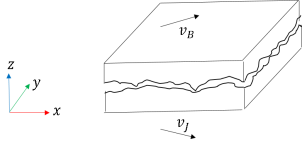
Consider two rough surfaces pressing against each other and supported by a lubricant film between them. The surfaces are in a relative sliding motion with each other with velocity vJ and
vB, respectively. When the lubricant film between them is thick enough, asperities in the surfaces do not come in contact with each other. This is usually the case for when the contact load is small. Such a lubrication is referred to as
full film lubrication. When the contact load is very high, the surfaces can come close to each other by squeezing the film. In such a scenario, the gap between the surfaces can be of the same order as the height of the asperities. Therefore, asperities can come in contact at various locations. As a result, the contact load is not only supported by the pressure in the lubricant film but also by the contact pressure between asperities. Such a lubrication is referred to as
mixed lubrication.