Materials
The following commands are used to add and assign material properties to each of the lenses. These materials are part of a dedicated Optical Material Library that is available with the Ray Optics Module or Wave Optics Module.
1
In the Materials toolbar, click Add Material
to open the Add Material window.
2
Go to the Add Material window.
3
In the tree, select Optical > Ohara Glass > Ohara S-LAM 3 Glass.
4
Click Add to Component
in the window toolbar.
5
In the tree, select Optical > Ohara Glass > Ohara S-BAH11 Glass.
6
Click Add to Component
in the window toolbar.
7
In the tree, select Optical > Schott Glass > Schott N-SF5 Glass.
8
Click Add to Component
in the window toolbar.
9
In the Materials toolbar, click Add Material
to close the Add Material window, since no other materials are needed.
Next, assign each material to the relevant lenses:
1
In the Model Builder window, under Component 1 (comp1)
> Materials
click Ohara S-LAM 3 Glass (mat1)
.
2
In the Settings, locate the Geometric Entity Selection section.
3
From the Selection list, choose Lens Material 1.
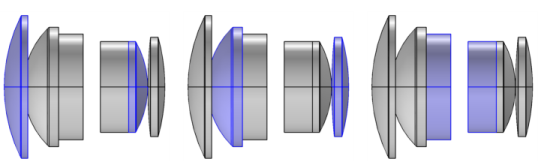
This is a Cumulative Selection that was defined in the geometry sequence. Each of the six lenses has been assigned to one of three lens material selections.
4
In the Settings window for Material Ohara S-BAH11 Glass (mat2)
, locate the Geometric Entity Selection section.
5
From the Selection list, choose Lens Material 2.
6
In the Settings window for Material Schott N-SF5 Glass (mat3)
, locate the Geometric Entity Selection section.
7
From the Selection list, choose Lens Material 3.
The material selections should look like the following figures.
Selections for the Ohara S-LAM 3 (left), Ohara S-BAH11(middle), and Schott N-SF5 (right) glasses.
The material models for these optical glasses do not define the refractive index directly. Instead, each of these three glasses uses the Sellmeier optical dispersion model, in which the refractive index is a function of the wavelength of light. The Sellmeier formula uses a set of coefficients that are defined in the Material nodes. If ray intensity is solved for, then the attenuation of energy as the rays propagate through each medium is governed by a separate material property called the internal transmittance, which is also defined as a function of wavelength.
 to open the Add Material window.
 in the window toolbar.
 in the window toolbar.
 in the window toolbar.
 to close the Add Material window, since no other materials are needed.
 > Materials
  click Ohara S-LAM 3 Glass (mat1)
  .
. , locate the Geometric Entity Selection section.
 , locate the Geometric Entity Selection section.