Introduction
The Ray Optics Module is a computational tool for modeling the propagation of light and other electromagnetic radiation with a ray tracing approach. The rays can propagate through the model geometry while being reflected, refracted, or absorbed at boundaries.
You can control where the rays are released, and in what direction. You can also assign different boundary conditions to every surface in the geometry.
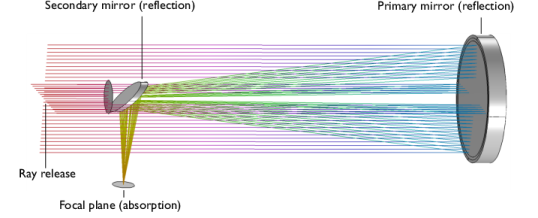
A simple Newtonian telescope. The incident rays are focused by a parabolic primary mirror and then redirected to the focal plane by a flat secondary mirror.
The fundamental assumption of ray optics is that the wavelength of the radiation is much smaller than the smallest geometric detail in the model, so that diffraction can be ignored.
The Ray Optics Module employs nonsequential ray tracing with a deterministic ray splitting algorithm at boundaries. In other words, rays can interact with any surfaces in the model geometry that they hit, without the order of ray-boundary interactions having to be specified
a priori
. At boundaries between different media, each incident ray can be split into a reflected ray and a refracted ray.
Within the simulation domain, the media can be homogeneous or can have gradients in the refractive index. Optionally, the medium can be absorbing; the absorbed energy could then be used to define a heat source for temperature computation. The Ray Optics Module is also fully compatible with physics interfaces that compute temperature and structural deformation, allowing for high-fidelity structural-thermal-optical performance (STOP) analysis. The refractive indices can be both wavelength- and temperature-dependent.
A wide variety of dedicated postprocessing tools are available to visualize ray propagation, extract figures of merit, and export relevant data.
About This Book
The next section of this booklet gives a list of the physics interfaces and multiphysics couplings that are available with the Ray Optics Module.
The subsequent sections explain the different types of physics interface settings and features that are provided for ray optics simulation.
The final section of this book is a detailed, step-by-step tutorial of the setup, ray tracing, and postprocessing of a double Gauss lens system.
Physics Interfaces by Space Dimension and Preset Study Type
Physics interface
Icon
Tag
Space Dimension
Available Study Type
Optics
Ray Optics
Geometrical Optics
gop
3D, 2D, 2D axisymmetric
ray tracing; bidirectionally coupled ray tracing; time dependent
Ray Heating
—
3D, 2D, 2D axisymmetric
ray tracing; bidirectionally coupled ray tracing; time dependent
The Ray Optics Interfaces
The Ray Optics Module includes the Geometrical Optics physics interface
, as well as a dedicated Ray Heating multiphysics interface
.
Geometrical Optics
The Geometrical Optics interface
is found under the Optics
branch in the Model Wizard
. It is used to model the propagation of electromagnetic rays. By default only the ray paths are solved for, but it is possible to solve for additional variables to analyze ray intensity, polarization, phase, optical path length, and more. Rays can propagate through both homogeneous and graded-index media. This interface supports a wide variety of ray sources, and the released rays can be reflected, refracted, or absorbed at any boundary in the model.
Ray Heating
The Ray Heating interface
is found under the Optics
branch in the Model Wizard
. It combines the Geometrical Optics
interface with the Heat Transfer in Solids
interface. These two interfaces are coupled together using the Ray Heat Source multiphysics node
.
When the rays pass through an absorbing medium, indicated by a complex-valued refractive index, the ray intensity decreases and a deposited heat source is defined within the domain. This heat source can then be combined with other heat sources and boundary conditions to compute the temperature of the domain.
It is possible to set up bidirectionally coupled models in which the temperature perturbation caused by ray attenuation significantly changes the refractive index of the medium or causes thermal deformation of the boundaries. The rays can then be traced through this perturbed system to yield a self-consistent solution.
 Optics
 Ray Optics

 , as well as a dedicated Ray Heating multiphysics interface
  .
. is found under the Optics
  branch in the Model Wizard
  . It is used to model the propagation of electromagnetic rays. By default only the ray paths are solved for, but it is possible to solve for additional variables to analyze ray intensity, polarization, phase, optical path length, and more. Rays can propagate through both homogeneous and graded-index media. This interface supports a wide variety of ray sources, and the released rays can be reflected, refracted, or absorbed at any boundary in the model.
 is found under the Optics
  branch in the Model Wizard
  . It combines the Geometrical Optics
  interface with the Heat Transfer in Solids
  interface. These two interfaces are coupled together using the Ray Heat Source multiphysics node
  .
.