 ) for both frequency-domain and time-domain modeling. It also includes the Microwave Heating interface that is found under Heat Transfer > Electromagnetic Heating. Also see Physics Interface Guide by Space Dimension and Study Type. A brief overview of the RF interfaces follows.
 AC/DC AC/DC |
|||||
 |
stationary; frequency domain; time dependent; frequency domain; eigenfrequency
|
||||
 Heat Transfer Heat Transfer |
|||||
 Electromagnetic Heating Electromagnetic Heating |
|||||
 |
|||||
 Radio Frequency Radio Frequency |
|||||
 |
|||||
 |
|||||
 |
|||||
 |
|||||
 |
|||||
 |
|||||
 |
|||||
 |
|||||
 |
|||||
|
1 This physics interface is a predefined multiphysics coupling that automatically adds all the physics interfaces and coupling features required.
|
|||||
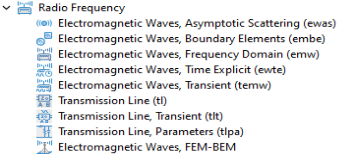
 ) solves a frequency-domain wave equation for the electric field. The sources can be in the form of point dipoles, line currents, or incident fields on boundaries or domains. It is used primarily to model electromagnetic wave propagation in different media and structures. This physics interface can also be used to solve an eigenvalue problem for the resonant frequencies and fields of a structure, or to find the propagating modes of a waveguide or transmission line. Some typical applications that are simulated with this physics interface are waveguides and transmission lines, filters and resonators, antennas, and RF connectors and couplers.
  ) solves a system of two first-order partial differential equations (Faraday’s law and Maxwell–Ampère’s law) for the electric and magnetic fields using the Time Explicit Discontinuous Galerkin method. The sources can be in the form of volumetric electric or magnetic currents or electric surface currents or fields on boundaries. It is used primarily to model electromagnetic wave propagation in linear media. Typical applications involve the transient propagation of electromagnetic pulses.
 ) solves a time-domain wave equation for the electric field. The sources can be in the form of point dipoles, line currents, or incident fields on boundaries or domains. It is used primarily to model electromagnetic wave propagation in different media and structures when a time-domain solution is required — for example, nonsinusoidal waveforms or nonlinear media. Typical applications involve the propagation of electromagnetic pulses and the generation of harmonics in nonlinear optical media.
 ) extracts transmission line parameters such as series resistance, series inductance, shunt conductance, and shunt capacitance, which are computed per unit length for each parameter. This interface also computes the characteristic impedance and propagation constant. Frequency-domain modeling is supported in 2D.
 ) solves the time-harmonic transmission line equation for the electric potential. This physics interface is used when solving for electromagnetic wave propagation along one-dimensional transmission lines and is available in 1D, 2D and 3D. Eigenfrequency and Frequency Domain study types are available. The frequency domain study is used for source-driven simulations at a single frequency or a sequence of frequencies. Typical applications involve the design of impedance matching elements and networks.
 ) is used to study propagation of waves in time domain along one-dimensional transmission lines. The physics interface solves the time-domain transmission line equation for the electric potential.
 ) is used for quick studies of the far-field response of a 3D or 2D object to a given background field. The physics interface sets up a surface electric background field for the far-field transformation, using the Stratton–Chu formula, performed in the postprocessing. Use this physics interface in 2D and 3D when approximating the scattered far-field of an object configured only by a perfect electric conductor boundary condition.
 ) solves a frequency-domain wave equation for the electric field. The formulation is based on the boundary element method (BEM) and requires the availability of a Green’s function. Thus, the physics interface solves the vector Helmholtz equation for piecewise-constant material properties.
 ) combines the features of the Electromagnetic Waves, Frequency Domain interface with those of the Heat Transfer in Solids interface. A predefined interaction automatically sets the electromagnetic losses as sources for the heat equation. This physics interface is based on the assumption that the electromagnetic cycle time is short compared to the thermal time scale (adiabatic assumption).
 ) can be connected to an RF interface. The lumped voltage and current variables from the circuits are translated into boundary conditions applied to the distributed field model. Typical applications include the modeling of transmission lines and antenna feeding.
 ) allows to build hybrid FEM-BEM models, where the boundary element method (BEM) is used to compute the electric fields outside the finite element method (FEM) domains. This multiphysics interface adds an Electromagnetic Waves, Frequency Domain interface and an Electromagnetic Waves, Boundary Elements interface. The multiphysics coupling assures continuity of the tangential electric and magnetic fields across boundaries between the two interfaces.