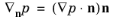
In thin structures, the tangential gradient and the normal gradient can be more appropriate to express the governing equations. The normal gradient is the projection of the gradient operator onto the normal vector,
n, of the boundary representing the thin structure. This is mathematically expressed for any scalar field
p as:
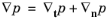
The tangential gradient removes the normal component from the gradient operation, so that only tangential components remain. This is mathematically expressed for any scalar field
p as:
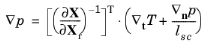
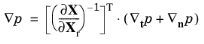
Equation 4-33 is valid for flat layered shells. However, for curved shells, the gradient expression should account for the surface area and the scaling of each layer. The gradient in the product geometry of a curved layered shell with variable thickness can be written as:
In some applications, it is required to model variable thickness layers. This is achieved by scaling the constant thickness of the layer, d, using a thickness factor,
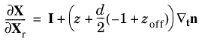
lsc, which can be a function of the surface coordinates. The deformation gradient in a scaled product geometry of a curved layered shell can be written as
where xd is the extra dimension coordinate,
n is the positive normal direction, and
 .
. .
.

 .
. .
.