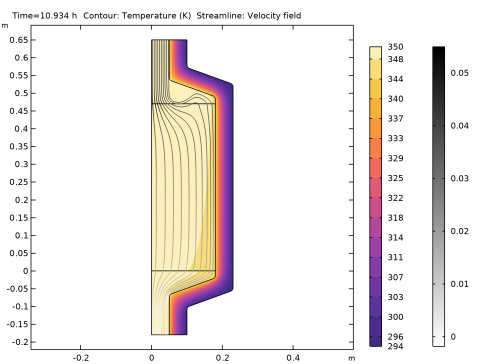
This example is inspired by the experimental investigation found in Ref. 1. It models the flow through a packed-bed storage tank, and it includes the effects of heat transfer with phase change and local thermal nonequilibrium (LTNE) while charging the LHS unit.
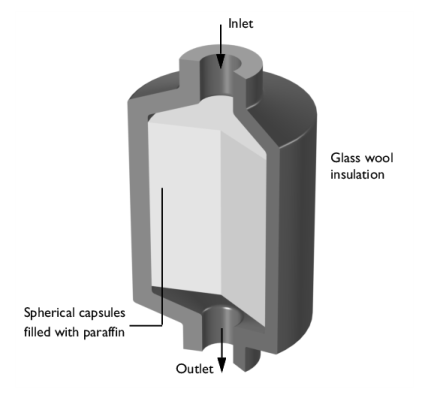
Paraffin-filled spherical capsules with a diameter of dp = 55 mm are stored in a tank of 36 cm in diameter and 47 cm in height. The porosity of this bed is
εp = 0.49. The model geometry is shown in
Figure 2.
The initial temperature in the tank is set to 32°C. Warm water flows through the tank with a flow rate of Vin = 2 l/min. During thermal charging the water is continuously heated up by a solar collector that delivers a power of
Qu = 375 W. The temperature difference at the tank’s inlet and outlet is given by the relation
Here, Tin and
Tout are the inlet and outlet temperatures, and
ρ and
Cp are the density and heat capacity of water.
here, μ (Pa·s) and
ρ (kg/m
3) are the viscosity and density of water,
dp (m) is the spheres’ diameter, and
εp the bed porosity. The permeability
κ (m
2) of the packed bed is given by
The maximum velocity in the tank, v, is about 6 mm/s, which implies a Reynolds number of about 600. For this Reynolds number the flow field is assumed to be independent of the temperature distribution, such that a stationary field can be computed before running the thermal simulation. This is a reasonable simplification that reduces the computational effort.
Here, Ts and
Tf are the paraffin and water temperatures, and
qsf (W/(m3·K)) is the interstitial convective heat transfer coefficient, which for spherical capsules reads
The interstitial heat transfer coefficient hsf follows a Nusselt number correlation (see the Local Thermal Nonequilibrium section in the documentation for more information). Convection inside the capsules is neglected, thus the paraffin wax is treated as a solid or immobile liquid.
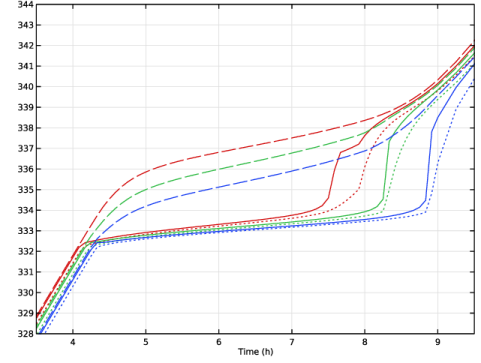
Figure 4 shows the evolution of the paraffin temperature, water temperature and the weighted average (porous medium) temperature at three different points located in the central axis of the tank. During the phase change, the encapsulated paraffin is not in thermal equilibrium with the surrounding water. Measuring the water temperature alone at the inlet or outlet does not give accurate information about neither the temperature inside the capsules nor the phase in which the paraffin wax is.
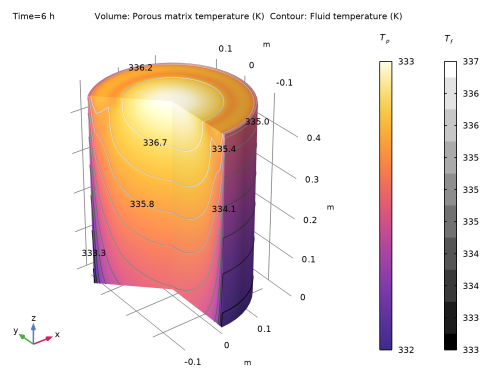
The temperature distribution after 6 hours, during the phase change, is shown in the Figure 5. The pellets remain nearly constant at 333 K, while the fluid temperature ranges between 333 K and 337 K, indicating that thermal equilibrium has not yet been reached.
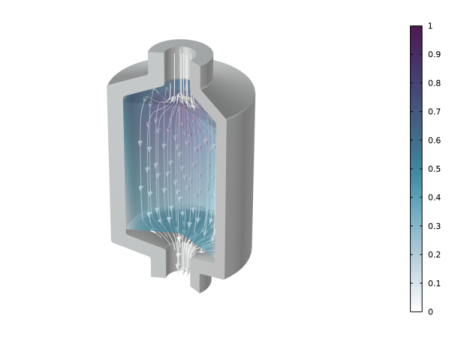
Figure 6 shows the paraffin phase distribution after 7 hours. Near the walls, where the flow velocity is negligible, the phase transition has not yet begun and the paraffin wax is still solid, while it is melted in the center of the tank.