Viscoelastic Flow (VEF)
1
In the Model Builder window, under Component 1 (comp1) click Viscoelastic Flow (vef).
2
In the Settings window for Viscoelastic Flow, click to expand the Discretization section.
3
From the Discretization of fluids list, choose P1+P1.
Note:
Several default nodes are added automatically to the model tree. The ‘D’ in the upper-left corner of the node indicates that these are default nodes.
Fluid Properties 1
1
In the Model Builder window, under Component 1 (comp1) > Viscoelastic Flow (vef), click Fluid Properties 1.
2
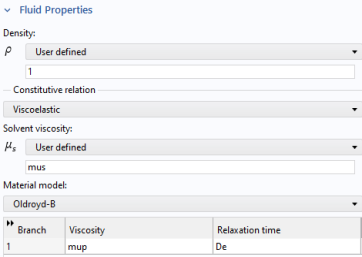
In the Settings window for Fluid Properties, locate the Fluid Properties section.
3
From the r list, choose User defined. In the associated text field, type
1
.
4
For the Viscoelastic interface, Viscoelastic, Newtonian, and Inelastic non-Newtonian constitutive relations are available. By default, the viscoelastic Oldroyd-B model is selected.
5
Choose User defined from the ms list. In the associated text field, type
mus
.
6
In the table, enter values for elastic viscosity and relaxation time:
Branch
Viscosity
Relaxation time
1
mup
De
Free Surface 1
The viscosity of the air is negligible compared to that of the viscoelastic fluid. Only the air pressure is accounted for on the exterior side of the free surface.
1
In the Physics toolbar, click
Boundaries and choose Free Surface.
2
Select Boundary 4 only.
3
In the Settings window for Free Surface, locate the Surface Tension section.
4
From the Surface tension coefficient list, choose User defined. In the s text field, type
1
.
Contact Angle 1
1
In the Model Builder window, expand the Free Surface 1 node, then click Contact Angle 1.
2
In the Settings window for Contact Angle, locate the Normal Wall Velocity section.
3
Select the Constrain wall-normal velocity checkbox.
Periodic Flow Condition 1
1
In the Physics toolbar, click
Boundaries and choose Periodic Flow Condition.
2
Select Boundaries 2 and 3 only.
Additionally, mesh boundary conditions are needed on all exterior boundaries (except for the
Free Surface
, which automatically includes the necessary mesh constraint).
 Boundaries and choose Free Surface.
 Boundaries and choose Periodic Flow Condition.