Tutorial Model: Beads-on-String Structure of Viscoelastic Filaments
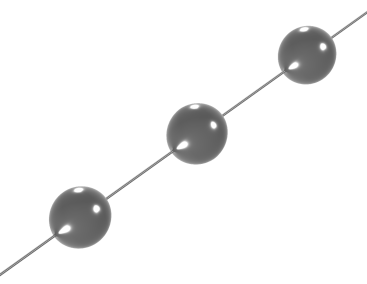
In this example, the thinning of a viscoelastic filament under the action of surface tension is studied. The evolution of the filament radius depends on the relative magnitude of capillary, viscous, and elastic stresses. The interplay of capillary and elastic stresses leads to the formation of very thin and stable filaments between drops, a so-called beads-on-a-string structure.
Model Geometry
This example studies the evolution of a long, initially unstretched axisymmetric filament of an Oldroyd-B fluid. The fluid filament is modeled as a liquid cylinder with a small perturbation of the initial radius of the cylinder, R0 (Figure 10, t = 0). The initial radius of the column is given by
where z is the z-coordinate and ε is the perturbation magnitude.
Domain Equations and Boundary Conditions
The Oldroyd-B fluid used in this example is viscoelastic and you should therefore use the Viscoelastic Flow interface. An arbitrary Lagrangian–Eulerian (ALE) method is used to handle the dynamics of the deforming geometry and moving boundaries. The Navier–Stokes equations for fluid flow and the evolution equations for the elastic stress tensor components are formulated in the coordinates of the moving frame.
A Free Surface feature is applied at the interface between the polymer fluid and the air. This feature sets up the surface-tension force and specifies the normal velocity of the free surface. The outside air pressure is assumed to be constant, and the tangential stress on the free surface is neglected. A Periodic Flow Condition feature is used at the top and bottom boundaries to mimic the effect of an infinitely long filament.
The problem is made dimensionless by the initial radius of the cylinder, R0; the surface tension coefficient, σ; the fluid density, ρ; and the total viscosity, μ0, of the polymer. The dynamics of the filament thinning is governed by two dimensionless parameters: the Deborah number (the dimensionless relaxation time of the polymer solution) and the Ohnesorge number (the ratio between the inertia-capillary and viscous-capillary time scales). The relative importance of viscous stresses from the solvent is characterized by the solvent viscosity ratio, β.
Results
Figure 10 shows the evolution of the filament at different times for the following set of the dimensionless parameters: β = 0.25, Oh = 3.16, and De = 94.9.

Figure 10: Filament profiles at 5 different dimensionless times: 0, 20, 30, 100, and 300.
The transformation of the filament shape can be divided into two regimes with distinct time scales. First, for times smaller than the polymer relaxation time, the beads-on-string structure develops. This is followed by an exponential thinning of the threads. The fluid is expelled from the threads to the connected beads leading to almost spherical drops. The numerical results show that both transient regimes compare well with the literature (Ref. 1).
Reference
1. C. Clasen, J. Eggers, M.A. Fontelos, J. Li, and G. McKinley, “The beads-on-string structure of viscoelastic threads,” J. Fluid Mech., vol. 556, pp. 283–308, 2006.
The following instructions show how to set up the model, solve it, and plot the results.