Tutorial Model: 2D Non-Newtonian Slot-Die Coating
Achieving uniform coating quality is important in several different areas, such as optical coatings, semiconductor and electronics industry, technologies utilizing thin membranes, and surface treatment of metals. Bad coating quality will compromise the performance of the products or lead to complete failure in some cases.
Several different coating processes exist. This tutorial investigates the performance of a slot-die coating process, a so-called premetered coating method. In this process, the coating fluid is suspended from a thin slot die to a moving substrate. The final coating layer thickness is evaluated from the continuity relationship for a coating liquid. Therefore, the thickness of the liquid layer is determined by the slot gap, the coating fluid inlet velocity, and the substrate speed.
The final goal of coating processes is to achieve a defect-free film of a desired thickness. However, manufacturing the uniform coating is not a trivial task, as various flow instabilities or defects such as bubbles, ribbing, and rivulets are frequently observed in the process. The die geometry, the size of the slot and height above the substrate, and the non-Newtonian fluid nature of the coating fluid are important to consider.
This tutorial demonstrates how to model the fluid flow in a polymer slot-die coating process using the Laminar Two-Phase Flow, Phase Field interface and an inelastic non-Newtonian power law model for the polymer fluid.
Model Geometry
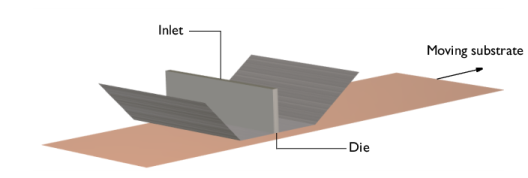
A typical setup of the slot-die coating process is shown in Figure 6.
Figure 6: Typical geometry for a slot-die coating process with the slot die positioned over a substrate.
This model uses a 2D cross section of the die shown in Figure 6, assuming out-of-plane invariance. See also Slot-Die Coating with Channel Defect in the Polymer Flow Module Application Library for a 3D model of slot-die coating. The inlet for the coating fluid is at the top of the die, as shown in Figure 7, and there are open boundaries at both ends. The bottom boundary is the coating substrate, which is moving at the coating velocity.
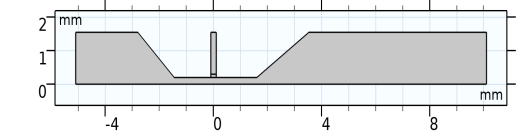
Figure 7: Model geometry. 2D cross section of a slot die.
The geometrical and material parameters in this model are taken from Ref. 1.
Domain Equations and Boundary Conditions
The flow in this model is laminar, so a Laminar Flow interface will be used together with a Phase Field in Fluids interface to track the interface between the air and the polymer fluid. The coupling of these two interfaces is handled by the Two-Phase Flow, Phase Field multiphysics interface. In this model, the air is specified as a Newtonian fluid, and the coating fluid is a non-Newtonian power law fluid.
The inlet fluid velocity is increases smoothly from 0 m/s to 0.1 m/s. Both the upstream and downstream boundaries of the model are specified as open boundaries. The corresponding inlet and outlet boundary conditions must also be set in the Phase Field in Fluids interface together with the initial values for both fluids to correctly define the position of the initial interface. For the moving substrate, a Moving Wall boundary condition with a Navier slip condition is used.
Results and Discussion
Figure 8 shows the evolution of the coating fluid interface for t = 0.03 s, t = 0.06 s, and t = 0.2 s.
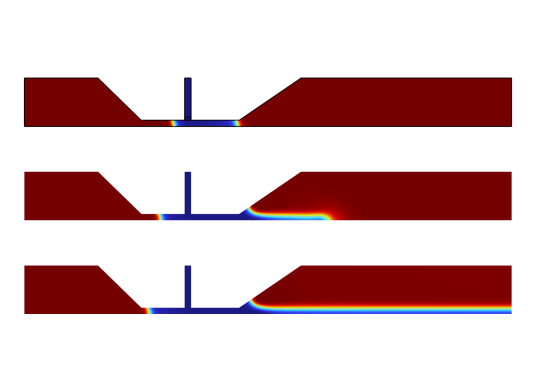
Figure 8: Coating fluid interface at t = 0.03 s, t = 0.06 s, and t = 0.2 s (top to bottom).
The coating film attains a constant thickness downstream of the die at = 0.2 s. The film forms upstream and downstream menisci with the upstream and downstream walls of the die. As the substrate speed increases or the inlet velocity decreases, the upstream meniscus is pulled closer to the slot, eventually causing defects in the coating film. The evolution of the film thickness and position of the upstream meniscus as a function of time is shown in Figure 9.
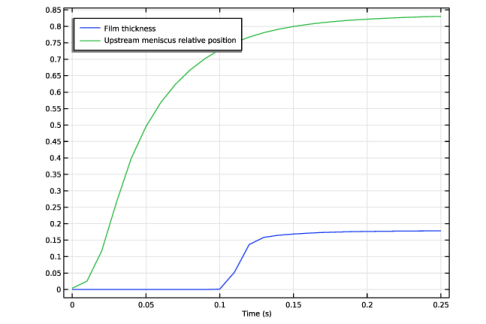
Figure 9: Film thickness and upstream meniscus position as a function of time.
By changing the geometry, the inlet velocity, and the wall velocity, it is easy to explore the sensitivity of the design parameters toward the film thickness and coating velocity for a variety of fluid properties in a fast and efficient manner.
Reference
1. K.L. Bhamidipati, Detection and elimination of defects during manufacture of high-temperature polymer electrolyte membranes, PhD Thesis, Georgia Institute of Technology, 2011.