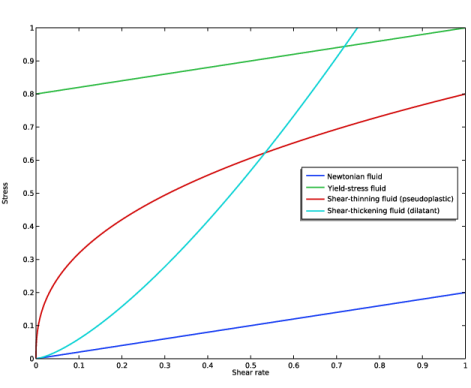
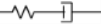
A fluid may be characterized according to its response under the action of a shear stress. A Newtonian fluid has a linear relationship between shear stress and shear rate, with the line passing through the origin. The constant of proportionality is referred to as the viscosity of the fluid and may depend on temperature, pressure, and composition. For a non-Newtonian fluid, the curve for shear stress versus shear rate is nonlinear or does not pass through the origin. If the curve is shifted away from the origin, the fluid has a yield stress. If the curve bends toward the shear-rate axis, the fluid is said to be shear thinning (pseudoplastic), but if it instead bends toward the shear-stress axis, it is said to be shear thickening (dilatant). The relationship may also contain time derivatives of the shear rate to model memory effects (thixotropy), and even parallel viscous and elastic responses. We refer to the latter as viscoelastic non-Newtonian fluids and all others as
inelastic non-Newtonian fluids. For the inelastic non-Newtonian models, it is possible to define an apparent viscosity from a generalized Newtonian relationship between the deviatoric stress tensor and the strain-rate tensor.