The Number of elements in the
Extra Dimension Settings must be enough to resolve the period evolution of the electric excitation. A minimum of 30 mesh elements per period in the extra dimension is recommended. In some discharges the current and the voltage at the electrodes departs from being a sinusoidal and fine structure might appear. An example of this is a discharge where the electron current contributes significantly to the total current when the sheath collapses. This leads to a burst of electron current that needs to be resolved and consequently more mesh elements in the extra dimension are needed.
with a low frequency fl of 2 MHz and a higher frequency
fh of 60 MHz one needs 900 mesh elements in the extra dimension in order to have 30 mesh elements per period of the high frequency.
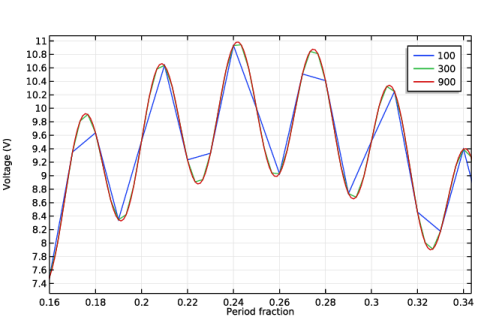
Figure 6-4 and
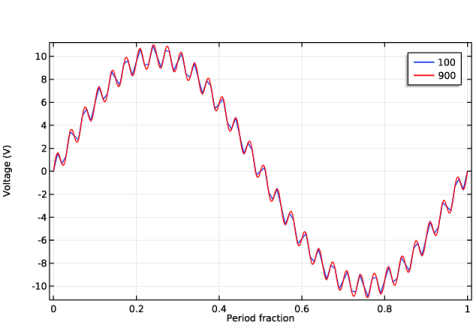
Figure 6-5 show the signal of
Equation 6-21 with different resolutions. When using 100 and 300 elements in the extra dimension the high frequency signal only has 3 and 10 elements per period, respectively, leading to poorly resolved signals.