For each electron impact reaction, the reaction formula is the first piece of information that is required. Most published papers involving the numerical modeling of plasmas include a table of the reactions which make up the plasma chemistry.
Once the formula is entered the dependency of the reaction rate on the electron energy needs to be supplied. The most common way of accomplishing this is to specify cross-section data for each of the electron impact reactions. The cross-section data can be hard to find or not even exist. Cross-section data is available for most of the common gases. The LXCat Plasma Data Exchange Project (
www.lxcat.net) is an excellent source to obtain electron impact cross-sections. When using data from the LXCat database it is encouraged to refer to the data as suggested in the LXCat website. Many models in COMSOL use data from LXCat. Any reutilization of these data should also be reference following LXCat norms. It is also encouraged to download the data directly from the LXCat database.
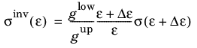
where σ is the cross section for the direct reaction,
ε is electron energy,
Δε is the excitation energy, and
glow and
gup are the statistical weights of the lower and upper levels of the heavy species.
where J is the total electronic angular momentum. The values for
J can be obtained from
Ref. 2. As an example, if the first four 4s levels of argon are to be used in a plasma model as a lumped level, the statistical weight of the excited lumped state is 12, which results from the sum of the statistical weights of the individual levels
Table 2-1.