Introduction
The Plasma Module is specifically designed for the modeling and simulation of both low-temperature and equilibrium plasma systems. It empowers engineers and scientists to investigate discharge physics and assess the performance of both existing and conceptual plasma designs.
Supporting simulations in 0D, 1D, 2D, and 3D, the Plasma Module addresses the complex and highly nonlinear nature of plasma behavior, where even small changes in parameters like electrical input, pressure, or plasma chemistry can lead to significant variations in discharge characteristics.
Plasma systems involve a wide range of interconnected physical phenomena, including fluid dynamics, reaction kinetics, heat and mass transfer, and electromagnetism. The Plasma Module offers specialized tools for accurately simulating both non-equilibrium and equilibrium discharges across a broad spectrum of engineering applications. It includes:
•
A comprehensive suite of physics interfaces for building custom models
•
A library of fully documented example models
•
A detailed user manual to support both new and advanced users
The Use of the Plasma Module
The Plasma Module provides advanced capabilities for simulating a wide range of plasmas, plasma reactors, and plasma-related surface processes relevant to both scientific research and engineering applications. The following sections highlight several representative use cases. The module supports simulations of plasmas sustained by various types of electromagnetic excitation sources. In the low-temperature (cold plasma) regime, typical applications include:
•
Direct Current Discharges
•
Inductively coupled plasmas
•
Capacitively Coupled Plasmas
•
Microwave Plasmas
•
Dielectric Barrier Discharges
The Plasma Module also enables the simulation of plasma-enhanced surface processes, such as:
•
Plasma Enhanced Chemical Vapor Deposition
•
Plasma Enhanced Etching
In addition, the Plasma Module supports the modeling of
Equilibrium Discharges
, where all species share a common temperature and the plasma is assumed to be fully ionized.
Direct Current Discharges
Direct current (DC) discharges are typically sustained through secondary electron emission from the cathode, triggered by ion bombardment. Electrons emitted from the cathode are accelerated through the cathode fall region, gaining energy as they enter the bulk plasma. If they acquire sufficient energy, these electrons can ionize the background gas, producing new electron-ion pairs. The resulting electrons travel toward the anode, while the ions migrate back to the cathode, where they may generate additional secondary electrons.
The discharge dynamics are such that most of the applied electric potential drops across the cathode fall region, a narrow zone near the cathode. Within this region, electron density and flux increase exponentially. Under certain conditions, the cathode fall is followed by a region of weak electric field, known as the positive column. In the positive column, the discharge becomes more uniform, and the electron-ion pairs produced are primarily lost to the surrounding walls in the radial direction.
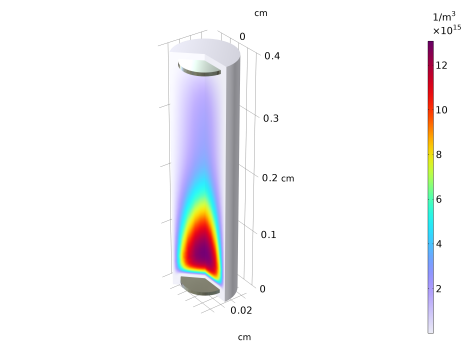
Electron density distribution in a DC argon discharge at 0.5 Torr and an applied voltage of 125 V.
Inductively coupled plasmas
Inductively Coupled Plasmas (ICPs) were initially developed in the 1960s as high-temperature thermal plasmas for coating applications. These early systems operated near atmospheric pressure, producing gas temperatures on the order of 10,000 K. By the 1990s, ICP technology transitioned into the semiconductor industry, where it became widely adopted for film processing and large-area wafer fabrication. Modern ICP reactors operate in a low-pressure range (typically between 0.002 and 1 Torr) maintaining gas temperatures close to ambient conditions. Low-pressure ICPs are favored for their ability to generate highly uniform plasma densities over large volumes and sustain high plasma densities, resulting in strong ion fluxes to wafer surfaces, which are critical for precise etching and deposition.
From an electrical standpoint, ICPs function similarly to transformers, with the driving coil acting as the primary winding and the plasma serving as the secondary. An alternating current in the coil induces a time-varying magnetic field, which generates currents within the plasma. The electron current in the plasma flows opposite to the coil current, inducing a reactive current back into the coil. Electron heating primarily occurs within the plasma’s skin depth, which decreases as plasma density or driving frequency increases, thereby limiting the volume where power is deposited into the electrons.
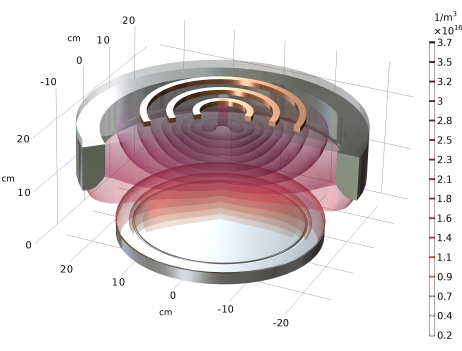
Silyl radical number density in an ICP reactor operating in a silane-argon mixture at 13.56 MHz and 50 W.
Capacitively Coupled Plasmas
Capacitively coupled plasmas (CCPs) are widely used in the semiconductor industry for thin film deposition and etching applications. In typical industrial setups, the plasma is generated between parallel plate electrodes spaced about 3 cm apart, with electrode diameters often reaching 30 cm. These systems usually operate at frequencies ranging from 100 kHz to 100 MHz and at pressures between 2 and 200 Pa. Although CCP sources can also operate at atmospheric pressure, doing so requires a much smaller discharge gap, typically on the order of a millimeter, to maintain a manageable pressure–distance (pd) product and ensure stable discharge conditions.
In CCP discharges, the charged species dynamics can create regions of intense charge separation at the electrodes that are strongly time modulated, the so-called plasma sheaths. Within the sheaths, intense electric fields accelerate electrons to energies sufficient for ionization, thus sustaining the discharge. In contrast, the plasma bulk (the region between the sheath) features much weaker electric fields and tends to remain quasi-neutral, with minimal net charge.
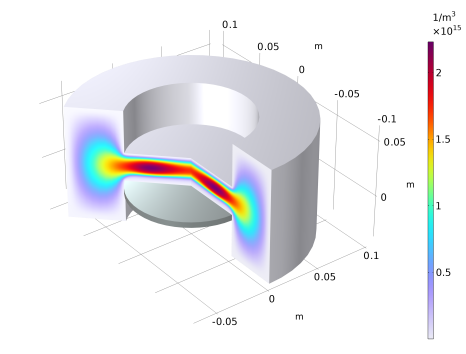
Period-averaged electron density in a GEC CCP reactor operating at 13.56 MHz with 1 W of power absorbed by the plasma.
Microwave Plasmas
Microwave plasmas, also known as wave-heated discharges, are sustained when electrons gain energy directly from an electromagnetic wave as it penetrates into the plasma. The behavior of a microwave plasma depends significantly on the mode of the electromagnetic wave, either TE (transverse electric) or TM (transverse magnetic). In 2D axisymmetric models, the TE mode involves computing only the azimuthal component of the electric field (out-of-plane), while the TM mode involves computing the radial and axial components (in-plane) of the electric field. These differences lead to distinct electromagnetic field distributions and energy deposition profiles. Regardless of the mode, electromagnetic waves cannot propagate into regions where the electron density exceeds the critical value. At this critical electron density contour, the wave transitions from propagating to evanescent, meaning that it decays exponentially instead of transmitting energy further into the plasma. As a result, all the wave power is absorbed within a very thin layer, which can lead to strong localization of heating. The operating pressure for microwave plasmas spans a wide range. For electron cyclotron resonance (ECR) plasmas, pressures are typically 1 Pa or lower. For non-ECR microwave plasmas, pressures usually range from 100 Pa to atmospheric pressure. Power levels can also vary greatly, from just a few watts to several kilowatts, depending on the application and plasma configuration.
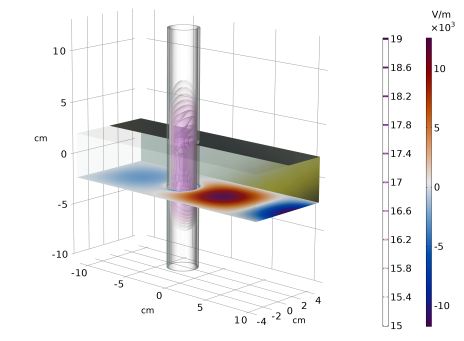
Electron number density isosurfaces (in logarithmic scale, m
-3
) and electric field norm in a microwave plasma torch operating at 2.45 GHz with an input power of 50 W.
Dielectric Barrier Discharges
Dielectric barrier discharges (DBDs) are used in a variety of applications, including ultraviolet (UV) and extreme ultraviolet (EUV) light sources, ozone generation, and surface modification. The fundamental operating principle of a DBD involves a gas-filled gap between typically two dielectric-covered electrodes. A time-varying voltage is applied to one electrode. As the applied voltage increases, the electric field within the gap strengthens. Free electrons present in the gas are accelerated by the field, and if the field is sufficiently strong, they can gain enough energy to ionize neutral gas molecules. This initiates an avalanche effect, rapidly increasing the electron population on a nanosecond timescale. During each voltage cycle, free charges accumulate on the surfaces of the dielectric barriers, effectively shielding the gap from the applied electric field. This accumulation suppresses further ionization and can lead to temporary plasma extinction, until the applied voltage reverses polarity, and the process begins again. Dielectric barrier discharges typically operate in the pressure range of 0.1–3 atm with an applied voltage of 1–100 kV and a frequency of kHz up to MHz.
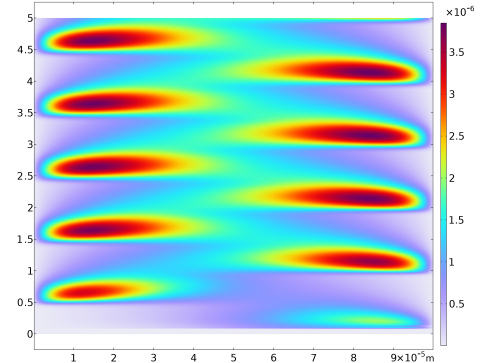
Space distribution and temporal evolution of the mass fraction of electronically excited argon atoms in a dielectric barrier discharge driven at 50 kHz with a sinusoidal voltage amplitude of 750 V at 1 atm. The x-axis represents space and the y-axis period fraction.
Plasma Enhanced Chemical Vapor Deposition
Plasma enhanced chemical vapor deposition (PECVD) is a widely used plasma-assisted thin-film deposition technique that enables the formation of high-quality coatings at relatively low substrate temperatures. By utilizing reactive plasma species generated from precursor gases, PECVD facilitates enhanced chemical reactions on the substrate surface, resulting in improved film properties. Modeling PECVD processes requires capturing the complex interplay between plasma dynamics, gas-phase chemistry, surface reactions, and transport phenomena. The Plasma Module provides comprehensive tools to simulate these coupled physical and chemical processes, enabling detailed analysis and optimization of PECVD reactor performance.
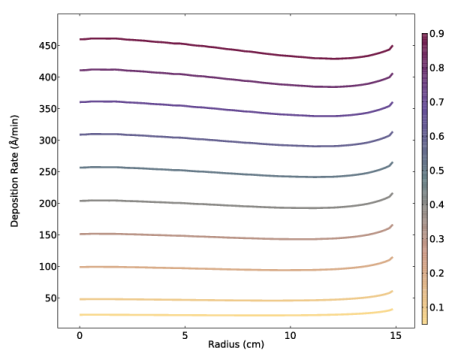
Variation of silicon deposition rate along the wafer with silane mole fraction in an inductively coupled plasma reactor using a silane-argon mixture at 13.56 MHz and 50 W.
Plasma Enhanced Etching
Plasma enhanced etching is a critical plasma-assisted process widely used in microfabrication to selectively remove material from a substrate with high precision and anisotropy. This technique leverages reactive plasma species, such as ions, radicals, and neutral particles, to chemically and physically etch target surfaces, enabling the fabrication of intricate micro- and nanoscale features. Accurate modeling of plasma enhanced etching involves capturing the complex interactions between plasma chemistry, surface reactions, ion bombardment, and transport phenomena within the reactor. The Plasma Module offers advanced simulation capabilities to analyze and optimize these processes, providing valuable insights into etch rates, and uniformity.
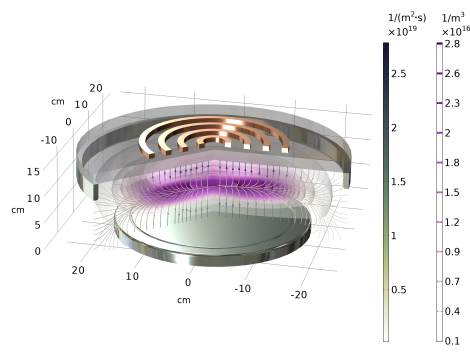
Number density and flux streamlines of CF
3
+
ions in an ICP reactor with an RF bias of 100 V amplitude. The color scale on the streamlines represents the magnitude of the CF
3
+
flux.
Equilibrium Discharges
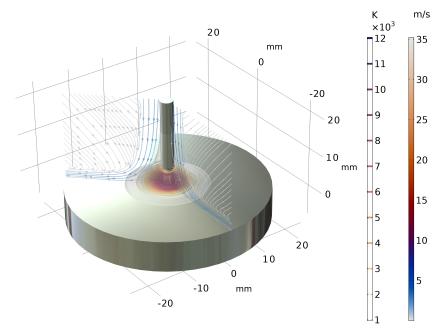
Equilibrium discharges, also known as thermal plasmas, have a wide range of industrial applications, including cutting, welding, thermal spraying, waste destruction, and surface treatment. These plasmas are typically assumed to operate under partial to full local thermodynamic equilibrium (LTE) conditions. Under LTE, the electron temperature is equal to the temperature of the background gas, and the plasma behaves like a conductive fluid mixture. As a result, thermal plasmas are modeled using the magnetohydrodynamics (MHD) equations, which treat the plasma as a continuum governed by fluid dynamics and electromagnetic interactions. Unlike non-equilibrium plasmas, equilibrium discharges do not require computation of the detailed chemical composition. Instead, the focus is on solving for gas temperature and electric fields. This modeling approach enables more efficient and numerically stable simulations, particularly when estimating thermal loads on surfaces, a critical factor in many industrial processes.
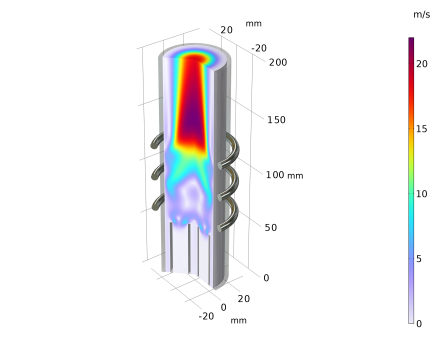
Fluid velocity in an atmospheric-pressure thermal plasma torch operating in air at 11 kW.
Temperature isosurfaces and fluid velocity magnitude streamlines in an atmospheric-pressure DC arc operating in air at 80 A.