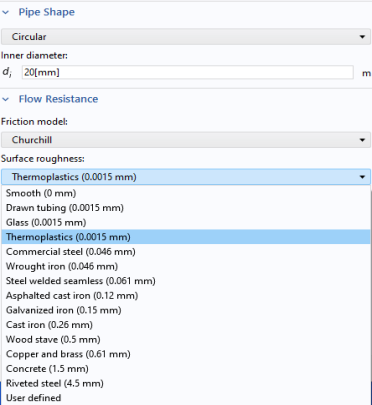
Above, A (SI unit: m
2) is the cross section area of the pipe,
ρ (SI unit: kg/m
3) is the density,
u (SI unit: m/s) is the fluid velocity in the tangential direction of the pipe curve segment, and
p (SI unit: N/m
2) is the pressure.
F (SI unit: N/m
3) is a volume force, like gravity.
The last two terms of Equation 1 describes the pressure drop due to internal viscous shear and gravity. One of the terms contain the Darcy friction factor,
fD, which is a function of the Reynolds number and the surface roughness divided by the hydraulic pipe diameter, e/
dh. The Nonisothermal Pipe Flow interface provides a library of built-in expressions for the Darcy friction factor,
fD.
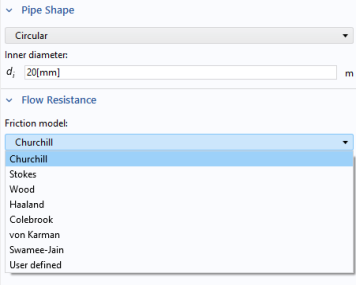
This example uses the Churchill relation (Ref. 1) that is valid for laminar flow, turbulent flow, and the transitional region in between. The Churchill relation is:
The physical properties of water as a function of temperature are directly available from the software’s built-in material library. Inspection of Equation 3 reveals that for low Reynolds numbers (at laminar flow), the friction factor is
64/
Re, and for very high Reynolds numbers, the friction factor is independent of
Re.
where Cp (SI unit: J/(kg·K)) is the heat capacity at constant pressure,
T is the temperature (SI unit: K), and
k (SI unit: W/(m·K)) is the thermal conductivity. The second term on the right-hand side of
Equation 7 corresponds to friction heat dissipated due to viscous shear.
Qwall (SI unit: W/m) is a source/sink term due to heat exchange with the surroundings through the pipe wall:
where Z (m) is the wetted perimeter of the pipe,
h (W/(m
2·K)) is an overall heat transfer coefficient and
Text (K) is the external temperature outside of the pipe.
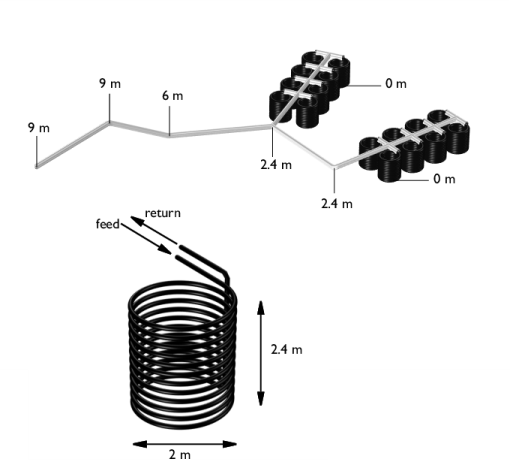


 , where z0 is the datum level of the free liquid surface. This reduces the model complexity and yields the same results. For models where you want to include gravity effects you can add a Volume Force node.