Particle Release Mechanisms
There are several ways to release particles: either from a grid, by importing a data file, or by selecting geometric entities that mark the initial particle positions. In each case the number of particles and the release times can be specified. There are also specific options available for each release feature as described below.
Release From a grid
Particles can be released from a grid that can either be regular or graded. In addition to the initial coordinates of the particles, the initial velocity and times to release the particles can be specified. There are also predefined initial velocity distributions available to release particles with a Maxwellian, Isotropic spherical, hemispherical, conical, or Lambertian distribution. Particles can either be placed at all combinations of the initial coordinates or only at specified combinations of them.
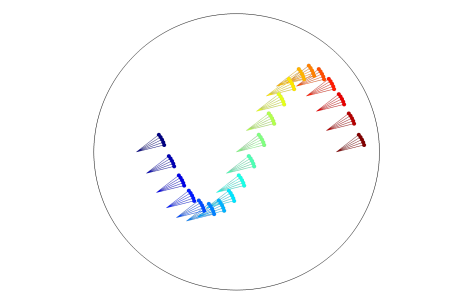
The initial particle coordinates can be a list of values. At each release point, a single particle can be released or particle velocities can be sampled from a distribution. Here a cone of particles is released at each point.
Release From a Domain
There are several different mechanisms for choosing the release points from within a selected domain.
•
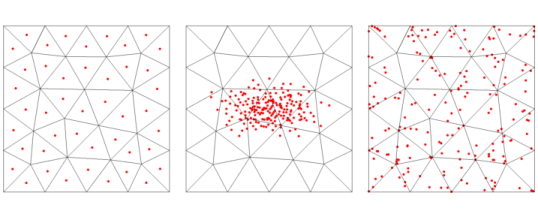
When the particle release is Mesh based, there is an option to specify the Refinement factor. The higher this factor, the more particles are released from within each mesh element.
•
When the particle release is Density based, the release of particles is weighted according to a user-defined expression. This expression for number density can be an analytic expression, a random function, or even a field variable computed by a previous study.
•
The Random option allows the initial position of the particles to be chosen at random. New random positions are chosen for each release time.
Comparison of the mesh-based release (left), density-based release using a bi-Gaussian distribution (center), and random release in the selected domain (right).
Release From a Boundary (Inlet)
The Inlet feature releases particles from a set of boundaries. The options for the domain-based Release are also available here, as well as an additional option to release particles uniformly from a selected boundary in 2D or from a projected plane grid in 3D.
Release From Edges and Points
The Release from Edge feature can be used to release particles along edges in a 3D geometry. Similarly, the Release from Point feature can be used to release particles from selected points in the geometry.
When releasing particles along edges, particle positions can be mesh-based, weighted by a user-defined density, or uniformly distributed along the edges.
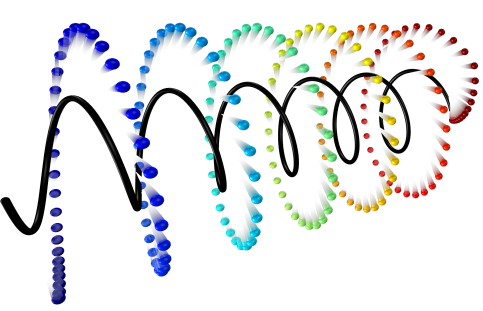
Using the Release from Edge feature, particles can be released from positions along arbitrary curves, such as the helix shown above.
Release from Data File
The Release from Data File feature allows the initial positions of particles to be specified by selecting columns from an imported text file. The initial velocity can also be read from the text file. If any Auxiliary Dependent Variable nodes are present, the initial values of auxiliary dependent variables can also be imported from the file.
When loading the initial particle positions from a file, you can also prescribe combinations of translation, rotation, and dilation. If a rotation is applied to the positions, and the particle velocity is also loaded from the same file, then optionally you can apply the same rotation to the loaded velocity vectors.