|
•
|
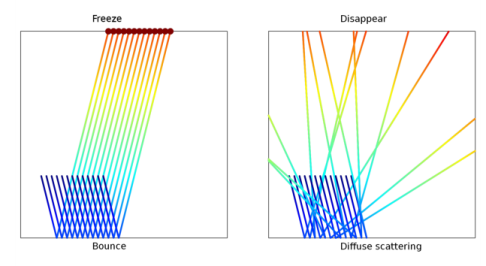
The Diffuse scattering option bounces particles off a wall according to the cosine law, sometimes called Knudsen’s cosine law or Lambertian reflection depending on the application area. The probability of a particle bouncing off the surface in a given direction within a differential solid angle dω is given by cos(θ)dω, where θ is the angle between the direction of the reflected particle and the wall normal. The kinetic energy of the particle is conserved.
|
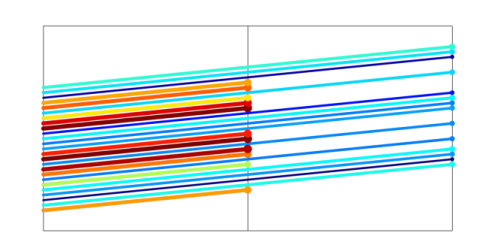
 ). The Freeze option freezes the particle in place when it interacts with a boundary, even if the boundary moves. The Disappear option completely removes particles from the simulation when they hit a surface.