 ) gives access to the underlying mathematical formalism on which the Charged Particle Tracing (
 ) and Particle Tracing for Fluid Flow (
 ) interfaces are built. The Mathematical Particle Tracing interface also allows for specification of particle motion in terms of either a Lagrangian or Hamiltonian. Often it is easier to write down an expression for the Lagrangian or Hamiltonian for particles rather than deriving the equations of motion.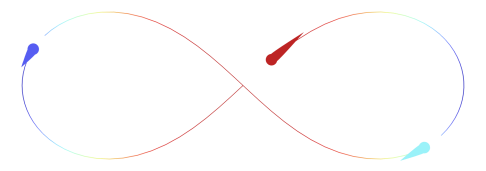
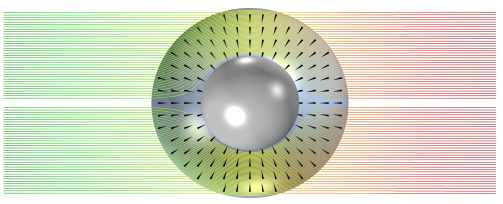
 ). This solves for the particle motion in the laboratory (inertial) reference frame. Alternatively, the particle motion in moving domains can sometimes be solved in the non-inertial reference frame, for example in purely rotating and axially symmetric domains. In such situations, the effect of the rotation of the domain on the particle dynamics can be included through the introduction of fictitious (virtual) forces such as the Centrifugal, Coriolis and the Euler force. When applicable, the latter approach can yield significant speed up in the computations as this avoids the need to compute the mesh displacements.