|
1
|
|
-
|
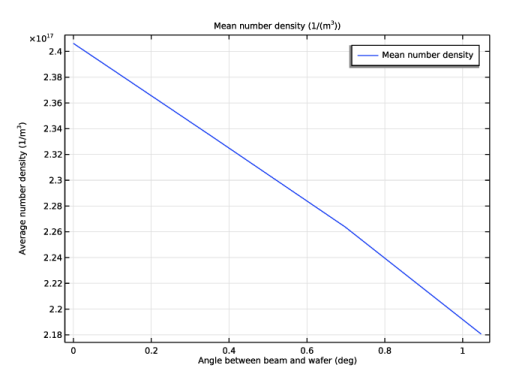
Select the x-axis label checkbox. In the associated text field, type Angle between beam and wafer (deg).
|
|
-
|
Select the y-axis label checkbox. In the associated text field, type Average number density (1/m<sup>3</sup>).
|
|
-
|
 node.
node. and choose Duplicate
  .
. and choose Selection
  .
. .
. .
. .
. .
. button.
 and choose 1D Plot Group
  .
. .
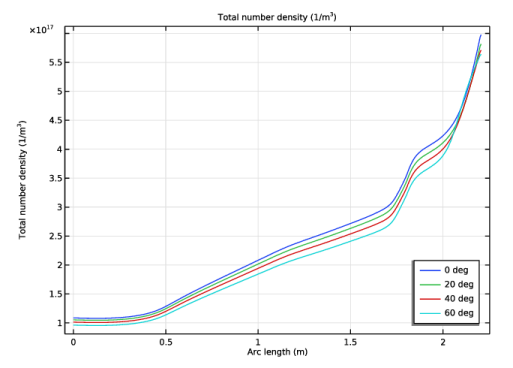
. in the upper-right corner of the y-Axis Data section. From the menu, choose Model > Component 1 > Free Molecular Flow > Number density > fmf.ntot—Total number density.
 .
. and choose 1D Plot Group
  .
. .
. .
.