

PDF

MEMS Pressure Sensor Drift Due to Hygroscopic Swelling
Introduction
For their integration in microelectronic circuits, MEMS and other devices are often overmolded with an epoxy mold compound (EMC) to protect the devices and their interconnects with the board. The epoxy polymers used for such applications are subject to moisture absorption and hygroscopic swelling, which can lead to delamination between the EMC and the board or to incorrect behavior of MEMS components. This example studies how the moisture absorption of an EMC affects the response of a MEMS pressure sensor over a one-year time period.
Model Definition
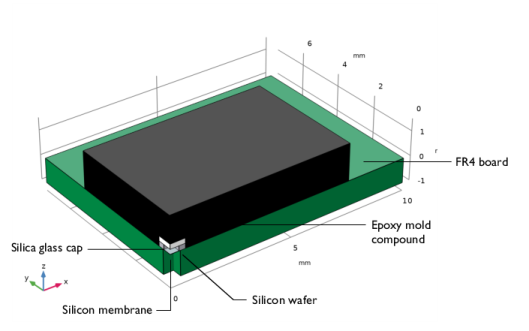
Figure 1: Component geometry.
It is sufficient to model a quarter of the whole structure due to the symmetry (Figure 1). The geometry is composed of:
-
-
When external pressure is applied on the bottom face of the membrane, the membrane deforms, and the strain is measured by means of a Wheatstone bridge made of piezoresistors. The measure of strain on the X- and Y-axes makes it possible to calculate the pressure. The membrane is modeled with a shell interface that is connected to the silicon domains via a shell-solid connection.
The moisture transport in the EMC is governed by the diffusion equation:
The moisture diffusion coefficient is temperature dependent:
Here U is the activation energy and k is the Boltzmann’s constant. For a typical EMC, D0 = 7.35·10-6 m2/s, U = 0.43 eV, and the diffusion coefficient at 25°C is approximately 4·1013 m2/s.
The boundary conditions on the exterior faces of the EMC should be a flux of moisture concentration. However, given the long simulation time (one year) a concentration constraint can be assumed. The concentration applied on the boundaries is the saturation concentration of the material at a given temperature and humidity conditions:
where S is the solubility on the water in the material a given condition, Psat is the vapor saturation pressure of water, and is the relative humidity. The product of solubility and saturation pressure is supposed to be temperature-independent, thus the saturation concentration in the material depends only on the relative humidity. At 60% humidity, the saturation concentration is 140 mol/m3.
The initial moisture concentration after molding is set to 40 mol/m3. This value can be also taken as reference for hygroscopic swelling because all the stresses are assumed relaxed just after molding.
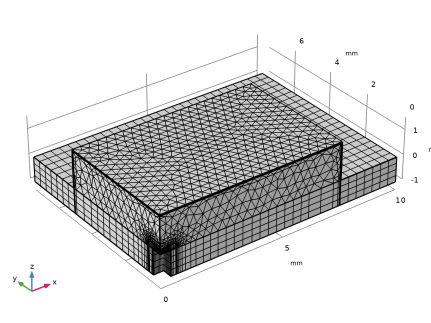
In order to avoid problems that can be caused by the discontinuity of concentration at initial state, the concentration boundary condition is applied smoothly, and a boundary layer type mesh is used near those boundaries (Figure 2).
Figure 2: Mesh of the device.
The hygroscopic swelling induces mainly an unidirectional dependence between concentration and mechanics, so in this example the enhance diffusion due to the deformation is neglected. For this reason, the concentration is calculated in a first time-dependent study step, and then the structural domains are computed in a stationary study step. This sequential approach reduces the computation time compared to a single solution including all physical interfaces.
Results and Discussion
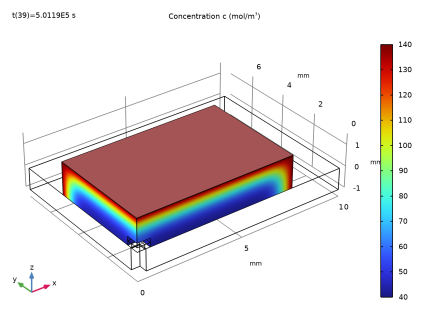
The moisture diffuses progressively in the EMC. After 6 days, the moisture has already partially reached the top face of the die (Figure 3).
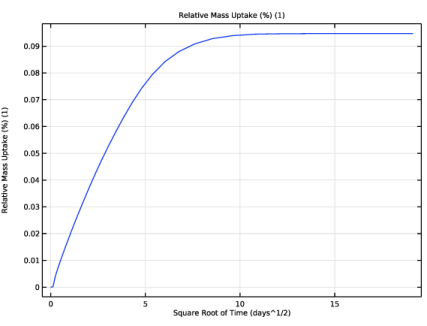
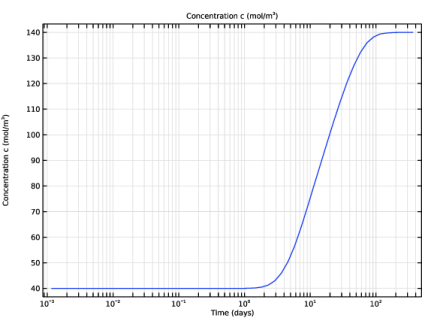
Figure 4 shows that the concentration at the die location starts to increase after 2 days until approximately 100 days. This is confirmed by the mass uptake shown in Figure 5, where the maximum value is reached after the same period of time.
Figure 3: Moisture concentration in the EMC after 6 days.
Figure 4: Moisture concentration at die location over time.
Figure 5: Total mass uptake in the EMC.
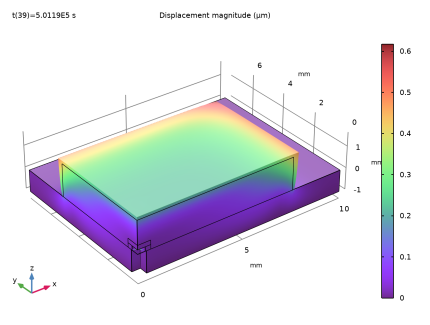
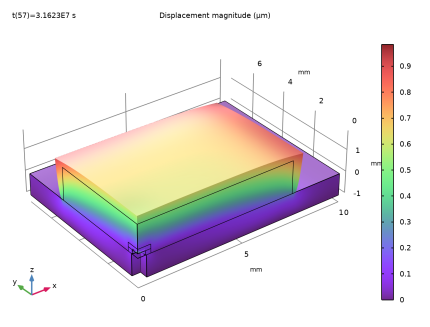
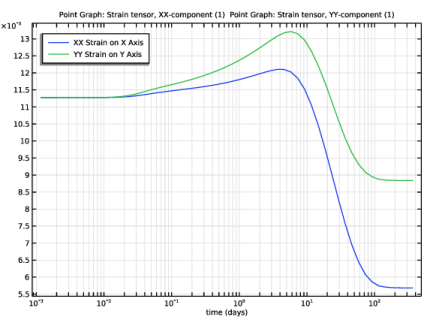
The progressive moisture diffusion is also noticeable on the displacement plots after hygroscopic swelling calculation: EMC swells only on its boundaries during the first days (Figure 6), and swells everywhere after one year (Figure 7). During the first period, the expansion on the exterior boundaries implies a stretching of the membrane and thus an increase in the measured strain. Then, the expansion at the center implies a compression on the die and a decrease in the strain along the axes; see Figure 8.
The moisture absorption and hygroscopic swelling have significant effect on the sensor sensibility, which have to be taken in account during the measurements, or when designing the sensor.
Figure 6: Displacement after 6 days.
Figure 7: Displacement after 1 year.
Figure 8: Evolution of measured strain on membrane axes.
Application Library path: Structural_Mechanics_Module/Hygroscopic_Swelling/pressure_sensor_hygroscopic_swelling
Modeling Instructions
From the File menu, choose New.
New
In the New window, click  Model Wizard.
Model Wizard
1
In the Model Wizard window, click  3D.
2
In the Select Physics tree, select Structural Mechanics > Solid Mechanics (solid).
3
Click Add.
4
In the Select Physics tree, select Structural Mechanics > Shell (shell).
5
Click Add.
6
In the Select Physics tree, select Chemical Species Transport > Transport in Solids (ts).
7
Click Add.
8
Click  Study.
9
In the Select Study tree, select General Studies > Time Dependent.
10
Global Definitions
Model Parameters
1
In the Model Builder window, under Global Definitions click Parameters 1.
2
In the Settings window for Parameters, locate the Parameters section.
3
Click  Load from File.
4
5
In the Label text field, type Model Parameters.
Geometry 1
The geometry sequence for the model is available in a file.
1
In the Geometry toolbar, click Insert Sequence and choose Insert Sequence.
2
Browse to the model’s Application Libraries folder and double-click the file pressure_sensor_hygroscopic_swelling_geom_sequence.mph.
3
In the Geometry toolbar, click  Build All.
4
Click the  Go to Default View button in the Graphics toolbar.
Definitions
Create selections to select domains easily in the following steps.
FR4
1
In the Definitions toolbar, click  Explicit.
2
In the Settings window for Explicit, type FR4 in the Label text field.
3
Silicon
1
In the Definitions toolbar, click  Explicit.
2
In the Settings window for Explicit, type Silicon in the Label text field.
3
Glass
1
In the Definitions toolbar, click  Explicit.
2
In the Settings window for Explicit, type Glass in the Label text field.
3
Mold Compound
1
In the Definitions toolbar, click  Explicit.
2
In the Settings window for Explicit, type Mold Compound in the Label text field.
3
Membrane
1
In the Definitions toolbar, click  Explicit.
2
In the Settings window for Explicit, type Membrane in the Label text field.
3
Locate the Input Entities section. From the Geometric entity level list, choose Boundary.
4
Shell (shell)
1
In the Model Builder window, under Component 1 (comp1) click Shell (shell).
2
In the Settings window for Shell, locate the Boundary Selection section.
3
From the Selection list, choose Membrane.
4
Click to expand the Default Through-Thickness Result Location section. In the z text field, type -1.
Thickness and Offset 1
Specify the shell thickness and the offset. The meshed boundary represents the shell bottom surface.
1
In the Model Builder window, under Component 1 (comp1) > Shell (shell) click Thickness and Offset 1.
2
In the Settings window for Thickness and Offset, locate the Thickness and Offset section.
3
In the d0 text field, type t_memb.
4
From the Position list, choose Bottom surface on boundary.
Use symmetry on the shell edges. The normal of the symmetry plane is the second axis of the local edge system, which is orthogonal to the edge and to the shell normal.
Symmetry 1
1
In the Physics toolbar, click  Edges and choose Symmetry.
2
Face Load 1
1
In the Physics toolbar, click  Boundaries and choose Face Load.
2
In the Settings window for Face Load, locate the Boundary Selection section.
3
From the Selection list, choose Membrane.
4
Locate the Force section. From the Load type list, choose Pressure.
5
In the p text field, type -pext.
Solid Mechanics (solid)
First, set the discretization to Quadratic in Solid Mechanics in order to fit the discretization of Shell.
1
In the Model Builder window, under Component 1 (comp1) click Solid Mechanics (solid).
2
In the Settings window for Solid Mechanics, click to expand the Discretization section.
3
From the Displacement field list, choose Quadratic Lagrange.
Fixed Constraint 1
1
In the Physics toolbar, click  Boundaries and choose Fixed Constraint.
2
Symmetry 1
1
In the Physics toolbar, click  Boundaries and choose Symmetry.
2
Definitions
Create a step function in order to apply the concentration boundary condition progressively.
Step 1 (step1)
1
In the Definitions toolbar, click  More Functions and choose Step.
2
In the Settings window for Step, locate the Parameters section.
3
In the Location text field, type 0.5[h].
4
Click to expand the Smoothing section. In the Size of transition zone text field, type 1[h].
5
Transport in Solids (ts)
1
In the Model Builder window, under Component 1 (comp1) click Transport in Solids (ts).
2
In the Settings window for Transport in Solids, locate the Domain Selection section.
3
From the Selection list, choose Mold Compound.
Solid 1
1
In the Model Builder window, under Component 1 (comp1) > Transport in Solids (ts) click Solid 1.
2
In the Settings window for Solid, locate the Diffusion section.
3
In the Dc text field, type Dc.
Initial Values 1
1
In the Model Builder window, click Initial Values 1.
2
In the Settings window for Initial Values, locate the Initial Values section.
3
In the c text field, type cini.
Symmetry 1
1
In the Physics toolbar, click  Boundaries and choose Symmetry.
2
Prescribed Transported Quantity 1
1
In the Physics toolbar, click  Boundaries and choose Prescribed Transported Quantity.
2
3
In the Settings window for Prescribed Transported Quantity, locate the Transported Quantity section.
4
Select the Species c checkbox.
5
In the c0,c text field, type cini+(cmax-cini)*step1(t).
Multiphysics
Add a multiphysics node to model hygroscopic swelling.
Shrinkage and Swelling 1 (sas1)
1
In the Physics toolbar, click  Multiphysics Couplings and choose Domain > Shrinkage and Swelling.
2
In the Settings window for Shrinkage and Swelling, locate the Domain Selection section.
3
From the Selection list, choose Mold Compound.
4
Locate the Shrinkage and Swelling Properties section. Find the Species c subsection. In the cref text field, type cini.
5
In the ΩVc text field, type 3.3e-4[m^3/kg]*(0.018[kg/mol]).
6
In the Mc text field, type 0.018[kg/mol].
7
Select the Include mass added by transported quantities checkbox.
Connect the shells and solids.
Solid–Thin Structure Connection 1 (sshc1)
1
In the Physics toolbar, click  Multiphysics Couplings and choose Global > Solid–Thin Structure Connection.
2
In the Settings window for Solid–Thin Structure Connection, locate the Connection Settings section.
3
Select the Manual control of selections checkbox.
4
Locate the Boundary Selection, Solid section. In the list box, select 11.
5
Click  Remove from Selection.
6
Definitions
Mass Properties 1 (mass1)
1
In the Model Builder window, under Component 1 (comp1) right-click Definitions and choose Physics Utilities > Mass Properties.
2
In the Settings window for Mass Properties, locate the Source Selection section.
3
From the Selection list, choose Mold Compound.
4
Locate the Density section. From the Density source list, choose From physics interface.
Materials
Add a material for each domain and for the membrane.
Add Material
1
In the Materials toolbar, click  Add Material to open the Add Material window.
2
Go to the Add Material window.
3
In the tree, select Built-in > FR4 (Circuit Board).
4
Click the Add to Component button in the window toolbar.
5
In the tree, select Built-in > Silicon.
6
Click the Add to Component button in the window toolbar.
7
Click the Add to Component button in the window toolbar.
8
In the tree, select Built-in > Silica glass.
9
Click the Add to Component button in the window toolbar.
10
In the Materials toolbar, click  Add Material to close the Add Material window.
Materials
FR4 (Circuit Board) (mat1)
1
In the Settings window for Material, locate the Geometric Entity Selection section.
2
From the Selection list, choose FR4.
Silicon (mat2)
1
In the Model Builder window, click Silicon (mat2).
2
In the Settings window for Material, locate the Geometric Entity Selection section.
3
From the Selection list, choose Silicon.
Silicon (membrane)
1
In the Model Builder window, under Component 1 (comp1) > Materials click Silicon 1 (mat3).
2
In the Settings window for Material, type Silicon (membrane) in the Label text field.
3
Locate the Geometric Entity Selection section. From the Geometric entity level list, choose Boundary.
4
From the Selection list, choose Membrane.
Silica glass (mat4)
1
In the Model Builder window, click Silica glass (mat4).
2
In the Settings window for Material, locate the Geometric Entity Selection section.
3
From the Selection list, choose Glass.
Mold Compound
1
In the Model Builder window, right-click Materials and choose Blank Material.
2
In the Settings window for Material, type Mold Compound in the Label text field.
3
Locate the Geometric Entity Selection section. From the Selection list, choose Mold Compound.
4
Locate the Material Contents section. In the table, enter the following settings:
5
Click to expand the Appearance section. From the Color list, choose Black.
6
In the Model Builder window, click Materials.
7
In the Settings window for Materials, in the Graphics window toolbar, clicknext to  Colors, then choose Show Material Color and Texture to reproduce Figure 1.
Mesh 1
Mesh the membrane using a 2D mapped mesh.
1
In the Model Builder window, under Component 1 (comp1) click Mesh 1.
2
In the Settings window for Mesh, locate the Physics-Controlled Mesh section.
3
From the Element size list, choose Extra fine.
Mapped 1
1
In the Mesh toolbar, click  More Generators and choose Mapped.
Use a swept mesh in the wafer domain to avoid stress singularities near the solid-shell connection.
2
In the Settings window for Mapped, locate the Boundary Selection section.
3
From the Selection list, choose Membrane.
Distribution 1
1
Right-click Mapped 1 and choose Distribution.
2
In the Settings window for Distribution, locate the Distribution section.
3
In the Number of elements text field, type 10.
4
Locate the Edge Selection section. From the Selection list, choose All edges.
Free Triangular 1
1
In the Mesh toolbar, click  More Generators and choose Free Triangular.
2
Swept 1
1
In the Mesh toolbar, click  Swept.
2
In the Settings window for Swept, locate the Domain Selection section.
3
From the Geometric entity level list, choose Domain.
4
From the Selection list, choose Silicon.
Distribution 1
1
Right-click Swept 1 and choose Distribution.
2
In the Settings window for Distribution, locate the Distribution section.
3
From the Distribution type list, choose Predefined.
4
In the Element ratio text field, type 5.
Free Tetrahedral 1
1
In the Mesh toolbar, click  Free Tetrahedral.
2
In the Settings window for Free Tetrahedral, locate the Domain Selection section.
3
From the Geometric entity level list, choose Domain.
4
From the Selection list, choose Glass.
Add boundary layer meshing on the exterior faces in order to smooth the initial concentration discontinuity.
Boundary Layers 1
1
In the Mesh toolbar, click  Boundary Layers.
2
In the Settings window for Boundary Layers, locate the Geometric Entity Selection section.
3
From the Geometric entity level list, choose Domain.
4
From the Selection list, choose Mold Compound.
Boundary Layer Properties
1
In the Model Builder window, click Boundary Layer Properties.
2
3
In the Settings window for Boundary Layer Properties, locate the Layers section.
4
In the Number of layers text field, type 4.
Swept 2
1
In the Mesh toolbar, click  Swept.
2
In the Settings window for Swept, locate the Domain Selection section.
3
From the Geometric entity level list, choose Domain.
4
From the Selection list, choose FR4.
Distribution 1
1
Right-click Swept 2 and choose Distribution.
2
In the Settings window for Distribution, locate the Distribution section.
3
In the Number of elements text field, type 4.
4
Click  Build All.
5
Click the  Go to Default View button in the Graphics toolbar.
Study 1
Step 1: Time Dependent
Since the moisture diffusion is independent of the structural behavior, solve only for the species transport in the time dependent analysis.
1
In the Model Builder window, under Study 1 click Step 1: Time Dependent.
2
In the Settings window for Time Dependent, locate the Study Settings section.
3
In the Output times text field, type 0 10^range(2,0.1,7.5).
4
Locate the Physics and Variables Selection section. In the Solve for column of the table, under Component 1 (comp1), clear the checkboxes for Solid Mechanics (solid) and Shell (shell).
Add a stationary step with a parametric sweep to compute the mechanical behavior.
Step 2: Stationary
1
In the Study toolbar, click  Stationary.
2
In the Settings window for Stationary, locate the Physics and Variables Selection section.
3
In the Solve for column of the table, under Component 1 (comp1), clear the checkbox for Transport in Solids (ts).
4
Click to expand the Values of Dependent Variables section. Find the Values of variables not solved for subsection. From the Settings list, choose User controlled.
5
From the Method list, choose Solution.
6
From the Study list, choose Study 1, Time Dependent.
7
From the Selection list, choose Automatic (all solutions).
8
Click to expand the Study Extensions section. Select the Auxiliary sweep checkbox.
9
10
Prepare a plot to visualize the concentration during the computation.
Solution 1 (sol1)
In the Study toolbar, click  Show Default Solver.
Results
Preferred Units 1
1
In the Model Builder window, expand the Results node.
2
Right-click Results and choose Preferred Units.
3
In the Settings window for Preferred Units, locate the Units section.
4
Click  Add Physical Quantity.
5
In the Physical Quantity dialog, select General > Displacement (m) in the tree.
6
7
In the Settings window for Preferred Units, locate the Units section.
8
9
Click  Add Physical Quantity.
10
In the Physical Quantity dialog, select Solid Mechanics > Stress tensor (N/m^2) in the tree.
11
12
In the Settings window for Preferred Units, locate the Units section.
13
14
Click  Apply.
Concentration
1
In the Results toolbar, click  3D Plot Group.
2
In the Settings window for 3D Plot Group, type Concentration in the Label text field.
Surface 1
1
Right-click Concentration and choose Surface.
2
In the Settings window for Surface, click Replace Expression in the upper-right corner of the Expression section. From the menu, choose Component 1 (comp1) > Transport in Solids > Species c > ts.c - Concentration c - mol/m³.
3
Click to expand the Range section. Select the Manual color range checkbox.
4
In the Minimum text field, type 40.
5
In the Maximum text field, type 140.
Study 1
Step 1: Time Dependent
1
In the Model Builder window, under Study 1 click Step 1: Time Dependent.
2
In the Settings window for Time Dependent, click to expand the Results While Solving section.
3
Select the Plot checkbox.
4
In the Study toolbar, click  Compute.
Results
Concentration
1
In the Settings window for 3D Plot Group, locate the Data section.
2
From the Parameter value (t (s)) list, choose 5.0119E5.
3
In the Concentration toolbar, click  Plot.
4
Click the  Go to Default View button in the Graphics toolbar.
Concentration at Die Location
1
In the Results toolbar, click  1D Plot Group.
2
In the Settings window for 1D Plot Group, type Concentration at Die Location in the Label text field.
3
Locate the Data section. From the Dataset list, choose Study 1/Solution Store 1 (sol2).
Point Graph 1
1
Right-click Concentration at Die Location and choose Point Graph.
2
3
In the Settings window for Point Graph, click Replace Expression in the upper-right corner of the y-Axis Data section. From the menu, choose Component 1 (comp1) > Transport in Solids > Species c > ts.c - Concentration c - mol/m³.
4
Locate the x-Axis Data section. From the Unit list, choose d.
Concentration at Die Location
1
In the Model Builder window, click Concentration at Die Location.
2
In the Settings window for 1D Plot Group, locate the Axis section.
3
Select the x-axis log scale checkbox.
4
In the Concentration at Die Location toolbar, click  Plot.
5
Locate the Plot Settings section.
6
Select the x-axis label checkbox. In the associated text field, type Time (days).
7
Click the  Zoom Extents button in the Graphics toolbar.
Mass Uptake
1
In the Results toolbar, click  1D Plot Group.
2
In the Settings window for 1D Plot Group, type Mass Uptake in the Label text field.
3
Locate the Data section. From the Dataset list, choose Study 1/Solution Store 1 (sol2).
4
Locate the Legend section. Clear the Show legends checkbox.
Global 1
1
Right-click Mass Uptake and choose Global.
2
In the Settings window for Global, locate the y-Axis Data section.
3
4
Locate the x-Axis Data section. From the Parameter list, choose Expression.
5
In the Expression text field, type sqrt(t[1/d]).
6
Select the Description checkbox. In the associated text field, type (time)^(1/2) [d^(1/2)].
Mass Uptake
1
In the Model Builder window, click Mass Uptake.
2
In the Settings window for 1D Plot Group, locate the Plot Settings section.
3
Select the x-axis label checkbox. In the associated text field, type Square Root of Time (days^1/2).
4
Locate the Axis section. Select the Manual axis limits checkbox.
5
In the x minimum text field, type 0.
6
In the x maximum text field, type 15.
7
In the Mass Uptake toolbar, click  Plot.
8
Click the  Zoom Extents button in the Graphics toolbar.
Result Templates
1
In the Home toolbar, click  Result Templates to open the Result Templates window.
2
Go to the Result Templates window.
3
In the tree, select Study 1/Solution 1 (sol1) > Solid Mechanics > Stress (solid).
4
Click the Add Result Template button in the window toolbar.
5
In the tree, select Study 1/Solution 1 (sol1) > Shell > Stress (shell).
6
Click the Add Result Template button in the window toolbar.
7
In the Results toolbar, click  Result Templates to close the Result Templates window.
Results
Stress (shell)
Plot stress of solid and shell in the same plot group.
Surface 1
1
In the Model Builder window, expand the Stress (shell) node.
2
Right-click Surface 1 and choose Copy.
Stress
1
In the Model Builder window, under Results click Stress (solid).
2
In the Settings window for 3D Plot Group, type Stress in the Label text field.
Surface 1
1
Right-click Stress and choose Paste Surface.
2
In the Settings window for Surface, click to expand the Title section.
3
From the Title type list, choose None.
4
Click to expand the Inherit Style section. From the Plot list, choose Volume 1.
Deformation
1
In the Model Builder window, expand the Results > Stress > Volume 1 node, then click Deformation.
2
In the Settings window for Deformation, locate the Scale section.
3
Select the Scale factor checkbox. In the associated text field, type 600.
4
In the Stress toolbar, click  Plot.
Stress (shell)
1
In the Model Builder window, under Results right-click Stress (shell) and choose Delete.
Plot displacement of solid and shell in the same plot group.
Result Templates
1
In the Home toolbar, click  Result Templates to open the Result Templates window.
2
Go to the Result Templates window.
3
In the tree, select Study 1/Solution 1 (sol1) > Solid Mechanics > Displacement (solid).
4
Click the Add Result Template button in the window toolbar.
5
In the Results toolbar, click  Result Templates to close the Result Templates window.
Results
Displacement
1
In the Settings window for 3D Plot Group, type Displacement in the Label text field.
2
In the Model Builder window, expand the Displacement node.
Deformation
1
In the Model Builder window, expand the Results > Displacement > Volume 1 node, then click Deformation.
2
In the Settings window for Deformation, locate the Scale section.
3
Select the Scale factor checkbox. In the associated text field, type 600.
Volume 2
1
In the Model Builder window, under Results > Displacement right-click Volume 1 and choose Duplicate.
2
In the Settings window for Volume, locate the Data section.
3
From the Dataset list, choose Shell.
4
From the Solution parameters list, choose From parent.
5
Click Replace Expression in the upper-right corner of the Expression section. From the menu, choose Component 1 (comp1) > Shell > Displacement > shell.disp - Displacement magnitude - m.
6
Click to expand the Title section. From the Title type list, choose None.
7
Click to expand the Inherit Style section. From the Plot list, choose Volume 1.
Deformation
1
In the Model Builder window, expand the Volume 2 node, then click Deformation.
2
In the Settings window for Deformation, click Replace Expression in the upper-right corner of the Expression section. From the menu, choose Component 1 (comp1) > Shell > Displacement > u2,v2,w2 - Displacement field.
Displacement
1
In the Model Builder window, under Results click Displacement.
2
In the Settings window for 3D Plot Group, locate the Data section.
3
From the Parameter value (t (s)) list, choose 5.0119E5.
4
In the Displacement toolbar, click  Plot.
Plot the strain on the bottom face of the membrane. To do so, add 3D cut points on the x- and y-axes.
Strain
1
In the Results toolbar, click  1D Plot Group.
2
In the Settings window for 1D Plot Group, type Strain in the Label text field.
Cut Point 3D 1
1
In the Model Builder window, expand the Results > Datasets node.
2
Right-click Results > Datasets and choose Cut Point 3D.
3
In the Settings window for Cut Point 3D, locate the Point Data section.
4
In the X text field, type l_memb/2-30[µm].
5
In the Y text field, type 0.
6
In the Z text field, type 0.
7
From the Snapping list, choose Snap to closest boundary.
Cut Point 3D 2
1
In the Results toolbar, click  Cut Point 3D.
2
In the Settings window for Cut Point 3D, locate the Point Data section.
3
In the X text field, type 0.
4
In the Y text field, type l_memb/2-30[µm].
5
In the Z text field, type 0.
6
From the Snapping list, choose Snap to closest boundary.
7
Point Graph 1
1
In the Model Builder window, right-click Strain and choose Point Graph.
2
In the Settings window for Point Graph, locate the Data section.
3
From the Dataset list, choose Cut Point 3D 1.
4
Locate the y-Axis Data section. In the Expression text field, type shell.eXX.
5
Locate the x-Axis Data section. From the Parameter list, choose Expression.
6
In the Expression text field, type t.
7
From the Unit list, choose d.
8
Click to expand the Legends section. Select the Show legends checkbox.
9
From the Legends list, choose Manual.
10
Point Graph 2
1
Right-click Strain and choose Point Graph.
2
In the Settings window for Point Graph, locate the Data section.
3
From the Dataset list, choose Cut Point 3D 2.
4
Locate the y-Axis Data section. In the Expression text field, type shell.eYY.
5
Locate the x-Axis Data section. From the Parameter list, choose Expression.
6
In the Expression text field, type t.
7
From the Unit list, choose d.
8
Locate the Legends section. Select the Show legends checkbox.
9
From the Legends list, choose Manual.
10
Strain
1
In the Model Builder window, click Strain.
2
In the Settings window for 1D Plot Group, locate the Axis section.
3
Select the x-axis log scale checkbox.
4
Locate the Plot Settings section.
5
Select the x-axis label checkbox. In the associated text field, type time (days).
6
Locate the Legend section. From the Position list, choose Upper left.
7
In the Strain toolbar, click  Plot.
Geometry modeling instructions
From the File menu, choose New.
New
In the New window, click  Model Wizard.
Model Wizard
1
In the Model Wizard window, click  3D.
2
Global Definitions
Model Parameters
1
In the Model Builder window, under Global Definitions click Parameters 1.
2
In the Settings window for Parameters, locate the Parameters section.
3
Click  Load from File.
4
5
In the Label text field, type Model Parameters.
Geometry 1
1
In the Model Builder window, expand the Component 1 (comp1) > Geometry 1 node, then click Geometry 1.
2
In the Settings window for Geometry, locate the Units section.
3
From the Length unit list, choose mm.
Create a block for the silicon wafer and the glass cap.
Block 1 (blk1)
1
In the Geometry toolbar, click  Block.
2
In the Settings window for Block, locate the Size and Shape section.
3
In the Width text field, type l_die/2.
4
In the Depth text field, type l_die/2.
5
In the Height text field, type t_Si+t_glass.
6
Click to expand the Layers section. In the table, enter the following settings:
Create a block for the EMC.
Block 2 (blk2)
1
In the Geometry toolbar, click  Block.
2
In the Settings window for Block, locate the Size and Shape section.
3
In the Width text field, type l_MC/2.
4
In the Depth text field, type w_MC/2.
5
In the Height text field, type t_MC.
Create a block and subtract it to make the cavity in the wafer.
Block 3 (blk3)
1
In the Geometry toolbar, click  Block.
2
In the Settings window for Block, locate the Size and Shape section.
3
In the Width text field, type l_memb/2.
4
In the Depth text field, type l_memb/2.
5
In the Height text field, type t_Si.
Difference 1 (dif1)
1
In the Geometry toolbar, click  Booleans and Partitions and choose Difference.
2
Select the objects blk1 and blk2 only.
3
In the Settings window for Difference, locate the Difference section.
4
Click to select the  Activate Selection toggle button for Objects to subtract.
5
6
Click  Build All Objects.
Create a block for the board.
Block 4 (blk4)
1
In the Geometry toolbar, click  Block.
2
In the Settings window for Block, locate the Size and Shape section.
3
In the Width text field, type l/2.
4
In the Depth text field, type w/2.
5
In the Height text field, type t_FR4.
6
Locate the Position section. In the z text field, type -t_FR4.
Create a block and subtract it to make a hole in the board.
Block 5 (blk5)
1
In the Geometry toolbar, click  Block.
2
In the Settings window for Block, locate the Size and Shape section.
3
In the Width text field, type l_hole/2.
4
In the Depth text field, type l_hole/2.
5
In the Height text field, type t_FR4.
6
Locate the Position section. In the z text field, type -t_FR4.
Difference 2 (dif2)
1
In the Geometry toolbar, click  Booleans and Partitions and choose Difference.
2
3
In the Settings window for Difference, locate the Difference section.
4
Click to select the  Activate Selection toggle button for Objects to subtract.
5
6
Click  Build All Objects.
Create a rectangle in a work plane to build the membrane.
Work Plane 1 (wp1)
1
In the Geometry toolbar, click  Work Plane.
2
In the Settings window for Work Plane, click  Go to Plane Geometry.
Work Plane 1 (wp1) > Plane Geometry
In the Model Builder window, click Plane Geometry.
Work Plane 1 (wp1) > Rectangle 1 (r1)
1
In the Work Plane toolbar, click  Rectangle.
2
In the Settings window for Rectangle, locate the Size and Shape section.
3
In the Width text field, type l_memb/2.
4
In the Height text field, type l_memb/2.
5
Click  Build Selected.
6
In the Model Builder window, right-click Geometry 1 and choose Build All.