PDF

Stresses and Heat Generation in Landing Gear
Introduction
This model simulates the dynamics of the shock absorber used in a landing gear mechanism using the Multibody Dynamics interface present in COMSOL Multiphysics. It analyzes the stresses in the landing gear components and the energy dissipated in the absorber during the landing of an aircraft. The heat transfer analysis is also performed, in which the rise of temperature in the components due to heat generated in the shock absorber is calculated by coupling the Multibody Dynamics interface with the Heat Transfer in Solids interface.
Model Definition
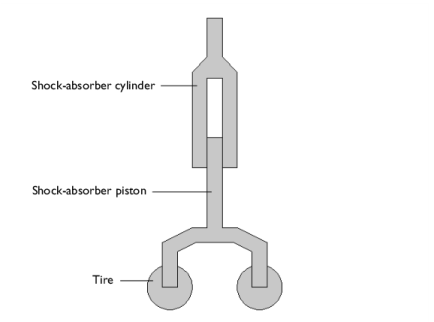
The landing gear assembly, shown in Figure 1, consists of two tires, a shock-absorber piston, and a shock-absorber cylinder. Other components in the landing gear, which are not relevant in this analysis, are not modeled.
Figure 1: Geometry of the landing gear.
The shock-absorber piston and cylinder are connected through a prismatic joint that has only one translational degree of freedom. The joint is loaded with a spring and a damper to absorb the shock during the landing. This is modeled using the spring and damper subnode of the prismatic joint.
To model the effect of the tires, the bottom surfaces of the shock-absorber piston are loaded with equivalent spring and damper. The energy dissipated in the damper is used as a heat source on the common boundaries of the shock-absorber piston and cylinder. Remaining boundaries are considered to be insulated. The heat generated on the boundaries is conducted into the landing gear components during the landing, which increases their temperature.
Results and Discussion
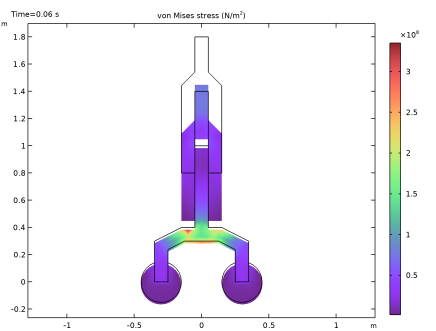
Figure 2 displays the stress generated in the landing gear components at the time when the displacement reaches its maximum.
Figure 2: von Mises stress distribution in the deformed landing gear.
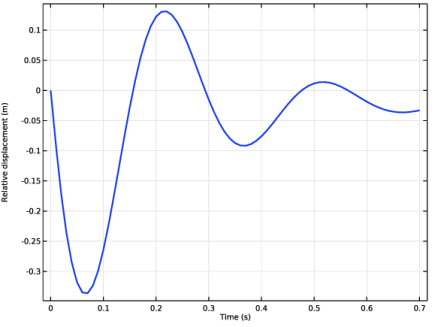
Figure 3 shows the relative displacement between the shock-absorber piston and cylinder during landing. The amplitude of the relative displacement is very high initially, but it decays rapidly due to the energy loss in the shock absorber and tires.
Figure 3: Relative displacement between the shock-absorber piston and cylinder.
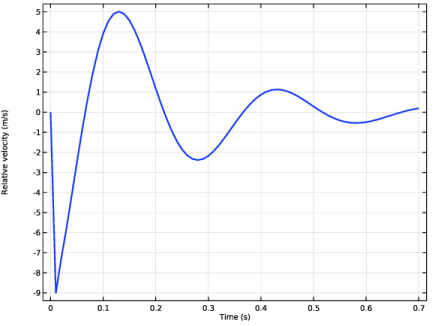
Figure 4: Relative velocity between the shock-absorber piston and cylinder.
Figure 4 shows the relative velocity variation between the shock-absorber piston and cylinder during landing. The relative velocity is also very high initially, and it decays to zero due to the energy loss in the shock absorber and tires during the course of the landing.
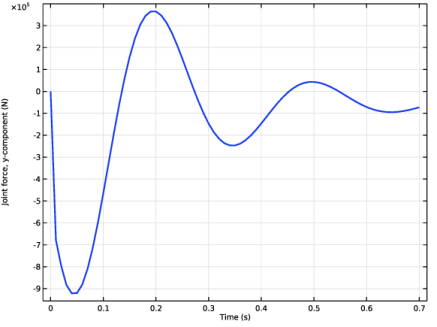
The force component in y direction in the prismatic joint is shown in Figure 5. The force also decays with time and subsequently acquires a steady state value equivalent to the weight of the whole supported system.
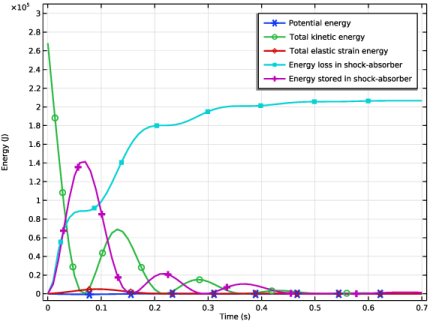
Figure 6 shows the variation in the energy components during the landing. Initially, the kinetic energy is very high. But due to the dissipation in the subsequent cycles, it decays to zero. The other forms of energies, such as strain energy and potential energy, are very small as compared to the kinetic energy. This happens because most of the kinetic energy is stored in the shock absorber initially and then dissipated before getting converted to any other forms of energy.
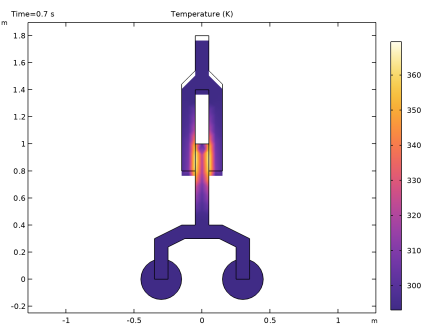
The temperature rise in the components due to heat dissipated in shock-absorber is shown in Figure 7. The maximum temperature rise occurs near the piston-cylinder boundaries.
Figure 5: The y component of force in the shock-absorber.
Figure 6: Variation of different types of energy in the gear during landing.
Figure 7: Temperature profile in the landing gear.
Application Library path: Multibody_Dynamics_Module/Automotive_and_Aerospace/landing_gear
Modeling Instructions
From the File menu, choose New.
New
In the New window, click  Model Wizard.
Model Wizard
1
In the Model Wizard window, click  2D.
2
In the Select Physics tree, select Structural Mechanics > Multibody Dynamics (mbd).
3
Click Add.
4
In the Select Physics tree, select Heat Transfer > Heat Transfer in Solids (ht).
5
Click Add.
6
Click  Study.
7
In the Select Study tree, select General Studies > Time Dependent.
8
Global Definitions
Parameters 1
1
In the Model Builder window, under Global Definitions click Parameters 1.
2
In the Settings window for Parameters, locate the Parameters section.
3
If you do not want to build all the geometry, you can load the geometry sequence from the stored model. In the Model Builder window, under Component 1 (comp1) right-click Geometry 1 and choose Insert Sequence. Browse to the model’s Application Libraries folder and double-click the file landing_gear.mph. You can then continue to the Add Material section below.
To build the geometry from scratch, continue here.
Geometry 1
Circle 1 (c1)
1
In the Geometry toolbar, click  Circle.
2
In the Settings window for Circle, locate the Size and Shape section.
3
In the Radius text field, type 0.15.
4
Locate the Position section. In the x text field, type -0.3.
Polygon 1 (pol1)
1
In the Geometry toolbar, click  Polygon.
2
In the Settings window for Polygon, locate the Coordinates section.
3
From the Data source list, choose Vectors.
4
In the x text field, type -0.35 -0.35 -0.35 -0.15 -0.15 -0.05 -0.05 -0.05 -0.05 0 0 0 0 -0.15+0.1*(sqrt(5)-2) -0.15+0.1*(sqrt(5)-2) -0.25 -0.25 -0.25.
5
In the y text field, type 0 0.3 0.3 0.4 0.4 0.4 0.4 1 1 1 1 0.3 0.3 0.3 0.3 0.3-0.05*(sqrt(5)-1) 0.3-0.05*(sqrt(5)-1) 0.
Polygon 2 (pol2)
1
In the Geometry toolbar, click  Polygon.
2
In the Settings window for Polygon, locate the Coordinates section.
3
From the Data source list, choose Vectors.
4
In the x text field, type -0.15 -0.15 -0.15 -0.05 -0.05 -0.05 -0.05 0 0 0 0 -0.05 -0.05 -0.05.
5
In the y text field, type 0.8 1.3+0.1*sqrt(2) 1.3+0.1*sqrt(2) 1.4+0.1*sqrt(2) 1.4+0.1*sqrt(2) 1.8 1.8 1.8 1.8 1.4 1.4 1.4 1.4 0.8.
6
Click  Build Selected.
7
Click the  Zoom Extents button in the Graphics toolbar.
Copy 1 (copy1)
1
In the Geometry toolbar, click  Transforms and choose Copy.
2
Difference 1 (dif1)
1
In the Geometry toolbar, click  Booleans and Partitions and choose Difference.
2
3
In the Settings window for Difference, locate the Difference section.
4
Click to select the  Activate Selection toggle button for Objects to subtract.
5
Mirror 1 (mir1)
1
In the Geometry toolbar, click  Transforms and choose Mirror.
2
Click in the Graphics window and then press Ctrl+A to select all objects.
3
In the Settings window for Mirror, locate the Input section.
4
Select the Keep input objects checkbox.
Union 1 (uni1)
1
In the Geometry toolbar, click  Booleans and Partitions and choose Union.
2
Select the objects mir1(2) and pol1 only.
3
In the Settings window for Union, locate the Union section.
4
Clear the Keep interior boundaries checkbox.
Union 2 (uni2)
1
In the Geometry toolbar, click  Booleans and Partitions and choose Union.
2
Select the objects mir1(3) and pol2 only.
3
In the Settings window for Union, locate the Union section.
4
Clear the Keep interior boundaries checkbox.
Union 3 (uni3)
1
In the Geometry toolbar, click  Booleans and Partitions and choose Union.
2
Select the objects dif1, mir1(1), and uni1 only.
Form Union (fin)
1
In the Model Builder window, under Component 1 (comp1) > Geometry 1 click Form Union (fin).
2
In the Settings window for Form Union/Assembly, locate the Form Union/Assembly section.
3
From the Action list, choose Form an assembly.
4
Click  Build Selected.
5
Click the  Go to Default View button in the Graphics toolbar.
6
Click the  Zoom Extents button in the Graphics toolbar.
Add Material
1
In the Materials toolbar, click  Add Material to open the Add Material window.
2
Go to the Add Material window.
3
In the tree, select Built-in > Structural steel.
4
Click the Add to Component button in the window toolbar.
5
In the Materials toolbar, click  Add Material to close the Add Material window.
Multibody Dynamics (mbd)
1
In the Settings window for Multibody Dynamics, locate the Thickness section.
2
In the d text field, type d.
Initial Values 1
1
In the Model Builder window, under Component 1 (comp1) > Multibody Dynamics (mbd) click Initial Values 1.
2
In the Settings window for Initial Values, locate the Initial Values section.
3
From the list, choose Locally defined.
4
Specify the du/dt vector as
5
Attachment 1
1
In the Physics toolbar, click  Boundaries and choose Attachment.
2
3
In the Settings window for Attachment, locate the Connection Type section.
4
Attachment 2
1
In the Physics toolbar, click  Boundaries and choose Attachment.
2
3
In the Settings window for Attachment, locate the Connection Type section.
4
Prismatic Joint 1
1
In the Physics toolbar, click  Global and choose Prismatic Joint.
2
In the Settings window for Prismatic Joint, locate the Attachment Selection section.
3
From the Source list, choose Attachment 1.
4
From the Destination list, choose Attachment 2.
5
Locate the Axis of Joint section. Specify the e0 vector as
Spring and Damper 1
1
In the Physics toolbar, click  Attributes and choose Spring and Damper.
2
In the Settings window for Spring and Damper, locate the Spring and Damper: Translational section.
3
In the ku text field, type k_sa.
4
In the cu text field, type c_sa.
Use the Added Mass node to account for the mass of the aircraft.
Added Mass 1
1
In the Physics toolbar, click  Boundaries and choose Added Mass.
2
3
In the Settings window for Added Mass, locate the Added Mass section.
4
From the Mass type list, choose Total mass.
5
6
Specify the m matrix as
Gravity 1
In the Physics toolbar, click  Global and choose Gravity.
The Spring Foundation node is used to account for the elastic and damping effects of the tires.
Spring Foundation 1
1
In the Physics toolbar, click  Boundaries and choose Spring Foundation.
2
3
In the Settings window for Spring Foundation, locate the Spring section.
4
From the Spring type list, choose Total spring constant.
5
6
Specify the ktot matrix as
7
Click to expand the Viscous Damping section. From the Damping type list, choose Total damping constant.
8
9
Specify the dtot matrix as
Definitions
Integration 1 (intop1)
1
In the Definitions toolbar, click  Nonlocal Couplings and choose Integration.
2
In the Settings window for Integration, locate the Source Selection section.
3
From the Selection list, choose All domains.
Variables 1
1
In the Definitions toolbar, click  Local Variables.
The heat generated due to the energy dissipation in the absorber is modeled as a heat source. This heat source is distributed on the common boundaries of the shock-absorber piston and cylinder.
2
In the Settings window for Variables, locate the Variables section.
3
Heat Transfer in Solids (ht)
1
In the Model Builder window, under Component 1 (comp1) click Heat Transfer in Solids (ht).
2
In the Settings window for Heat Transfer in Solids, locate the Physical Model section.
3
In the dz text field, type d.
Boundary Heat Source 1
1
In the Physics toolbar, click  Pairs and choose Boundary Heat Source.
2
In the Settings window for Boundary Heat Source, locate the Pair Selection section.
3
4
In the Add dialog, select Identity Boundary Pair 1 (ap1) in the Pairs list.
5
6
In the Settings window for Boundary Heat Source, locate the Boundary Heat Source section.
7
From the Heat source list, choose Heat rate.
8
In the Pb text field, type Q.
Mesh 1
1
In the Model Builder window, under Component 1 (comp1) click Mesh 1.
2
In the Settings window for Mesh, locate the Physics-Controlled Mesh section.
3
From the Element size list, choose Finer.
4
Click  Build All.
Study 1
Step 1: Time Dependent
1
In the Model Builder window, under Study 1 click Step 1: Time Dependent.
2
In the Settings window for Time Dependent, locate the Study Settings section.
3
In the Output times text field, type range(0,0.01,0.7).
4
In the Study toolbar, click  Compute.
Results
Follow these instructions to generate a plot similar to the one shown in Figure 2:
Stress
1
In the Model Builder window, under Results click Displacement (mbd).
2
In the Settings window for 2D Plot Group, type Stress in the Label text field.
3
Locate the Plot Settings section. From the Frame list, choose Material  (X, Y, Z).
4
Locate the Data section. From the Time (s) list, choose 0.06.
Surface
1
In the Model Builder window, expand the Stress node, then click Surface.
2
In the Settings window for Surface, click Replace Expression in the upper-right corner of the Expression section. From the menu, choose Component 1 (comp1) > Multibody Dynamics > Stress > mbd.misesGp - von Mises stress - N/m².
3
Click to expand the Quality section. From the Evaluation settings list, choose Manual.
4
From the Resolution list, choose No refinement.
5
In the Stress toolbar, click  Plot.
6
Click the  Zoom Extents button in the Graphics toolbar.
Follow these instructions to generate a plot similar to the one shown in Figure 7:
Surface 1
1
In the Model Builder window, expand the Results > Temperature (ht) node, then click Surface 1.
2
In the Settings window for Surface, locate the Quality section.
3
From the Evaluation settings list, choose Manual.
4
From the Resolution list, choose No refinement.
Deformation 1
1
Right-click Surface 1 and choose Deformation.
2
In the Settings window for Deformation, locate the Scale section.
3
Select the Scale factor checkbox. In the associated text field, type 1.
4
In the Temperature (ht) toolbar, click  Plot.
Follow these instructions to generate a relative displacement plot similar to the one shown in Figure 3:
Relative Displacement
1
In the Results toolbar, click  1D Plot Group.
2
In the Settings window for 1D Plot Group, type Relative Displacement in the Label text field.
3
Click to expand the Title section. From the Title type list, choose None.
Global 1
1
Right-click Relative Displacement and choose Global.
2
In the Settings window for Global, click Replace Expression in the upper-right corner of the y-Axis Data section. From the menu, choose Component 1 (comp1) > Multibody Dynamics > Prismatic joints > Prismatic Joint 1 > mbd.prj1.u - Relative displacement - m.
3
Click to expand the Legends section. Clear the Show legends checkbox.
4
Click to expand the Coloring and Style section. From the Width list, choose 2.
5
In the Relative Displacement toolbar, click  Plot.
Relative Displacement
Follow these instructions to generate a relative velocity plot similar to the one shown in Figure 4:
Relative Velocity
1
In the Model Builder window, right-click Relative Displacement and choose Duplicate.
2
In the Settings window for 1D Plot Group, type Relative Velocity in the Label text field.
Global 1
1
In the Model Builder window, expand the Relative Velocity node, then click Global 1.
2
In the Settings window for Global, click Replace Expression in the upper-right corner of the y-Axis Data section. From the menu, choose Component 1 (comp1) > Multibody Dynamics > Prismatic joints > Prismatic Joint 1 > mbd.prj1.u_t - Relative velocity - m/s.
3
In the Relative Velocity toolbar, click  Plot.
Relative Velocity
Follow these instructions to generate a joint force plot similar to the one shown in Figure 5:
Joint Force
1
In the Model Builder window, right-click Relative Velocity and choose Duplicate.
2
In the Settings window for 1D Plot Group, type Joint Force in the Label text field.
Global 1
1
In the Model Builder window, expand the Joint Force node, then click Global 1.
2
In the Settings window for Global, click Replace Expression in the upper-right corner of the y-Axis Data section. From the menu, choose Component 1 (comp1) > Multibody Dynamics > Prismatic joints > Prismatic Joint 1 > Joint force - N > mbd.prj1.Fy - Joint force, y-component.
3
In the Joint Force toolbar, click  Plot.
To generate the energy plot shown in Figure 6, follow the instructions below.
Energy
1
In the Results toolbar, click  1D Plot Group.
2
In the Settings window for 1D Plot Group, type Energy in the Label text field.
3
Locate the Title section. From the Title type list, choose None.
Global 1
1
Right-click Energy and choose Global.
2
In the Settings window for Global, click Replace Expression in the upper-right corner of the y-Axis Data section. From the menu, choose Component 1 (comp1) > Definitions > Variables > Wp - Potential energy - J.
3
Click Add Expression in the upper-right corner of the y-Axis Data section. From the menu, choose Component 1 (comp1) > Multibody Dynamics > Global > mbd.Wk_tot - Total kinetic energy - J.
4
Click Add Expression in the upper-right corner of the y-Axis Data section. From the menu, choose Component 1 (comp1) > Multibody Dynamics > Global > mbd.Ws_tot - Total elastic strain energy - J.
5
Click Add Expression in the upper-right corner of the y-Axis Data section. From the menu, choose Component 1 (comp1) > Definitions > Variables > h_sa - Energy loss in shock-absorber - J.
6
Click Add Expression in the upper-right corner of the y-Axis Data section. From the menu, choose Component 1 (comp1) > Definitions > Variables > Ws_sa - Energy stored in shock-absorber - J.
7
Locate the Coloring and Style section. From the Width list, choose 2.
8
Find the Line markers subsection. From the Marker list, choose Cycle.
9
From the Positioning list, choose Interpolated.
10
In the Energy toolbar, click  Plot.
Energy
1
In the Model Builder window, click Energy.
2
In the Settings window for 1D Plot Group, locate the Plot Settings section.
3
Select the y-axis label checkbox. In the associated text field, type Energy (J).
4
Locate the Axis section. Select the Manual axis limits checkbox.
5
In the y maximum text field, type 3.1e5.
6
In the Energy toolbar, click  Plot.
Use the instructions below to generate an animation of the stress distribution in the landing gear components.
Animation 1
1
In the Results toolbar, click  Animation and choose File.
2
In the Settings window for Animation, locate the Target section.
3
From the Target list, choose Player.
4
Locate the Frames section. In the Number of frames text field, type 100.
Finally, follow these instructions to generate an animation of the temperature distribution in the components.
Animation 2
1
In the Results toolbar, click  Animation and choose File.
2
In the Settings window for Animation, locate the Target section.
3
From the Target list, choose Player.
4
Locate the Scene section. From the Subject list, choose Temperature (ht).
5
Locate the Frames section. In the Number of frames text field, type 100.