PDF

Trichel Pulses
Introduction
Trichel pulses are a well-known phenomenon in the study of corona discharges, first observed by H. Trichel in the early 20th century. These pulses occur during negative corona discharges, which are electrical discharges brought about by a high voltage applied between a pointed electrode and a flat surface, commonly referred to as a point-to-plate configuration. The negative corona discharge is characterized by a series of rapid, repetitive pulses, resulting from the ionization of the surrounding gas and the subsequent movement of charged particles.
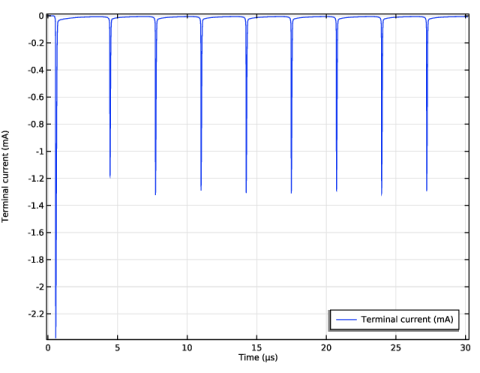
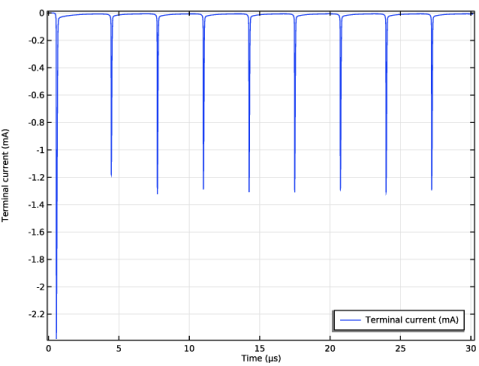
This model simulates Trichel pulses produced by a negative corona discharge under a point-to-plate configuration. The simulation captures key parameters such as electron density, electric field distribution, and discharge current. The model effectively demonstrates the pulsating nature of the discharge current, which is a distinctive characteristic of Trichel pulses. Each current pulse exhibits a rise time of approximately 40 nanoseconds and a decay time of about 150 nanoseconds, highlighting the rapid and transient nature of these electrical events. This simulation provides valuable insights into the dynamics of negative corona discharges and the formation of Trichel pulses. The simulated discharge current is in good agreement with those published in Ref. 1.
Model Definition
The Electric Discharge interface is used to simulate the negative corona discharge. The built-in charge transport model is used:
where
e, p, n denote electrons, positive ions, and negative ions
ni is the number density of the charge carrier (SI unit: 1/m3)
E is the electric field (SI unit: V/m)
zi denotes the carrier charge (SI unit: 1)
μi denotes the carrier mobility (SI unit: m2/(V·s))
wi is the drift velocity in the electric field (SI unit: m/s)
Di is the diffusion coefficient (SI unit: m2/s)
Ri is the reaction rate (SI unit: 1/(m3·s))
α is the ionization coefficient (SI unit: 1/m)
η is the attachment coefficient (SI unit: 1/m)
βep is the electron–ion recombination coefficient (SI unit: m3/s)
βpn is the ion–ion recombination coefficient (SI unit: m3/s)
The above transport equations are fully coupled with Poisson’s equation through the electric field and the space charge:
where e is the elementary charge.
The secondary electron emission is responsible for generating current pulses. At the cathode, new electrons are generated by the collision of positive ions to the cathode:
where γ is the secondary emission coefficient. The Electrode feature has the built-in boundary condition to model the secondary electron emission.
Results and Discussion
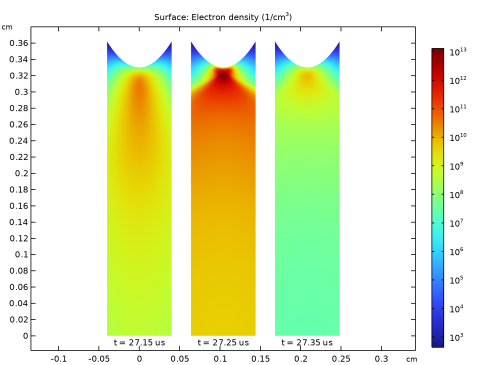
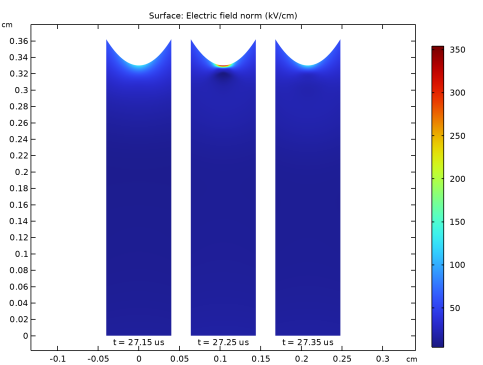
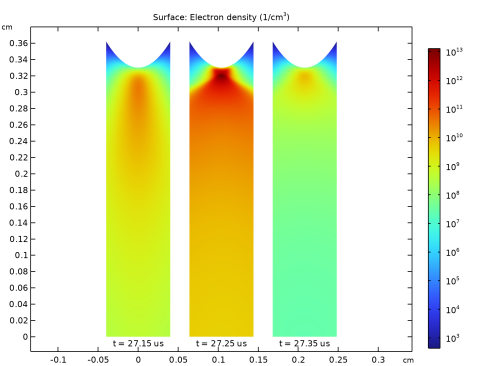
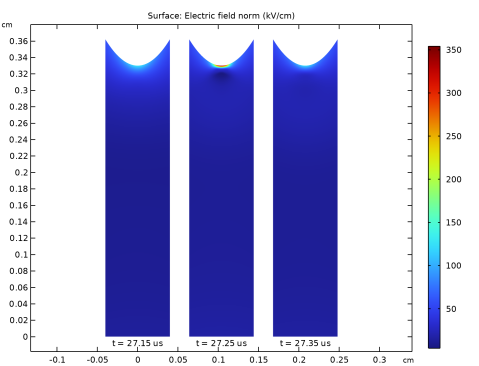
Figure 1 shows the discharge current as a function of time. Figure 2 and Figure 3 plot the distribution of electron density and electric field during a current pulse, respectively.
Figure 1: The Trichel pulses.
Figure 2: The distributions of electron density during a Trichel pulse.
Figure 3: The distributions of the electric field during a Trichel pulse.
References
1. T. Tran and others, “Numerical modelling of negative discharges in air with experimental validation,” J. Phys. D: Appl. Phys., vol. 44, no. 1, p. 15203, 2010.
Application Library path: Electric_Discharge_Module/Corona_Discharges/trichel_pulses
Modeling Instructions
From the File menu, choose New.
New
In the New window, click  Model Wizard.
Model Wizard
1
In the Model Wizard window, click  2D Axisymmetric.
2
In the Select Physics tree, select Electric Discharge > Electric Discharge (edis).
3
Click Add.
4
Click  Study.
5
In the Select Study tree, select Preset Studies for Selected Physics Interfaces > Time Dependent with Initialization.
6
Global Definitions
Parameters 1
1
In the Model Builder window, under Global Definitions click Parameters 1.
2
In the Settings window for Parameters, locate the Parameters section.
3
Definitions
Global Variable Probe 1 (var1)
1
In the Model Builder window, expand the Component 1 (comp1) > Definitions node.
2
Right-click Definitions and choose Probes > Global Variable Probe.
3
In the Settings window for Global Variable Probe, type i0 in the Variable name text field.
4
Locate the Expression section. In the Expression text field, type edis.I0_0.
5
In the Table and plot unit field, type mA.
6
In the Model Builder window, collapse the Definitions node.
Geometry 1
1
In the Model Builder window, under Component 1 (comp1) click Geometry 1.
2
In the Settings window for Geometry, locate the Units section.
3
From the Length unit list, choose cm.
Rectangle 1 (r1)
1
In the Geometry toolbar, click  Rectangle.
2
In the Settings window for Rectangle, click to expand the Layers section.
3
4
Select the Layers to the left checkbox.
5
Clear the Layers on bottom checkbox.
6
Click  Build Selected.
Parametric Curve 1 (pc1)
1
In the Geometry toolbar, click  More Primitives and choose Parametric Curve.
2
In the Settings window for Parametric Curve, locate the Parameter section.
3
In the Maximum text field, type 0.2.
4
Locate the Expressions section. In the r text field, type s.
5
In the z text field, type a*(s)^2*1[cm]+gap.
6
Click  Build Selected.
Line Segment 1 (ls1)
1
In the Geometry toolbar, click  More Primitives and choose Line Segment.
2
On the object pc1, select Point 2 only.
3
In the Settings window for Line Segment, locate the Endpoint section.
4
Click to select the  Activate Selection toggle button for End vertex.
5
On the object r1, select Point 2 only.
6
Click  Build Selected.
Line Segment 2 (ls2)
1
In the Geometry toolbar, click  More Primitives and choose Line Segment.
2
On the object ls1, select Point 2 only.
3
In the Settings window for Line Segment, locate the Endpoint section.
4
Click to select the  Activate Selection toggle button for End vertex.
5
On the object pc1, select Point 1 only.
6
Click to clear the  Activate Selection toggle button for End vertex.
7
Click  Build Selected.
Convert to Solid 1 (csol1)
1
In the Geometry toolbar, click  Conversions and choose Convert to Solid.
2
Select the objects ls1, ls2, and pc1 only.
3
In the Settings window for Convert to Solid, click  Build Selected.
Difference 1 (dif1)
1
In the Geometry toolbar, click  Booleans and Partitions and choose Difference.
2
3
In the Settings window for Difference, locate the Difference section.
4
Click to select the  Activate Selection toggle button for Objects to subtract.
5
Rectangle 2 (r2)
1
In the Geometry toolbar, click  Rectangle.
2
In the Settings window for Rectangle, locate the Size and Shape section.
3
In the Width text field, type 80[um].
4
In the Height text field, type 80[um].
5
Locate the Position section. In the z text field, type gap-85[um].
6
Click  Build All Objects.
7
Click the  Zoom Extents button in the Graphics toolbar.
8
In the Model Builder window, collapse the Geometry 1 node.
Add Material
1
In the Materials toolbar, click  Add Material to open the Add Material window.
2
Go to the Add Material window.
3
In the tree, select Electric Discharge > Gases > Air > Air [Kang et al. 2003].
4
Right-click and choose Add to Component 1 (comp1).
5
In the Materials toolbar, click  Add Material to close the Add Material window.
Electric Discharge (edis)
1
Click the  Show More Options button in the Model Builder toolbar.
2
In the Show More Options dialog, select Physics > Stabilization in the tree.
3
4
Click  Select All.
5
6
In the Settings window for Electric Discharge, click to expand the Consistent Stabilization section.
7
Clear the Streamline diffusion checkbox.
8
Click to expand the Inconsistent Stabilization section. Select the Isotropic diffusion checkbox.
Gas 1
1
In the Model Builder window, under Component 1 (comp1) > Electric Discharge (edis) click Gas 1.
2
In the Settings window for Gas, locate the Model Formulation section.
3
Clear the Include background ionization checkbox.
4
Locate the Transport Properties section. Find the Diffusion subsection. From the Diffusion coefficient list, choose User defined.
5
In the De text field, type 0.18.
6
In the Dp text field, type 0.01.
7
In the Dn text field, type 0.01.
Initial Values 1
1
In the Model Builder window, click Initial Values 1.
2
In the Settings window for Initial Values, locate the Initial Values section.
3
In the ne text field, type 1E5[1/cm^3].
4
In the np text field, type 1E5[1/cm^3].
5
In the nn text field, type 1E5[1/cm^3].
Gas 1
In the Model Builder window, click Gas 1.
Electrode 1
1
In the Physics toolbar, click  Attributes and choose Electrode.
2
3
In the Settings window for Electrode, locate the Terminal section.
4
In the V0 text field, type V0.
5
Locate the Charge Transport section. From the Boundary condition for electrons list, choose Surface emission.
6
From the Boundary condition for negative ions list, choose Number density.
7
In the n0,n text field, type 1E5[1/cm^3].
8
Locate the Surface Emission section. Find the Surface emission mechanisms subsection. Select the Secondary electron emission checkbox.
Gas 1
In the Model Builder window, click Gas 1.
Electrode 2
1
In the Physics toolbar, click  Attributes and choose Electrode.
2
3
In the Settings window for Electrode, locate the Charge Transport section.
4
From the Boundary condition for positive ions list, choose Number density.
5
In the n0,p text field, type 1E5[1/cm^3].
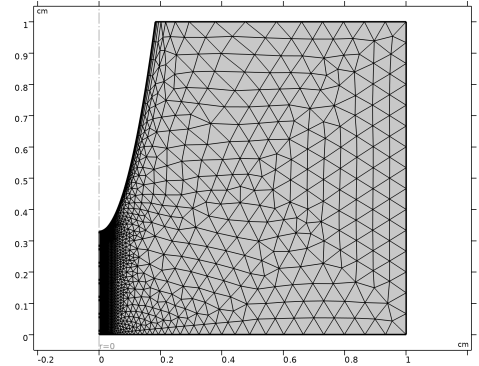
Mesh 1
1
In the Model Builder window, under Component 1 (comp1) click Mesh 1.
2
In the Settings window for Mesh, locate the Sequence Type section.
3
From the list, choose User-controlled mesh.
Mapped 1
1
In the Mesh toolbar, click  Mapped.
2
3
In the Settings window for Mapped, locate the Domain Selection section.
4
From the Geometric entity level list, choose Domain.
5
Distribution 1
1
Right-click Mapped 1 and choose Distribution.
2
3
In the Settings window for Distribution, locate the Distribution section.
4
From the Distribution type list, choose Predefined.
5
In the Number of elements text field, type 80.
6
In the Element ratio text field, type 5.
7
Select the Reverse direction checkbox.
Distribution 2
1
In the Model Builder window, right-click Mapped 1 and choose Distribution.
2
3
In the Settings window for Distribution, locate the Distribution section.
4
In the Number of elements text field, type 80.
Size 1
1
In the Model Builder window, right-click Free Triangular 1 and choose Size.
2
In the Settings window for Size, locate the Geometric Entity Selection section.
3
From the Geometric entity level list, choose Boundary.
4
Click the  Zoom Box button in the Graphics toolbar.
5
Click the  Zoom Box button in the Graphics toolbar.
6
7
Locate the Element Size section. Click the Custom button.
8
Locate the Element Size Parameters section.
9
Select the Maximum element size checkbox. In the associated text field, type 1/1000.
Size 2
1
Right-click Free Triangular 1 and choose Size.
2
In the Settings window for Size, locate the Geometric Entity Selection section.
3
From the Geometric entity level list, choose Domain.
4
5
Locate the Element Size section. Click the Custom button.
6
Locate the Element Size Parameters section.
7
Select the Maximum element size checkbox. In the associated text field, type 1/200.
8
Select the Maximum element growth rate checkbox. In the associated text field, type 1.1.
9
Click  Build All.
Boundary Layers 1
In the Mesh toolbar, click  Boundary Layers.
Boundary Layer Properties
1
In the Model Builder window, click Boundary Layer Properties.
2
In the Settings window for Boundary Layer Properties, locate the Boundary Selection section.
3
Click  Paste Selection.
4
In the Paste Selection dialog, type 12-13 in the Selection text field.
5
6
In the Settings window for Boundary Layer Properties, locate the Layers section.
7
In the Number of layers text field, type 4.
8
In the Stretching factor text field, type 1.5.
9
In the Model Builder window, right-click Mesh 1 and choose Build All.
10
Click the  Zoom Extents button in the Graphics toolbar.
11
In the Model Builder window, collapse the Mesh 1 node.
Study 1
Step 2: Time Dependent
1
In the Model Builder window, under Study 1 click Step 2: Time Dependent.
2
In the Settings window for Time Dependent, locate the Study Settings section.
3
From the Time unit list, choose µs.
4
In the Output times text field, type range(0,3,27) 27.15 27.25 27.35 30.
5
Click to expand the Results While Solving section. In the Model Builder window, click Study 1.
6
In the Settings window for Study, locate the Study Settings section.
7
Clear the Generate default plots checkbox.
Solution 1 (sol1)
1
In the Study toolbar, click  Show Default Solver.
2
In the Model Builder window, expand the Solution 1 (sol1) node.
3
In the Model Builder window, under Study 1 > Solver Configurations > Solution 1 (sol1) click Time-Dependent Solver 1.
4
In the Settings window for Time-Dependent Solver, click to expand the Time Stepping section.
5
Select the Initial step checkbox. In the associated text field, type 1e-15[s].
The PARDISO direct solver is usually a bit faster and leaner on memory than the default direct solver (MUMPS) on this type of model.
6
In the Model Builder window, under Study 1 > Solver Configurations > Solution 1 (sol1) > Time-Dependent Solver 1 click Direct.
7
In the Settings window for Direct, locate the General section.
8
From the Solver list, choose PARDISO.
9
In the Study toolbar, click  Compute.
Results
Mirror 2D 1
1
In the Model Builder window, expand the Results > Datasets node.
2
Right-click Results > Datasets and choose More 2D Datasets > Mirror 2D.
3
In the Settings window for Mirror 2D, click to expand the Advanced section.
Selection
1
In the Results toolbar, click  Attributes and choose Selection.
2
In the Settings window for Selection, locate the Geometric Entity Selection section.
3
From the Geometric entity level list, choose Domain.
4
Discharge Current
1
In the Model Builder window, under Results click Probe Plot Group 1.
2
In the Settings window for 1D Plot Group, type Discharge Current in the Label text field.
3
Locate the Legend section. From the Position list, choose Lower right.
4
In the Discharge Current toolbar, click  Plot.
5
Click the  Zoom Extents button in the Graphics toolbar.
Electron Density
1
In the Results toolbar, click  2D Plot Group.
2
In the Settings window for 2D Plot Group, type Electron Density in the Label text field.
3
Locate the Data section. From the Dataset list, choose Mirror 2D 1.
4
Locate the Plot Settings section. Clear the Plot dataset edges checkbox.
Surface 1
1
Right-click Electron Density and choose Surface.
2
In the Settings window for Surface, locate the Expression section.
3
In the Expression text field, type edis.n_e.
4
In the Unit field, type 1/cm^3.
5
Locate the Coloring and Style section. From the Scale list, choose Logarithmic.
Solution Array 1
1
Right-click Surface 1 and choose Solution Array.
2
In the Settings window for Solution Array, locate the Data section.
3
From the Time selection list, choose From list.
4
In the Times (µs) list, choose 27.15, 27.25, and 27.35.
Electron Density
1
In the Model Builder window, under Results click Electron Density.
2
In the Settings window for 2D Plot Group, click to expand the Title section.
3
From the Title type list, choose Custom.
4
Find the Solution subsection. Clear the Solution checkbox.
Annotation 1
1
Right-click Electron Density and choose Annotation.
2
In the Settings window for Annotation, locate the Annotation section.
3
In the Text text field, type t = eval(t,us,4) us.
4
Locate the Coloring and Style section. Clear the Show point checkbox.
5
From the Anchor point list, choose Upper middle.
6
Click to expand the Plot Array section. Select the Manual indexing checkbox.
Solution Array 1
In the Model Builder window, under Results > Electron Density > Surface 1 right-click Solution Array 1 and choose Copy.
Solution Array 1
In the Model Builder window, right-click Annotation 1 and choose Paste Solution Array.
Electron Density
1
In the Electron Density toolbar, click  Plot.
2
Click the  Zoom Extents button in the Graphics toolbar.
3
In the Model Builder window, under Results click Electron Density.
Electron Field
1
Right-click Electron Density and choose Duplicate.
2
In the Settings window for 2D Plot Group, type Electron Field in the Label text field.
Surface 1
1
In the Model Builder window, expand the Electron Field node, then click Surface 1.
2
In the Settings window for Surface, locate the Expression section.
3
In the Expression text field, type edis.normE.
4
In the Unit field, type kV/cm.
5
Locate the Coloring and Style section. From the Scale list, choose Linear.
Electron Field
1
In the Model Builder window, click Electron Field.
2
In the Electron Field toolbar, click  Plot.
3
Click the  Zoom Extents button in the Graphics toolbar.