



PDF

Polymerization in Multijet Tubular Reactor
Introduction
Production processes for polymers often involve turbulent flows and rapid reaction kinetics. The sophisticated interplay between fluid dynamics and fast chemical reactions can significantly impact the reactor performance, and thereby affect conversion and yield. Furthermore, the turbulent fluid mixing and its effects on the reaction can influence the average length of polymer chains, the molecular weight distribution, cross-linking, and chain-branching. All these properties are important for the integrity of the final material. This example demonstrates a polyester reactor, with multiple inlets, and includes heat transfer and temperature dependent kinetics. It employs the eddy dissipation model for the mean reaction rate in turbulent flows.
Note: This application requires both the Chemical Reaction Engineering Module and the CFD Module.
Model Definition
Geometry
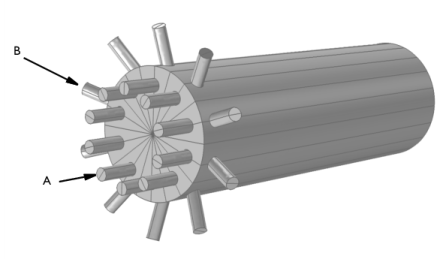
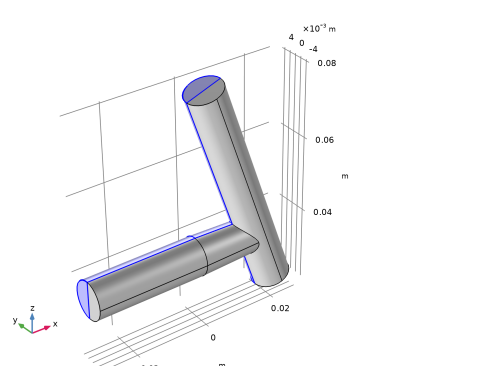
The geometry of the inlet section of a multijet tubular reactor is illustrated in Figure 1.
Figure 1: Inlet section of a multijet tubular reactor. Monomer A (diol) enters through the axial inlets while monomer B (diacid) enters through the radial ports.
Two reacting monomers enter through separate inlet ports. Monomer A enters through the axial inlets while monomer B enters through the radial ports.
Chemistry
Condensation reactions are fundamental to the production of many important polymers, such as polyamides, polyesters, polyurethanes, and silicones.
This model simulates a polyester reactor. Condensation polymerization of monomers A (a diol) and B (a diacid), forms the polyester linkage, L (Ref. 1, Ref. 2). The reactions take place in the presence of a solvent catalyst, S.
The catalytic species, S, is temporarily trapped in an intermediary H2O complex, S · C, where C represents the complex-forming water in the irreversible reaction
(1)
The regeneration of solvent is governed by the reversible reaction
(2)
The reaction rates for each chemical reaction is determined by the law of mass action and the eddy dissipation concept (EDC) model. The law of mass action gives the rates (mol/(m3·s))
(3)
and
(4)
for reactions Equation 1and Equation 2, respectively, where the rate constants are given by the Arrhenius expression
(5)
In Equation 5, Aj is the frequency factor and Ej the activation energy (J/mol) for the jth reaction. The table below lists the values of the Arrhenius parameters for the reactions. The rates are adjusted for turbulent conditions according to the EDC model: If the time scale of the turbulent mixing is larger than the reaction kinetics derived by the law of mass action above, the turbulent mixing will be rate determining. For detailed information, see the section Eddy Dissipation Model in the CFD Module User’s Guide.
Transport
The 3D model geometry is illustrated in Figure 1.
Velocities and Pressure
The average velocities at the radial and axial inlets are set to 5 m/s. Furthermore, a constant pressure is set at the outlet and logarithmic wall functions are specified at the solid walls.
Mass Transport
Concentration boundary conditions apply at the inlets:
(6)
The catalytic solvent S is set as solvent in the mass transport model.
Energy Transport
The reactor is assumed to be insulated at the walls and all inlet streams are specified to 440 K temperature.
Summary of Input Data
For the rate expressions in Equation 3 and Equation 4 the following data is used (Ref. 1):
Table 2: kinetic data.
The material properties and boundary conditions used are (Ref. 1 and Ref. 2).
Table 3: Input data.
Modeling in COMSOL
The polymerization reactions are first solved for using an ideal plug flow reactor model. This is performed using the Reaction Engineering interface, and produces the one dimensional development of the flow rates and temperature along the reactor.
To model the system in 3D, the Generate Space-Dependent Model feature, Reaction Engineering interface, is then used. A part from a 3D component, this also creates and a Reacting Flow multiphysics interface combining four physics interfaces. The Chemistry interface implements the reaction kinetics, using the same reactions as in the plug flow model. The Transport of Concentrated Species interface and the Heat Transfer in Fluids interface solves for the mass transport and heat transfer respectively, including the mass sources and heat of reactions as defined by the Chemistry interface. The Turbulent Flow k-ε interface solves for the velocity, pressure, and turbulent mixing, used in the equations for mass transfer and the heat transfer. The Reacting Flow multiphysics node controls the coupling between the individual physics interfaces.
Staged Solution
Since the chemical reactions are strongly dependent on the flow, the composition, and the temperature, the fully coupled system is often difficult to converge by starting from constant initial conditions. A faster and more robust solution procedure is to first solve for the velocity and pressure. And to use this as initial conditions, in a second step, to solve for the entire system.
Geometry
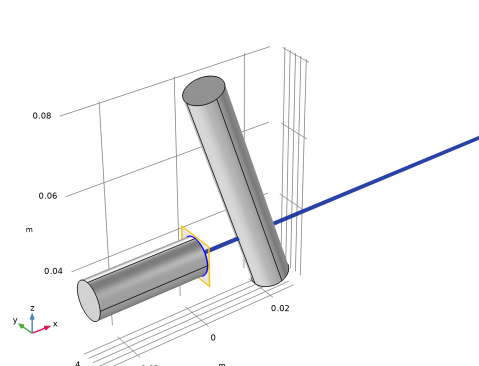
Due to symmetry, a sector of one 1/20 of the geometry shown in Figure 1 is modeled. The modeling results are rotated to the full geometry by sector datasets.
Mesh
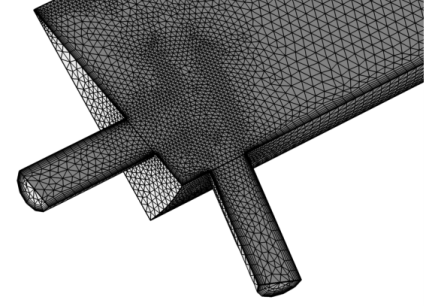
The mesh is calibrated to resolve the shear layers that appear near the inlets of the reactor. Further downstream where the flow profile is expected to be more uniform, a simpler extruded mesh is used to save time and memory.
Results and Discussion
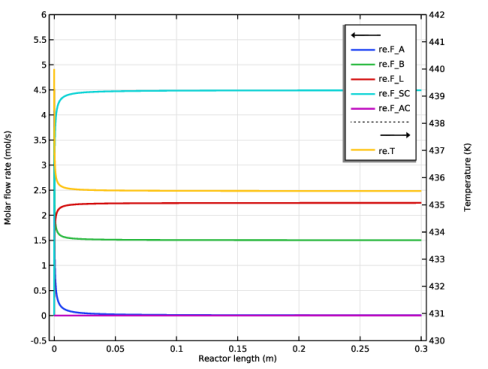
The results when solving for an ideal plug flow reactor of the same length as the 3D geometry are seen in Figure 2 below. As reactants are assumed fully mixed already when entering the reactor, the reactions go to completion over a small fraction of the reactor.
Figure 2: Flow rates and temperature in an ideal plug flow reactor.
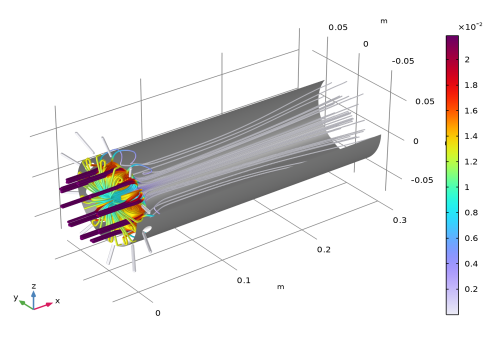
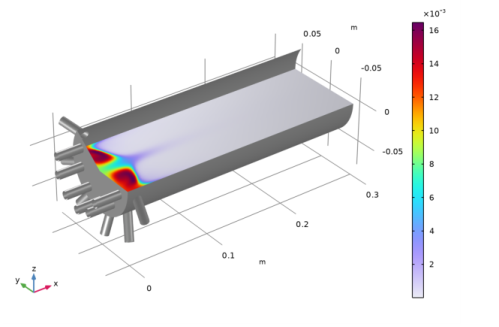
In the 3D geometry the monomer reactants enter the reactor from different inlets and needs to be mixed before the reactions take place. Results from the 3D multijet tubular reactor model are shown below. Figure 3 shows the velocity field in a cut plane through the reactor. The figure indicates an intense mixing zone in the region were the axial and radial jets impinge. Plotting the streamlines of the velocity field Figure 4 provides more detailed information about the flow paths. Closer inspection at the entrance of the reactor reveals several recirculation zones.
Figure 3: Velocity field (m/s) in the multijet tubular reactor.
Figure 4: Streamlines of the velocity field shows the recirculation zones near the inlet orifices. The concentration of reactants decrease rapidly at after the inlet stretch.
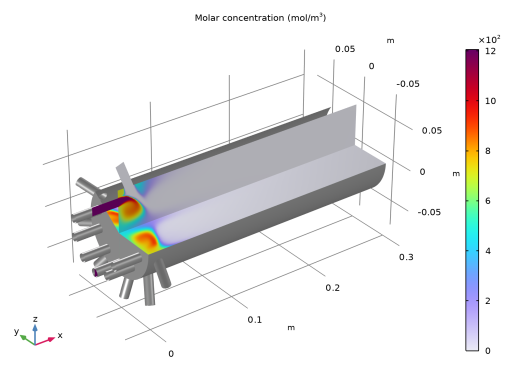
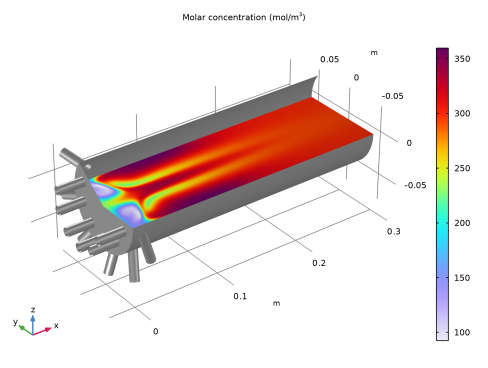
The turbulent flow field transports and mixes the chemical species. Once monomer A comes into contact with the radial streams of monomer B, polymerization starts. Figure 5 shows the resulting concentration field of monomer A.
Figure 5: Concentration distribution of monomer A (mol/m3).
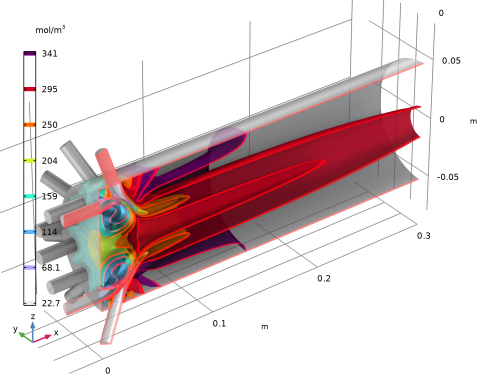
Figure 6 shows isosurfaces of the polymer linkage L concentration. Concentrated isolevels clearly mark the positions of where the inlet streams meet. But isolevels are also present throughout the recirculation zones.
Figure 6: Isosurfaces for the concentration of L (mol/m3) visualized using a clip plane.
As mentioned above, recirculation is evident in the entrance of the reactor. Recirculation will increase the effective residence time of the reactor. Figure 7 shows the concentration of polymer linkage, cL, with a surface slice plot. Clearly, the concentration of L is relatively low in the recirculation region. In polymerization processes, increasing linkage concentration can lead to dramatic changes in the properties of the reacting fluid, particularly viscosity. This in turn may cause fouling or even reactor failure.
Figure 7: Concentration distribution of polymer linkage, cL (mol/m3).
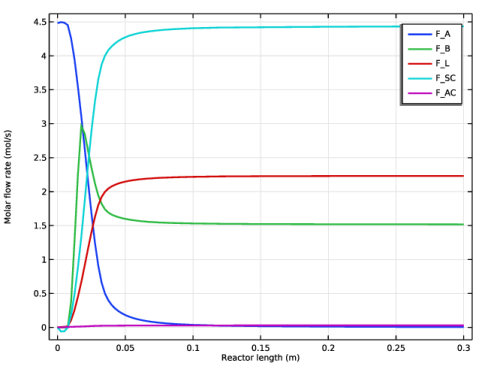
Figure 8 shows the axial development of the flow rates though the multijet tubular reactor. The flow rate of monomer B is initially zero since it is injected through radial inlets attached about 1.3 cm into the reactor. Following the injection, monomer B attains a maximum around 2 cm into the reactor. The other species evolve monotonically in the axial direction. It can be noted that the reaction zone in the 3D reactor is significantly longer compared to that in Figure 2 using the plug flow assumption.
Figure 8: Axial development of flow rates through the multijet tubular reactor.
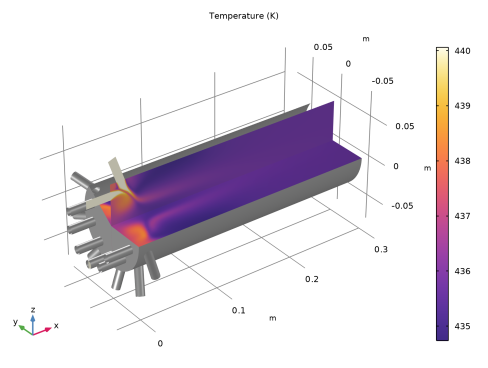
The total condensation chemistry is endothermic. Figure 9 displays the resulting temperature field in the reactor.
Figure 9: Temperature distribution in the multijet tubular reactor. The inlet temperatures of radial and axial streams are 440 K.
References
1. N.H. Kolhapure, J.N. Tilton, and C.J. Pereira, “Integration of CFD and condensation polymerization chemistry for a commercial multi-jet tubular reactor,” Chem. Eng. Sci., vol. 59, p. 5177, 2004.
2. en.wikipedia.org/wiki/Polyester.
Application Library path: Chemical_Reaction_Engineering_Module/Reactors_with_Mass_and_Heat_Transfer/polymerization_multijet
Modeling Instructions
From the File menu, choose New.
New
In the New window, click  Model Wizard.
Model Wizard
1
In the Model Wizard window, click  0D.
2
In the Select Physics tree, select Chemical Species Transport > Reaction Engineering (re).
3
Click Add.
4
Click  Study.
5
In the Select Study tree, select Preset Studies for Selected Physics Interfaces > Stationary Plug Flow.
6
Global Definitions
Parameters 1
1
In the Model Builder window, under Global Definitions click Parameters 1.
2
In the Settings window for Parameters, locate the Parameters section.
3
Click  Load from File.
4
Definitions
Variables 1
1
In the Model Builder window, under Component 1 (comp1) right-click Definitions and choose Variables.
2
In the Settings window for Variables, locate the Variables section.
3
Reaction Engineering (re)
1
In the Model Builder window, under Component 1 (comp1) click Reaction Engineering (re).
2
In the Settings window for Reaction Engineering, click to expand the Equation section.
3
Locate the Reactor section. From the Reactor type list, choose Plug flow.
4
Locate the Energy Balance section. From the Energy balance list, choose Include.
5
Locate the Mixture Properties section. From the Phase list, choose Liquid.
Reaction 1
1
In the Reaction Engineering toolbar, click  Reaction.
2
In the Settings window for Reaction, locate the Reaction Formula section.
3
In the Formula text field, type 2 A + B + S => L + 2 SC.
4
Click Apply.
5
Locate the Rate Constants section. Select the Use Arrhenius expressions checkbox.
6
In the Af text field, type Af1.
7
In the Ef text field, type Ef1.
8
Locate the Reaction Thermodynamic Properties section. From the Enthalpy of reaction list, choose User defined.
9
In the H text field, type H1.
Species: A
1
In the Model Builder window, click Species: A.
2
In the Settings window for Species, locate the Chemical Formula section.
3
In the M text field, type MwA.
4
Click to expand the Thermodynamic Expressions section. From the list, choose User defined.
Species: B
1
In the Model Builder window, click Species: B.
2
In the Settings window for Species, locate the Chemical Formula section.
3
In the M text field, type MwB.
4
Locate the Thermodynamic Expressions section. From the list, choose User defined.
Species: S
1
In the Model Builder window, click Species: S.
2
In the Settings window for Species, locate the Chemical Formula section.
3
In the M text field, type MwS.
4
In the ρ text field, type rho_S.
5
Locate the Thermodynamic Expressions section. From the list, choose User defined.
6
In the Cp text field, type Cp_S*MwS.
Species: L
1
In the Model Builder window, click Species: L.
2
In the Settings window for Species, locate the Chemical Formula section.
3
In the M text field, type MwL.
4
Locate the Thermodynamic Expressions section. From the list, choose User defined.
Species: SC
1
In the Model Builder window, click Species: SC.
2
In the Settings window for Species, locate the Chemical Formula section.
3
In the M text field, type MwSC.
4
Locate the Thermodynamic Expressions section. From the list, choose User defined.
Reaction 2
1
In the Reaction Engineering toolbar, click  Reaction.
2
In the Settings window for Reaction, locate the Reaction Formula section.
3
In the Formula text field, type A + SC <=> S + AC.
4
Click Apply.
5
Locate the Rate Constants section. Select the Use Arrhenius expressions checkbox.
6
In the Af text field, type Af2.
7
In the Ef text field, type Ef2.
8
In the Ar text field, type Ar2.
9
In the Er text field, type Er2.
10
Locate the Reaction Thermodynamic Properties section. From the Enthalpy of reaction list, choose User defined.
11
In the H text field, type H2.
Species: AC
1
In the Model Builder window, click Species: AC.
2
In the Settings window for Species, locate the Chemical Formula section.
3
In the M text field, type MwAC.
4
Locate the Thermodynamic Expressions section. From the list, choose User defined.
Initial Values 1
1
In the Model Builder window, click Initial Values 1.
2
In the Settings window for Initial Values, locate the General Parameters section.
3
In the T0,in text field, type T_in.
4
Locate the Volumetric Species Initial Values section. In the table, enter the following settings:
Study 1
Step 1: Stationary Plug Flow
1
In the Model Builder window, under Study 1 click Step 1: Stationary Plug Flow.
2
In the Settings window for Stationary Plug Flow, locate the Study Settings section.
3
In the Output volumes text field, type range(0,0.1,1)*V_r.
4
In the Study toolbar, click  Compute.
Create a plot showing the flow rates and temperature in a plug flow reactor.
Results
Plug Flow: Flow Rate and Temperature
1
In the Settings window for 1D Plot Group, type Plug Flow: Flow Rate and Temperature in the Label text field.
2
Click to expand the Title section. From the Title type list, choose None.
3
Locate the Plot Settings section. In the x-axis label text field, type Reactor length (m).
4
Select the Two y-axes checkbox.
5
Select the Secondary y-axis label checkbox. In the associated text field, type Temperature (K).
Global 1
1
In the Model Builder window, expand the Plug Flow: Flow Rate and Temperature node, then click Global 1.
2
In the Settings window for Global, locate the y-Axis Data section.
3
4
Locate the x-Axis Data section. From the Parameter list, choose Expression.
5
In the Expression text field, type r_len.
6
Click to expand the Coloring and Style section. From the Width list, choose 2.
Plug Flow: Flow Rate and Temperature
In the Plug Flow: Flow Rate and Temperature toolbar, click  Global.
T
1
In the Settings window for Global, type T in the Label text field.
2
Locate the y-Axis Data section. Click  Clear Table.
3
4
Locate the x-Axis Data section. From the Parameter list, choose Expression.
5
In the Expression text field, type r_len.
6
Locate the Coloring and Style section. From the Width list, choose 2.
Plug Flow: Flow Rate and Temperature
1
In the Model Builder window, click Plug Flow: Flow Rate and Temperature.
2
In the Settings window for 1D Plot Group, locate the Plot Settings section.
3
In the table, select the Plot on secondary y-axis checkbox for T.
4
Locate the Axis section. Select the Manual axis limits checkbox.
5
In the y minimum text field, type -0.5.
6
In the y maximum text field, type 6.
7
In the Secondary y minimum text field, type 430.
8
In the Secondary y maximum text field, type 442.
9
In the Plug Flow: Flow Rate and Temperature toolbar, click  Plot.
Temperature (re)
In the Model Builder window, right-click Temperature (re) and choose Delete.
Reaction Engineering (re)
Generate Space-Dependent Model 1
1
In the Reaction Engineering toolbar, click  Generate Space-Dependent Model.
2
In the Settings window for Generate Space-Dependent Model, locate the Physics Interfaces section.
3
Find the Chemical species transport subsection. From the list, choose Nonisothermal Reacting Flow: New.
4
From the list, choose Turbulent Flow.
5
Locate the Space-Dependent Model Generation section. Click Create/Refresh.
Geometry 1(3D)
For the 3D model, start by building the geometry of the multijet reactor. You can simplify this by inserting a prepared geometry sequence from file. You can read the instruction for building the geometry in the appendix.
1
In the Model Builder window, expand the Component 2 (comp2) node, then click Geometry 1(3D).
2
In the Geometry toolbar, click Insert Sequence and choose Insert Sequence.
3
4
In the Geometry toolbar, click  Build All.
Mesh Control Domains 1 (mcd1)
1
In the Geometry toolbar, click  Virtual Operations and choose Mesh Control Domains.
2
On the object fin, select Domain 4 only.
Mesh Control Faces 1 (mcf1)
1
In the Geometry toolbar, click  Virtual Operations and choose Mesh Control Faces.
2
On the object mcd1, select Boundary 11 only.
Mesh Control Domains 1 (mcd1)
1
In the Model Builder window, click Mesh Control Domains 1 (mcd1).
2
In the Settings window for Mesh Control Domains, locate the Input section.
3
Click to select the  Activate Selection toggle button for Domains to include.
4
In the Geometry toolbar, click  Build All.
Turbulent Flow, k-ε (spf)
Initial Values 1
1
In the Model Builder window, expand the Component 2 (comp2) > Turbulent Flow, k-ε (spf) node, then click Initial Values 1.
2
In the Settings window for Initial Values, locate the Initial Values section.
3
In the k text field, type 7e-8.
4
In the ep text field, type 1e-11.
Symmetry 1
1
In the Physics toolbar, click  Boundaries and choose Symmetry.
2
Inlet 1
1
In the Model Builder window, click Inlet 1.
2
3
In the Settings window for Inlet, locate the Boundary Condition section.
4
From the list, choose Fully developed flow.
5
Locate the Fully Developed Flow section. In the Uav text field, type 5.
Outlet 1
1
In the Model Builder window, click Outlet 1.
2
Chemistry (chem)
1
In the Model Builder window, under Component 2 (comp2) click Chemistry (chem).
2
In the Settings window for Chemistry, locate the Mixture Properties section.
3
From the Density list, choose User defined.
4
In the ρ text field, type rho_S.
5
Click to expand the Calculate Transport Properties section. From the Heat capacity list, choose User defined.
6
In the Cp text field, type Cp_S.
7
From the Thermal conductivity list, choose User defined.
8
In the k text field, type 0.21+Cp_S*spf.muT/0.72.
9
In the μ text field, type 0.001*(1.17817558982837+(-298[K]+T)/223[K])^(-3.758)[Pa*s].
Transport of Concentrated Species (tcs)
1
In the Model Builder window, under Component 2 (comp2) click Transport of Concentrated Species (tcs).
2
In the Settings window for Transport of Concentrated Species, locate the Transport Mechanisms section.
3
From the Diffusion model list, choose Fick’s law.
4
Locate the Species section. From the From mass constraint list, choose wS.
Fluid 1
1
In the Model Builder window, expand the Transport of Concentrated Species (tcs) node, then click Fluid 1.
2
In the Settings window for Fluid, locate the Density section.
3
From the ρ list, choose User defined. In the associated text field, type rho_S.
4
Locate the Diffusion section. In the DfwA text field, type D.
5
In the DfwAC text field, type D.
6
In the DfwB text field, type D.
7
In the DfwL text field, type D.
8
In the DfwS text field, type D.
9
In the DfwSC text field, type D.
Initial Values 1
1
In the Model Builder window, click Initial Values 1.
2
In the Settings window for Initial Values, locate the Initial Values section.
3
In the ω0,wA text field, type 1e-6.
4
In the ω0,wAC text field, type 1e-6.
5
In the ω0,wB text field, type 1e-6.
6
In the ω0,wL text field, type 1e-6.
7
In the ω0,wSC text field, type 1e-6.
Inflow 1
1
In the Model Builder window, click Inflow 1.
2
3
In the Settings window for Inflow, locate the Inflow section.
4
From the Mixture specification list, choose Molar concentrations.
5
In the c0,wA text field, type 1200[mol/m^3].
6
In the c0,wAC text field, type 1e-3[mol/m^3].
7
In the c0,wB text field, type 1e-3[mol/m^3].
8
In the c0,wL text field, type 1e-3[mol/m^3].
9
In the c0,wSC text field, type 1e-3[mol/m^3].
Inflow 2
1
In the Physics toolbar, click  Boundaries and choose Inflow.
2
3
In the Settings window for Inflow, locate the Inflow section.
4
From the Mixture specification list, choose Molar concentrations.
5
In the c0,wA text field, type 1e-3[mol/m^3].
6
In the c0,wAC text field, type 1e-3[mol/m^3].
7
In the c0,wB text field, type 1000[mol/m^3].
8
In the c0,wL text field, type 1e-3[mol/m^3].
9
In the c0,wSC text field, type 1e-3[mol/m^3].
Outflow 1
1
In the Model Builder window, click Outflow 1.
2
Symmetry 1
1
In the Physics toolbar, click  Boundaries and choose Symmetry.
2
Reaction Sources 1
1
In the Model Builder window, click Reaction Sources 1.
2
3
In the Settings window for Reaction Sources, locate the Reactions section.
4
From the Chemistry list, choose Chemistry (chem).
5
Clear the Mass transfer to other phases checkbox.
Heat Transfer in Fluids (ht)
Initial Values 1
1
In the Model Builder window, under Component 2 (comp2) > Heat Transfer in Fluids (ht) click Initial Values 1.
2
In the Settings window for Initial Values, locate the Initial Values section.
3
In the T text field, type 440[K].
Temperature 1
1
In the Model Builder window, click Temperature 1.
2
3
In the Settings window for Temperature, locate the Temperature section.
4
In the T0 text field, type 440[K].
Outflow 1
1
In the Model Builder window, click Outflow 1.
2
Symmetry 1
1
In the Physics toolbar, click  Boundaries and choose Symmetry.
2
Mesh 1
Free Tetrahedral 1
In the Mesh toolbar, click  Free Tetrahedral.
Size
1
In the Model Builder window, click Size.
2
In the Settings window for Size, locate the Element Size section.
3
From the Calibrate for list, choose Fluid dynamics.
Free Tetrahedral 1
1
In the Model Builder window, click Free Tetrahedral 1.
2
In the Settings window for Free Tetrahedral, locate the Domain Selection section.
3
From the Geometric entity level list, choose Domain.
4
Size 1
1
Right-click Free Tetrahedral 1 and choose Size.
2
In the Settings window for Size, locate the Geometric Entity Selection section.
3
From the Geometric entity level list, choose Edge.
4
5
Locate the Element Size section. From the Calibrate for list, choose Fluid dynamics.
6
From the Predefined list, choose Extra fine.
Swept 1
1
In the Mesh toolbar, click  Swept.
2
In the Settings window for Swept, locate the Domain Selection section.
3
From the Geometric entity level list, choose Domain.
4
Distribution 1
1
Right-click Swept 1 and choose Distribution.
2
In the Settings window for Distribution, locate the Distribution section.
3
From the Distribution type list, choose Predefined.
4
In the Number of elements text field, type 40.
5
In the Element ratio text field, type 4.
Boundary Layers 1
1
In the Mesh toolbar, click  Boundary Layers.
2
In the Settings window for Boundary Layers, click to expand the Corner Settings section.
3
In the Maximum angle per split text field, type 50.
Boundary Layer Properties
1
In the Model Builder window, click Boundary Layer Properties.
2
3
In the Settings window for Boundary Layer Properties, locate the Layers section.
4
In the Number of layers text field, type 6.
5
In the Thickness adjustment factor text field, type 2.4.
6
Click  Build All.
When solving reacting flow problems it is often efficient to start by solving for the fluid flow only. This ensures good initial flow conditions when solving the full problem.
Study 2
Step 1: Stationary
1
In the Model Builder window, expand the Study 2 node, then click Step 1: Stationary.
2
In the Settings window for Stationary, locate the Physics and Variables Selection section.
3
In the Solve for column of the table, under Component 2 (comp2), clear the checkboxes for Transport of Concentrated Species (tcs) and Heat Transfer in Fluids (ht).
4
In the Solve for column of the table, under Component 2 (comp2) > Multiphysics, clear the checkbox for Reacting Flow 1 (nirf1).
Step 2: Stationary 2
In the Study toolbar, click  Stationary.
Solution 2 (sol2)
1
In the Study toolbar, click  Show Default Solver.
2
In the Model Builder window, click Study 2.
3
In the Settings window for Study, locate the Study Settings section.
4
Clear the Generate default plots checkbox.
5
In the Study toolbar, click  Compute.
Results
Sector 3D 1
1
In the Model Builder window, expand the Results node.
2
Right-click Results > Datasets and choose More 3D Datasets > Sector 3D.
3
In the Settings window for Sector 3D, locate the Data section.
4
From the Dataset list, choose Study 2/Solution 2 (3) (sol2).
5
Locate the Axis Data section. In row Point 2, set x to 1 and z to 0.
6
Locate the Symmetry section. In the Number of sectors text field, type 20.
7
From the Transformation list, choose Rotation and reflection.
8
Find the Radial direction of reflection plane subsection. In the x text field, type 0.
9
In the z text field, type 1.
10
Sector 3D 2
1
Right-click Sector 3D 1 and choose Duplicate.
2
In the Settings window for Sector 3D, locate the Symmetry section.
3
From the Sectors to include list, choose Manual.
4
In the Start sector text field, type 5.
5
In the Number of sectors to include text field, type 12.
6
Click the  Zoom Extents button in the Graphics toolbar.
Cut Plane 1
1
In the Results toolbar, click  Cut Plane.
2
In the Settings window for Cut Plane, locate the Data section.
3
From the Dataset list, choose Sector 3D 1.
4
Locate the Plane Data section. From the Plane list, choose xy-planes.
5
Cut Line 3D 1
1
In the Results toolbar, click  Cut Line 3D.
2
In the Settings window for Cut Line 3D, locate the Data section.
3
From the Dataset list, choose Sector 3D 1.
4
Locate the Line Data section. In row Point 2, set x to 0.4.
5
6
Click the  Zoom Extents button in the Graphics toolbar.
Figure 3 is created with the following steps.
Velocity, xy-Plane
1
In the Results toolbar, click  3D Plot Group.
2
In the Settings window for 3D Plot Group, type Velocity, xy-Plane in the Label text field.
3
Locate the Data section. From the Dataset list, choose Sector 3D 1.
4
Locate the Plot Settings section. Clear the Plot dataset edges checkbox.
Slice 1
1
Right-click Velocity, xy-Plane and choose Slice.
2
In the Settings window for Slice, locate the Plane Data section.
3
From the Plane list, choose xy-planes.
4
In the Planes text field, type 1.
5
Locate the Coloring and Style section. From the Color table list, choose Prism.
Velocity, xy-Plane
Right-click Slice 1 and choose Surface.
Surface 1
1
In the Settings window for Surface, locate the Data section.
2
From the Dataset list, choose Sector 3D 2.
Selection 1
1
Right-click Surface 1 and choose Selection.
2
Surface 1
1
In the Model Builder window, click Surface 1.
2
In the Settings window for Surface, click to expand the Title section.
3
From the Title type list, choose None.
Material Appearance 1
1
Right-click Surface 1 and choose Material Appearance.
2
In the Settings window for Material Appearance, locate the Appearance section.
3
From the Appearance list, choose Custom.
4
From the Material type list, choose Steel (anodized).
5
In the Velocity, xy-Plane toolbar, click  Plot.
6
Click the  Zoom Extents button in the Graphics toolbar.
Figure 5 showing the monomer A concentration is reproduced in the following way.
Concentration, A
1
In the Model Builder window, right-click Velocity, xy-Plane and choose Duplicate.
2
In the Settings window for 3D Plot Group, type Concentration, A in the Label text field.
Slice 1
1
In the Model Builder window, expand the Concentration, A node, then click Slice 1.
2
In the Settings window for Slice, click Replace Expression in the upper-right corner of the Expression section. From the menu, choose Component 2 (comp2) > Transport of Concentrated Species > Species wA > tcs.c_wA - Molar concentration - mol/m³.
Slice 2
1
Right-click Results > Concentration, A > Slice 1 and choose Duplicate.
2
In the Settings window for Slice, click to expand the Title section.
3
From the Title type list, choose None.
4
Locate the Plane Data section. From the Plane list, choose zx-planes.
5
In the Planes text field, type 1.
6
Click to expand the Inherit Style section. From the Plot list, choose Slice 1.
7
In the Concentration, A toolbar, click  Plot.
8
Click the  Zoom Extents button in the Graphics toolbar.
Figure 6 showing the polymer linkage L concentration is reproduced in the following way.
Concentration, L
1
In the Model Builder window, right-click Concentration, A and choose Duplicate.
2
In the Settings window for 3D Plot Group, type Concentration, L in the Label text field.
Slice 1
1
In the Model Builder window, expand the Concentration, L node, then click Slice 1.
2
In the Settings window for Slice, click Replace Expression in the upper-right corner of the Expression section. From the menu, choose Component 2 (comp2) > Transport of Concentrated Species > Species wL > tcs.c_wL - Molar concentration - mol/m³.
3
Locate the Coloring and Style section. Select the Color legend checkbox.
Slice 2
In the Model Builder window, right-click Slice 2 and choose Disable.
Concentration, L
1
Click the  Zoom Extents button in the Graphics toolbar.
2
In the Model Builder window, click Concentration, L.
3
In the Concentration, L toolbar, click  Plot.
Concentration, A
Figure 8 showing the temperature within the reactor and is created with these steps.
Temperature
1
In the Model Builder window, right-click Concentration, A and choose Duplicate.
2
In the Settings window for 3D Plot Group, type Temperature in the Label text field.
Slice 1
1
In the Model Builder window, expand the Temperature node, then click Slice 1.
2
In the Settings window for Slice, click Replace Expression in the upper-right corner of the Expression section. From the menu, choose Component 2 (comp2) > Heat Transfer in Fluids > Temperature > T - Temperature - K.
3
Locate the Coloring and Style section. From the Color table list, choose HeatCameraLight.
Slice 2
1
In the Model Builder window, click Slice 2.
2
In the Settings window for Slice, click Replace Expression in the upper-right corner of the Expression section. From the menu, choose Component 2 (comp2) > Heat Transfer in Fluids > Temperature > T - Temperature - K.
3
Click the  Zoom Extents button in the Graphics toolbar.
4
In the Temperature toolbar, click  Plot.
Use a 1D Plot Group to create Figure 8, showing the axial flow rates in the reactor. First create a Cut Plane dataset with cut planes perpendicular to axial direction.
Cut Plane 2
1
In the Results toolbar, click  Cut Plane.
2
In the Settings window for Cut Plane, locate the Plane Data section.
3
Select the Additional parallel planes checkbox.
4
In the Distances text field, type range(0.0025,0.0025,0.08) 0.085 0.09 0.1 0.12 0.15 0.2 0.25 0.3.
Evaluation Group 1
1
In the Results toolbar, click  Evaluation Group.
Create an Evaluation Group to compute the axial flow rates at the positions defined in the Cut Plane.
2
In the Settings window for Evaluation Group, locate the Data section.
3
From the Dataset list, choose Cut Plane 2.
Surface Average 1
1
Right-click Evaluation Group 1 and choose Average > Surface Average.
2
In the Settings window for Surface Average, locate the Expressions section.
3
4
Locate the Multiple Surfaces section. Select the Evaluate each plane separately checkbox.
Evaluation Group 1
In the Evaluation Group 1 toolbar, click  Integration and choose Surface Integration.
Surface Integration 1
1
In the Settings window for Surface Integration, locate the Multiple Surfaces section.
2
Select the Evaluate each plane separately checkbox.
3
Click Replace Expression in the upper-right corner of the Expressions section. From the menu, choose Component 2 (comp2) > Transport of Concentrated Species > Species wA > Fluxes > Total flux - kg/(m²·s) > tcs.tflux_wAx - Total flux, x-component.
4
Locate the Expressions section. In the table, enter the following settings:
5
Right-click Surface Integration 1 and choose Copy.
Surface Integration 2
Right-click Results > Evaluation Group 1 > Surface Integration 1 and choose Duplicate.
Duplicate the node and edit the resulting nodes to compute the molar flow rates of the remaining species.
Surface Integration 3
Right-click Surface Integration 1 and choose Duplicate.
Surface Integration 4
Right-click Surface Integration 1 and choose Duplicate.
Surface Integration 5
Right-click Surface Integration 1 and choose Duplicate.
Surface Integration 2
1
In the Model Builder window, click Surface Integration 2.
2
In the Settings window for Surface Integration, locate the Expressions section.
3
Surface Integration 3
1
In the Model Builder window, click Surface Integration 3.
2
In the Settings window for Surface Integration, locate the Expressions section.
3
Surface Integration 4
1
In the Model Builder window, click Surface Integration 4.
2
In the Settings window for Surface Integration, locate the Expressions section.
3
Surface Integration 5
1
In the Model Builder window, click Surface Integration 5.
2
In the Settings window for Surface Integration, locate the Expressions section.
3
Evaluation Group 1
1
In the Model Builder window, click Evaluation Group 1.
2
In the Settings window for Evaluation Group, locate the Transformation section.
3
Select the Transpose checkbox.
4
Click to expand the Format section. From the Concatenation list, choose Vertical.
5
In the Evaluation Group 1 toolbar, click  Evaluate.
Use the table data to plot the flow rates in a line graph.
Evaluation Group 1
1
Go to the Evaluation Group 1 window.
2
Click the Table Graph button in the window toolbar.
Results
Axial Flow Rates
1
In the Model Builder window, under Results click 1D Plot Group 6.
2
In the Settings window for 1D Plot Group, type Axial Flow Rates in the Label text field.
Table Graph 1
1
In the Model Builder window, click Table Graph 1.
2
In the Settings window for Table Graph, locate the Data section.
3
From the x-axis data list, choose Column 1.
4
Click to expand the Legends section. Select the Show legends checkbox.
5
Locate the Coloring and Style section. From the Width list, choose 2.
6
Locate the Legends section. From the Legends list, choose Manual.
7
Axial Flow Rates
1
In the Model Builder window, click Axial Flow Rates.
2
In the Settings window for 1D Plot Group, locate the Plot Settings section.
3
Select the x-axis label checkbox. In the associated text field, type Reactor length (m).
4
Select the y-axis label checkbox. In the associated text field, type Molar flow rate (mol/s).
Figure 3, showing the velocity field streamlines, can be reproduced using the following steps.
Velocity Streamlines
1
In the Results toolbar, click  3D Plot Group.
2
In the Settings window for 3D Plot Group, type Velocity Streamlines in the Label text field.
3
Locate the Data section. From the Dataset list, choose Sector 3D 1.
4
Click to expand the Title section. From the Title type list, choose None.
5
Locate the Plot Settings section. Clear the Plot dataset edges checkbox.
6
Locate the Color Legend section. Select the Show units checkbox.
Streamline 1
1
Right-click Velocity Streamlines and choose Streamline.
2
In the Settings window for Streamline, locate the Streamline Positioning section.
3
In the Points text field, type 100.
4
Locate the Coloring and Style section. Find the Line style subsection. From the Type list, choose Tube.
5
In the Tube radius expression text field, type sqrt(tcs.c_wA)+sqrt(tcs.c_wB).
Color Expression 1
1
Right-click Streamline 1 and choose Color Expression.
2
In the Settings window for Color Expression, locate the Coloring and Style section.
3
From the Color table list, choose Prism.
4
In the Velocity Streamlines toolbar, click  Plot.
5
Click the  Zoom Extents button in the Graphics toolbar.
Velocity Streamlines
Right-click Color Expression 1 and choose Surface.
Surface 1
1
In the Settings window for Surface, locate the Data section.
2
From the Dataset list, choose Sector 3D 2.
Material Appearance 1
1
Right-click Surface 1 and choose Material Appearance.
2
In the Settings window for Material Appearance, locate the Appearance section.
3
From the Appearance list, choose Custom.
4
From the Material type list, choose Steel (anodized).
Selection 1
1
Right-click Surface 1 and choose Selection.
2
Adjust the view angle of the plot with the mouse.
Velocity Streamlines
1
In the Model Builder window, under Results click Velocity Streamlines.
2
In the Velocity Streamlines toolbar, click  Plot.
Figure 7 shows the isosurface concentration of L. Follow these step to create this figure.
Concentration, L (Isosurface)
1
In the Results toolbar, click  3D Plot Group.
2
In the Settings window for 3D Plot Group, type Concentration, L (Isosurface) in the Label text field.
3
Locate the Data section. From the Dataset list, choose Sector 3D 1.
4
Locate the Title section. From the Title type list, choose None.
5
Locate the Color Legend section. Select the Show units checkbox.
Isosurface 1
1
Right-click Concentration, L (Isosurface) and choose Isosurface.
2
In the Settings window for Isosurface, click Replace Expression in the upper-right corner of the Expression section. From the menu, choose Component 2 (comp2) > Transport of Concentrated Species > Species wL > tcs.c_wL - Molar concentration - mol/m³.
3
Locate the Levels section. In the Total levels text field, type 8.
4
Locate the Coloring and Style section. From the Color table list, choose Prism.
5
Click the  Zoom Extents button in the Graphics toolbar.
6
In the Concentration, L (Isosurface) toolbar, click  Plot.
Add a clip plane to visualize the solution inside the reactor. First add a separate view to be used in the current plot group only.
Concentration, L (Isosurface)
1
In the Model Builder window, click Concentration, L (Isosurface).
2
In the Settings window for 3D Plot Group, locate the Plot Settings section.
3
From the View list, choose New view.
4
Clear the Plot dataset edges checkbox.
5
In the Concentration, L (Isosurface) toolbar, click  Plot.
6
In the Graphics window toolbar, clicknext to  Clipping, then choose Add Clip Plane.
7
Right-click Concentration, L (Isosurface) and choose Align to y-Axis.
8
Right-click Concentration, L (Isosurface) and choose Invert Clipping.
9
In the Graphics window toolbar, clicknext to  Scene Light, then choose Ambient Occlusion.
Use the mouse to hover over the gizmo in the frame outlining the clip plane. Right-clicking the gizmo displays a context menu with clip-plane options.
10
11
Using the clip plane, the solution can be traversed by dragging the frame in the normal direction of the plane. The gizmo can be used to interactively change the cut plane orientation.
For the time being, hide the gizmo for a tidier view.
12
In the Graphics window toolbar, clicknext to  Clipping Active, then choose Show Gizmos.
Add transparency to the concentration isosurfaces. Also plot the exterior of the reactor to visualize the full geometry.
Transparency 1
1
In the Model Builder window, right-click Isosurface 1 and choose Transparency.
2
In the Settings window for Transparency, locate the Transparency section.
3
Find the Transparency subsection. In the Transparency text field, type 0.1.
Surface 1
1
In the Model Builder window, right-click Concentration, L (Isosurface) and choose Surface.
2
In the Settings window for Surface, locate the Expression section.
3
In the Expression text field, type 1.
4
Locate the Coloring and Style section. From the Coloring list, choose Uniform.
5
From the Color list, choose Gray.
Transparency 1
1
Right-click Surface 1 and choose Transparency.
2
In the Settings window for Transparency, locate the Transparency section.
3
Find the Transparency subsection. In the Transparency text field, type 0.3.
Filter 1
1
In the Model Builder window, right-click Surface 1 and choose Filter.
2
In the Settings window for Filter, locate the Element Selection section.
3
In the Logical expression for inclusion text field, type (sqrt(y^2+z^2)>r_r*0.995)||(x<r_r*0.005).
4
In the Concentration, L (Isosurface) toolbar, click  Plot.
5
Right-click Filter 1 and choose Copy.
Filter 1
1
In the Model Builder window, right-click Isosurface 1 and choose Paste Filter.
2
In the Settings window for Filter, locate the Element Selection section.
3
In the Logical expression for inclusion text field, type (sqrt(y^2+z^2)<r_r*0.995)&&(x>r_r*0.005).
4
In the Concentration, L (Isosurface) toolbar, click  Plot.
Appending — Geometry Modeling Instructions
From the File menu, choose New.
New
In the New window, click  Model Wizard.
Model Wizard
1
In the Model Wizard window, click  3D.
2
Geometry 1
Cylinder 1 (cyl1)
1
In the Geometry toolbar, click  Cylinder.
2
In the Settings window for Cylinder, locate the Size and Shape section.
3
In the Radius text field, type 0.005.
4
In the Height text field, type 0.06.
5
Locate the Position section. In the x text field, type 0.01318.
6
In the z text field, type 0.0205.
7
Click  Build Selected.
Rotate 1 (rot1)
1
In the Geometry toolbar, click  Transforms and choose Rotate.
2
3
4
In the Settings window for Rotate, locate the Rotation section.
5
In the Angle text field, type -19.2.
6
Locate the Point on Axis of Rotation section. In the x text field, type 0.01318.
7
In the z text field, type 0.05.
8
Locate the Rotation section. From the Axis type list, choose y-axis.
9
Click  Build Selected.
Cylinder 2 (cyl2)
1
In the Geometry toolbar, click  Cylinder.
2
In the Settings window for Cylinder, locate the Size and Shape section.
3
In the Radius text field, type 0.005.
4
In the Height text field, type 0.03.
5
Locate the Position section. In the x text field, type -0.03.
6
In the z text field, type 0.036.
7
Locate the Axis section. From the Axis type list, choose x-axis.
8
Click  Build Selected.
Extrude 1 (ext1)
1
In the Geometry toolbar, click  Extrude.
Select the far edge of the lying cylinder to add face 4 to the list.
2
On the object cyl2, select Boundary 4 only.
3
In the Settings window for Extrude, locate the Distances section.
4
5
Click to expand the Scales section. In the table, enter the following settings:
The scales creates a slightly tapered cylinder section.
6
Click  Build Selected.
Union 1 (uni1)
1
In the Geometry toolbar, click  Booleans and Partitions and choose Union.
Now click both geometry parts to add them to the selection list.
2
Click in the Graphics window and then press Ctrl+A to select both objects.
3
In the Settings window for Union, locate the Union section.
4
Clear the Keep interior boundaries checkbox.
5
Click  Build Selected.
Work Plane 1 (wp1)
1
In the Geometry toolbar, click  Work Plane.
2
In the Settings window for Work Plane, locate the Plane Definition section.
3
From the Plane list, choose zx-plane.
Partition Objects 1 (par1)
1
In the Geometry toolbar, click  Booleans and Partitions and choose Partition Objects.
2
3
In the Settings window for Partition Objects, locate the Partition Objects section.
4
From the Partition with list, choose Work plane.
5
Click  Build Selected.
6
In the Graphics window toolbar, clicknext to  Select Objects, then choose Select Domains.
7
On the object par1, select Domain 2 only.
Delete Entities 1 (del1)
In the Geometry toolbar, click  Delete.
Work Plane 2 (wp2)
1
In the Geometry toolbar, click  Work Plane.
2
In the Settings window for Work Plane, locate the Plane Definition section.
3
From the Plane list, choose yz-plane.
4
Click  Go to Plane Geometry.
Work Plane 2 (wp2) > Circle 1 (c1)
1
In the Work Plane toolbar, click  Circle.
2
In the Settings window for Circle, locate the Size and Shape section.
3
In the Radius text field, type 0.05.
4
In the Sector angle text field, type 18.
5
Locate the Rotation Angle section. In the Rotation text field, type 90.
6
Click  Build Selected.
Extrude 2 (ext2)
1
In the Model Builder window, under Component 1 (comp1) > Geometry 1 right-click Work Plane 2 (wp2) and choose Extrude.
2
In the Settings window for Extrude, locate the Distances section.
3
4
Click  Build Selected.
Form Union (fin)
1
In the Model Builder window, click Form Union (fin).
2
In the Settings window for Form Union/Assembly, click  Build Selected.