PDF

Flow Duct — Modes with Impedance Condition
Introduction
The acoustic field in a model of an axially symmetric lined aero-engine duct, based on modal sound transmission, is analyzed. The source is generated by a single mode excitation at a boundary. Sources and nonreflecting conditions are applied using port boundary conditions. The model analysis is performed in three steps: first computing the background mean flow (compressible irrotational potential flow), then analyzing the propagating modes with a boundary mode analysis, and finally solving the acoustic field in the lined flow-duct with the linearized potential flow equations. This model represents an extension of the Flow Duct model where the modes used at the ports are computed including the wall lining (impedance condition). Results are presented for the case with a background flow and for the lined duct walls.
Model Definition
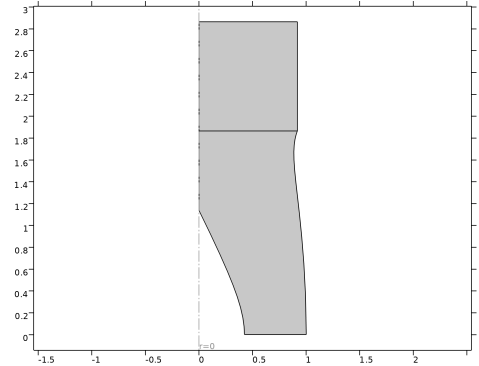
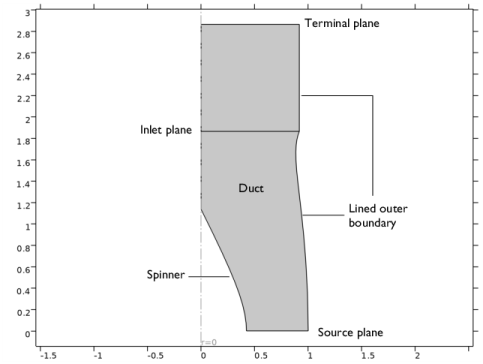
Depicted in Figure 1, the setup and geometry of this model closely follow those of the Flow Duct model. Specifically, this model is only solved for the condition with a liner (impedance condition) on the outer boundary of the flow duct.
Figure 1: Schematic of the flow duct geometry including reference planes.
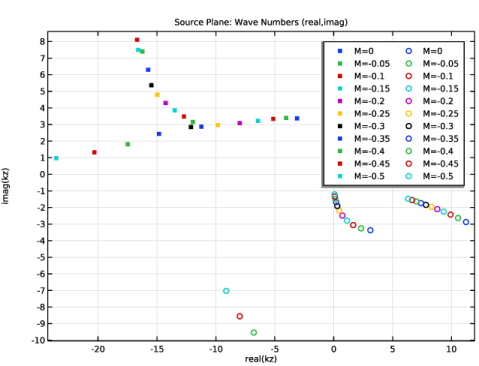
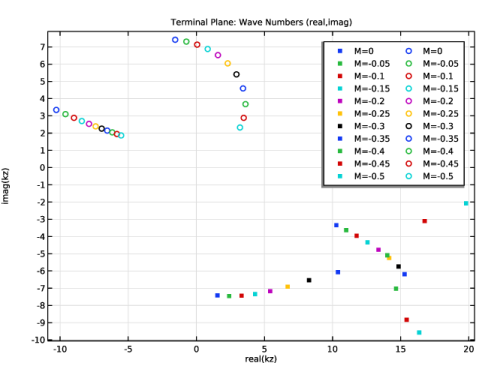
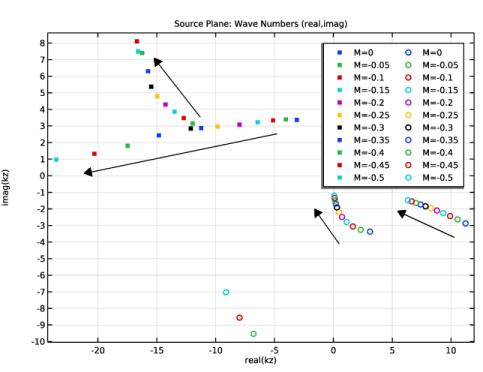
Moreover, the modes that are used for the Port boundary conditions are also computed including the impedance condition. In the Flow Duct model, the modes are computed for the hard-wall condition. To study the dynamics of the out-of-plane wave number in the complex plane, the background mean flow is solved for several different Mach numbers M. An example of such a plot for the source plane is depicted in Figure 2.
Figure 2: Dynamics of the out-of-plane wave number in the complex plane for increasing background mean flow Mach number.
In Figure 2, the location of the out-of-plane wave number in the complex plane is depicted for a range of Mach numbers M (increasing values in the direction of the arrows). Moreover, different symbols are used for the modes that are incoming and outgoing, or rather the symbols indicate if the mode is moving in the positive or negative z direction. The condition is based on the sign of the integral of the axial component of the intensity vector:
(1)
where I is the intensity vector and ez is the unit vector in the axial direction. In Figure 2, the dots represent modes propagating in the positive direction (incoming at the source plane), whereas circles are modes propagating in the negative direction (outgoing at the source plane).
Just like for the Flow Duct model, one of the configurations from Ref. 1 is studied here. This is the case in which the dimensionless angular frequency (nondimensionalized through division by R/c) is ω = 16, and the azimuthal mode number is m = 10. If you want to obtain a deeper understanding of the duct’s aeroacoustic characteristics, you can, of course, perform a systematic exploration of the parameter space by varying these quantities independently. Several additional cases are examined in the reference paper.
Results and Discussion
The Mean-Flow Field
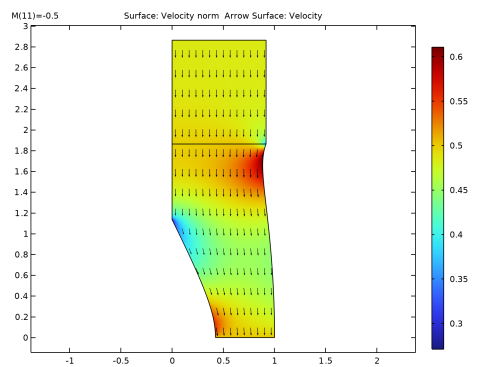
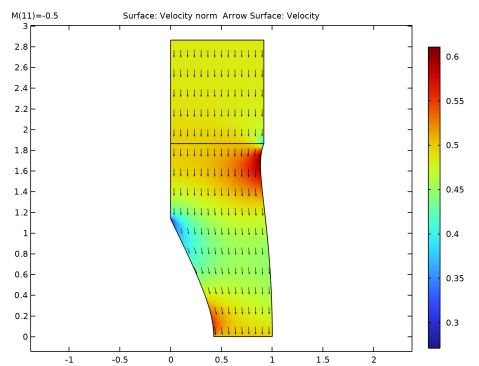
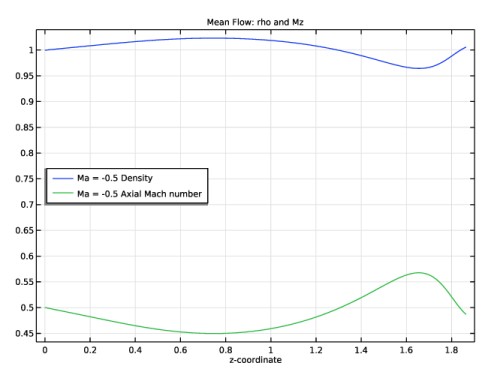
The mean flow velocity for M = −0.5 is depicted in Figure 3.
Figure 3: Mean flow velocity field.
Source and Terminal Plane Modes
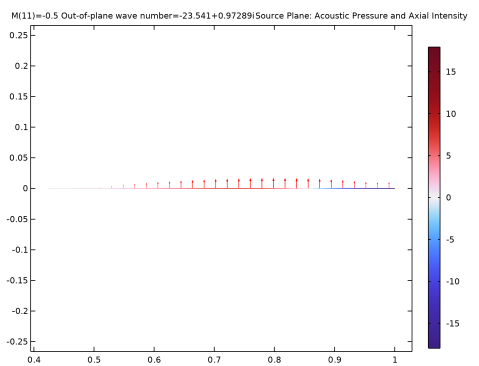
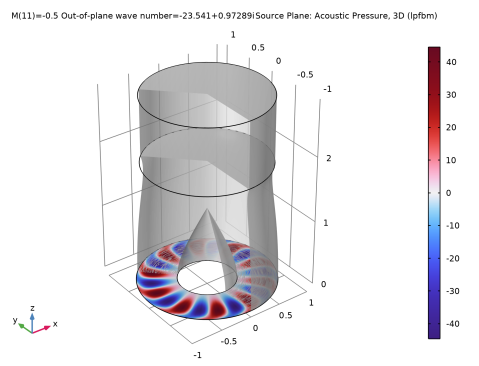
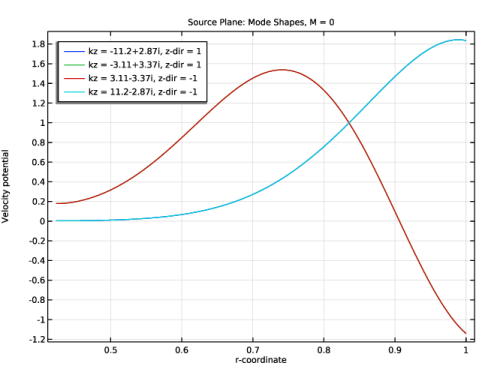
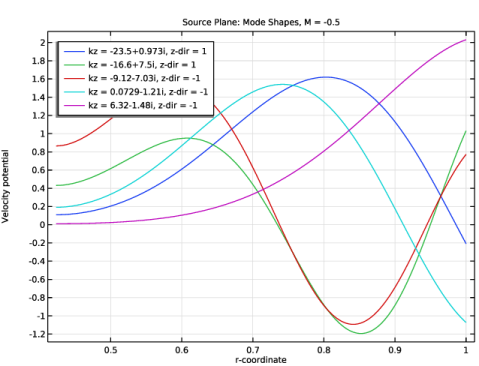
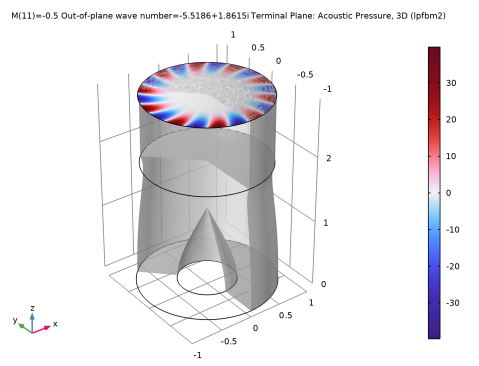
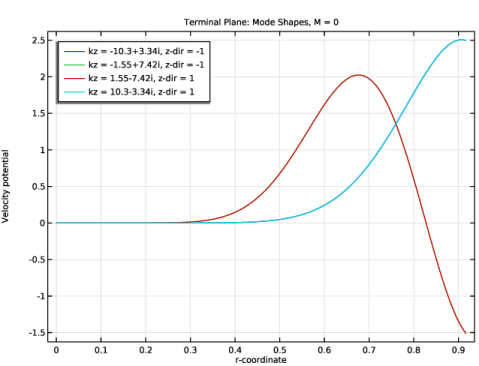
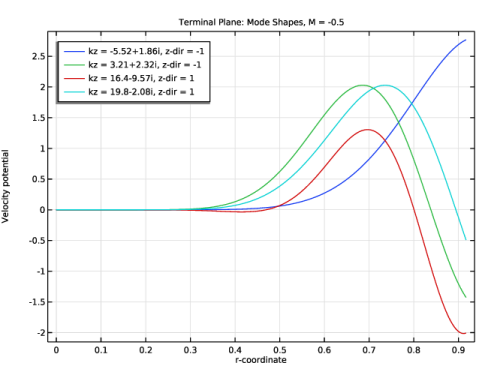
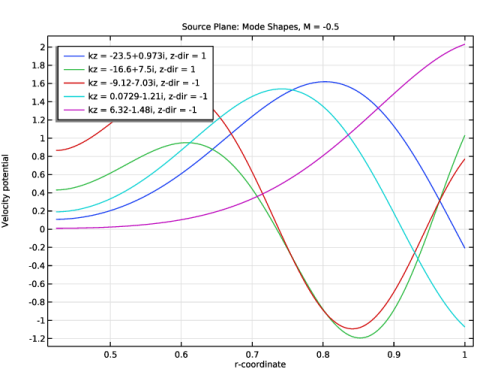
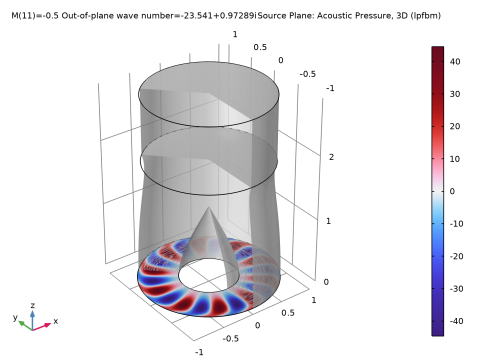
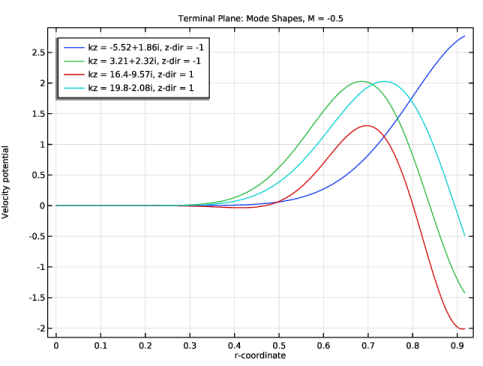
The source plane modes are represented in a 2D plot in Figure 4 for the azimuthal angle zero. The plot also includes a legend that shows the axial propagation direction. The first radial mode used to excite the system is represented in Figure 5 in the revolved geometry including the azimuthal dependency. Finally, the propagating modes at the terminal plane are depicted in Figure 6, again in a 2D plot for the azimuthal angle zero.
Figure 4: The source plane modes shapes (2D representation for azimuthal angle 0). The legend shows if the propagation direction is in the positive (incident) or negative (outgoing) axial direction.
Figure 5: First radial (incident) mode used to excite the system at the source plane, here represented in the revolved geometry including the azimuthal dependency.
Figure 6: The terminal plane modes shapes (2D representation for azimuthal angle 0). The legend shows if the propagation direction is in the positive (outgoing) or negative (incident) axial direction.
The Aeroacoustic Field
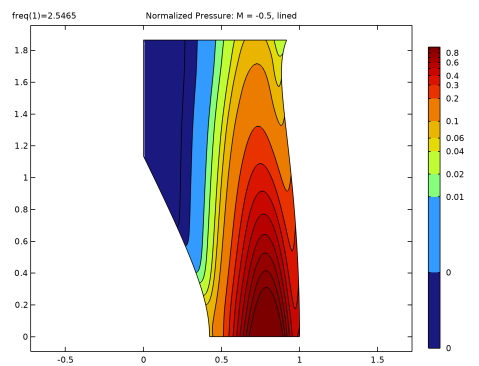
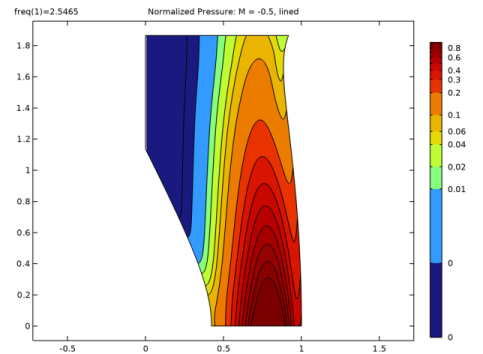
The normalized pressure fields, for the lined case with a background mean flow (M = −0.5), shown in Figure 7, very closely match those for the corresponding finite-element-model (FEM) solutions presented in Figure 6 of  Ref. 1. Similarly, the results for the attenuation between the source and inlet planes in the lined-wall case are in good agreement: 26.60 dB for the COMSOL Multiphysics solution versus 27.20 dB for the FEM solution, as shown in Table 1 in Ref. 1. This agreement is slightly better than for the results presented in the Flow Duct tutorial (computed to be 28.0 dB), where the modes are computed based on the hard wall.
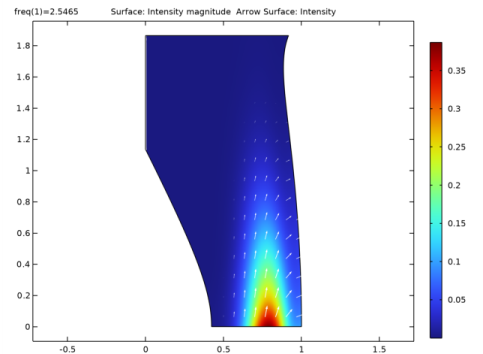
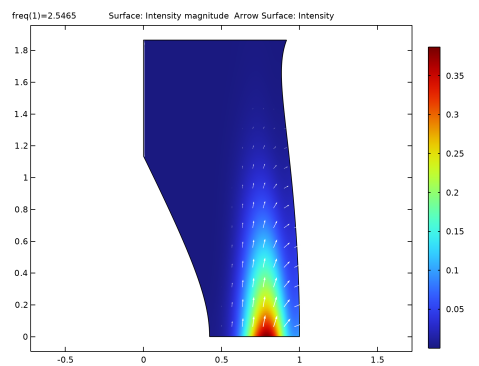
Finally, the acoustic intensity magnitude and normalized direction is depicted in Figure 8. The figure shows that there is no mismatch between the imposed acoustic field at the source plane and the lined boundary. In the case where the computed modes do not match the boundary conditions perfectly, a small accommodation length is necessary.
Figure 7: Normalized acoustic pressure field for the lined configuration studied here.
Figure 8: Acoustic intensity magnitude and direction.
Notes About the COMSOL Implementation
Referencing the Acoustic Modes at the Ports
The modes computed at the source plane and the terminal plane with the boundary mode interfaces need to be referenced and used by the port conditions. This is achieved by using the withsol() operator. The operator is called with a solution tag, referencing which solution it should look at. Here the tag used depends on if the model is solved at the source ('sol3') or the terminal planes ('sol7'). The input is the variable needed, for example, phi_sp for the source plane potential or lpfbm.kn for the source plane mode wave-number. Finally, the operator is called with two arguments using setval() to reference if the Mach number M is 0 or -0.5; and using setind() to set the solution index of the mode (of the eigenvalue lambda). For the index, it is the number of the eigenvalue in the solution object. Note that lambda is always used as the internal eigenvalue variable in COMSOL Multiphysics.
Reference
1. S.W. Rienstra and W. Eversman, “A Numerical Comparison Between the Multiple-Scales and Finite-Element Solution for Sound Propagation in Lined Flow Ducts,” J. Fluid Mech., vol. 437, pp. 367–384, 2001.
Application Library path: Acoustics_Module/Aeroacoustics_and_Noise/flow_duct_impedance
Modeling Instructions
From the File menu, choose New.
New
In the New window, click  Model Wizard.
Model Wizard
1
In the Model Wizard window, click  2D Axisymmetric.
2
In the Select Physics tree, select Acoustics > Aeroacoustics > Compressible Potential Flow (cpf).
3
Click Add.
4
In the Select Physics tree, select Acoustics > Aeroacoustics > Linearized Potential Flow, Boundary Mode (lpfbm).
5
Click Add.
6
In the Velocity potential (m²/s) text field, type phi_sp.
Here _sp stands for source plane.
7
In the Select Physics tree, select Acoustics > Aeroacoustics > Linearized Potential Flow, Boundary Mode (lpfbm).
8
Click Add.
9
In the Velocity potential (m²/s) text field, type phi_tp.
Here _tp stands for terminal plane.
10
In the Select Physics tree, select Acoustics > Aeroacoustics > Linearized Potential Flow, Frequency Domain (lpff).
11
Click Add.
12
Click  Study.
13
In the Select Study tree, select Preset Studies for Some Physics Interfaces > Stationary.
14
Root
1
In the Model Builder window, click the root node.
2
In the root node’s Settings window, locate the Unit System section.
3
From the Unit system list, choose None.
This setting turns off all unit support in the model.
Global Definitions
Parameters 1
Load the parameters from a file. They define model, geometry, and physical properties including the liner impedance. Then proceed and create the geometry of the duct.
1
In the Model Builder window, under Global Definitions click Parameters 1.
2
In the Settings window for Parameters, locate the Parameters section.
3
Click  Load from File.
4
Proceed and draw the geometry of the engine duct. Use the Parametric Curve features to draw the shapes defined by the functions described in the main document.
Geometry 1
Parametric Curve 1 (pc1)
1
In the Geometry toolbar, click  More Primitives and choose Parametric Curve.
2
In the Settings window for Parametric Curve, locate the Expressions section.
3
In the r text field, type 1-0.18453*s^2+0.10158*(exp(-11*(1-s))-exp(-11))/(1-exp(-11)).
4
In the z text field, type s*zi.
Parametric Curve 2 (pc2)
1
In the Geometry toolbar, click  More Primitives and choose Parametric Curve.
2
In the Settings window for Parametric Curve, locate the Parameter section.
3
In the Maximum text field, type 0.7.
4
Locate the Expressions section. In the r text field, type 0.64212-sqrt(0.04777+0.98234*s^2).
5
In the z text field, type s*zi.
Line Segment 1 (ls1)
1
In the Geometry toolbar, click  More Primitives and choose Line Segment.
2
In the Settings window for Line Segment, locate the Starting Point section.
3
From the Specify list, choose Coordinates.
4
Locate the Endpoint section. From the Specify list, choose Coordinates.
5
In the z text field, type zi.
Union 1 (uni1)
1
In the Geometry toolbar, click  Booleans and Partitions and choose Union.
2
Select the objects ls1 and pc2 only.
Line Segment 2 (ls2)
1
In the Geometry toolbar, click  More Primitives and choose Line Segment.
2
In the Settings window for Line Segment, locate the Starting Point section.
3
Click to select the  Activate Selection toggle button for Start vertex.
4
On the object uni1, select Point 5 only.
5
Locate the Endpoint section. Click to select the  Activate Selection toggle button for End vertex.
6
On the object pc1, select Point 1 only.
Line Segment 3 (ls3)
1
In the Geometry toolbar, click  More Primitives and choose Line Segment.
2
On the object uni1, select Point 4 only.
3
In the Settings window for Line Segment, locate the Endpoint section.
4
Click to select the  Activate Selection toggle button for End vertex.
5
On the object pc1, select Point 2 only.
6
In the Geometry toolbar, click  Build All.
Delete Entities 1 (del1)
1
In the Model Builder window, right-click Geometry 1 and choose Delete Entities.
2
On the object uni1, select Boundaries 1 and 3 only.
3
In the Settings window for Delete Entities, click  Build Selected.
Convert to Solid 1 (csol1)
1
In the Geometry toolbar, click  Conversions and choose Convert to Solid.
2
Click in the Graphics window and then press Ctrl+D to clear all objects.
3
Click the  Select All button in the Graphics toolbar.
Rectangle 1 (r1)
1
In the Geometry toolbar, click  Rectangle.
2
In the Settings window for Rectangle, locate the Size and Shape section.
3
In the Width text field, type ri.
4
Locate the Position section. In the z text field, type zi.
Form Union (fin)
1
In the Geometry toolbar, click  Build All.
2
Click the  Zoom Extents button in the Graphics toolbar.
3
In the Model Builder window, click Form Union (fin).
Proceed and set up variables used for the results analysis. One is a normalized absolute pressure which uses a maximum operator over the domain. Define selections for the source, inlet and terminal planes. Finally, define an integration operator used to compute the power through the inlet plane.
Definitions
Variables 1
1
In the Model Builder window, under Component 1 (comp1) right-click Definitions and choose Variables.
2
In the Settings window for Variables, locate the Geometric Entity Selection section.
3
From the Geometric entity level list, choose Domain.
4
5
Locate the Variables section. In the table, enter the following settings:
Source Plane
1
In the Definitions toolbar, click  Explicit.
2
In the Settings window for Explicit, type Source Plane in the Label text field.
3
Locate the Input Entities section. From the Geometric entity level list, choose Boundary.
4
Inlet Plane
1
In the Definitions toolbar, click  Explicit.
2
In the Settings window for Explicit, type Inlet Plane in the Label text field.
3
Locate the Input Entities section. From the Geometric entity level list, choose Boundary.
4
Terminal Plane
1
In the Definitions toolbar, click  Explicit.
2
In the Settings window for Explicit, type Terminal Plane in the Label text field.
3
Locate the Input Entities section. From the Geometric entity level list, choose Boundary.
4
Maximum 1 (maxop1)
1
In the Definitions toolbar, click  Nonlocal Couplings and choose Maximum.
2
Integration 1 (intop1)
1
In the Definitions toolbar, click  Nonlocal Couplings and choose Integration.
2
In the Settings window for Integration, type intop_ip in the Operator name text field.
3
Locate the Source Selection section. From the Geometric entity level list, choose Boundary.
4
From the Selection list, choose Inlet Plane.
Integration 2 (intop2)
1
In the Definitions toolbar, click  Nonlocal Couplings and choose Integration.
2
In the Settings window for Integration, type intop_sp in the Operator name text field.
3
Locate the Source Selection section. From the Geometric entity level list, choose Boundary.
4
From the Selection list, choose Source Plane.
Integration 3 (intop3)
1
In the Definitions toolbar, click  Nonlocal Couplings and choose Integration.
2
In the Settings window for Integration, type intop_tp in the Operator name text field.
3
Locate the Source Selection section. From the Geometric entity level list, choose Boundary.
4
From the Selection list, choose Terminal Plane.
Now proceed and set up the physics for the Compressible Potential Flow as well as the two Boundary Mode interfaces. The latter two are used to compute the propagating modes at the source and the terminal planes. The modes are used in the Port boundary conditions used for the frequency domain analysis.
Compressible Potential Flow (cpf)
1
In the Model Builder window, under Component 1 (comp1) click Compressible Potential Flow (cpf).
2
In the Settings window for Compressible Potential Flow, locate the Reference Values section.
3
In the pref text field, type cpf.rhoref^gamma/gamma.
4
In the ρref text field, type rho0.
5
In the vref text field, type M.
Compressible Potential Flow Model 1
1
In the Model Builder window, under Component 1 (comp1) > Compressible Potential Flow (cpf) click Compressible Potential Flow Model 1.
2
In the Settings window for Compressible Potential Flow Model, locate the Compressible Potential Flow Model section.
3
From the γ list, choose User defined. In the associated text field, type gamma.
Normal Flow 1
1
In the Physics toolbar, click  Boundaries and choose Normal Flow.
2
In the Settings window for Normal Flow, locate the Boundary Selection section.
3
From the Selection list, choose Terminal Plane.
Mass Flow 1
1
In the Physics toolbar, click  Boundaries and choose Mass Flow.
2
In the Settings window for Mass Flow, locate the Boundary Selection section.
3
From the Selection list, choose Source Plane.
Linearized Potential Flow, Boundary Mode (lpfbm)
1
In the Model Builder window, under Component 1 (comp1) click Linearized Potential Flow, Boundary Mode (lpfbm).
2
In the Settings window for Linearized Potential Flow, Boundary Mode, locate the Boundary Selection section.
3
From the Selection list, choose Source Plane.
4
Locate the Linearized Potential Flow Equation Settings section. In the m text field, type m.
Linearized Potential Flow Model 1
1
In the Model Builder window, under Component 1 (comp1) > Linearized Potential Flow, Boundary Mode (lpfbm) click Linearized Potential Flow Model 1.
2
In the Settings window for Linearized Potential Flow Model, locate the Model Input section.
3
From the u0 list, choose Velocity (cpf/cpf1).
4
Locate the Fluid Properties section. From the ρ0 list, choose Density (cpf).
5
From the c0 list, choose Speed of sound (cpf/cpf1).
Impedance 1
1
In the Physics toolbar, click  Points and choose Impedance.
2
3
In the Settings window for Impedance, locate the Impedance section.
4
In the Zn text field, type Zw.
Linearized Potential Flow, Boundary Mode 2 (lpfbm2)
1
In the Model Builder window, under Component 1 (comp1) click Linearized Potential Flow, Boundary Mode 2 (lpfbm2).
2
In the Settings window for Linearized Potential Flow, Boundary Mode, locate the Boundary Selection section.
3
From the Selection list, choose Terminal Plane.
4
Locate the Linearized Potential Flow Equation Settings section. In the m text field, type m.
Linearized Potential Flow Model 1
1
In the Model Builder window, under Component 1 (comp1) > Linearized Potential Flow, Boundary Mode 2 (lpfbm2) click Linearized Potential Flow Model 1.
2
In the Settings window for Linearized Potential Flow Model, locate the Model Input section.
3
From the u0 list, choose Velocity (cpf/cpf1).
4
Locate the Fluid Properties section. From the ρ0 list, choose Density (cpf).
5
From the c0 list, choose Speed of sound (cpf/cpf1).
Impedance 1
1
In the Physics toolbar, click  Points and choose Impedance.
2
3
In the Settings window for Impedance, locate the Impedance section.
4
In the Zn text field, type Zw.
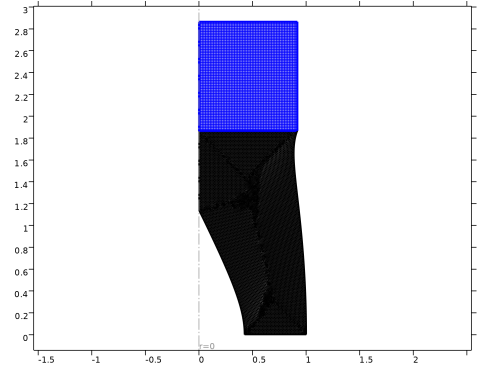
Set up a fully user defined mesh for the computational domain.
Mesh 1
Free Triangular 1
1
In the Mesh toolbar, click  Free Triangular.
2
In the Settings window for Free Triangular, locate the Domain Selection section.
3
From the Geometric entity level list, choose Domain.
4
Size 1
1
Right-click Free Triangular 1 and choose Size.
2
In the Settings window for Size, locate the Element Size section.
3
Click the Custom button.
4
Locate the Geometric Entity Selection section. From the Geometric entity level list, choose Point.
5
6
Locate the Element Size Parameters section.
7
Select the Maximum element size checkbox. In the associated text field, type 0.005.
Size
1
In the Model Builder window, under Component 1 (comp1) > Mesh 1 click Size.
2
In the Settings window for Size, locate the Element Size section.
3
Click the Custom button.
4
Locate the Element Size Parameters section. In the Maximum element size text field, type 0.015.
5
In the Minimum element size text field, type 0.001.
Mapped 1
1
In the Mesh toolbar, click  Mapped.
2
In the Settings window for Mapped, click  Build All.
Now, first solve the background flow and look at the results. The flow is solved for several Mach numbers using a Parametric Sweep.
Study 1 - Background Flow
1
In the Model Builder window, click Study 1.
2
In the Settings window for Study, type Study 1 - Background Flow in the Label text field.
Parametric Sweep
1
In the Study toolbar, click  Parametric Sweep.
2
In the Settings window for Parametric Sweep, locate the Study Settings section.
3
4
5
In the Study toolbar, click  Compute.
Results
Arrow Surface 1
1
Right-click Mean Flow Velocity (cpf) and choose Arrow Surface.
2
In the Settings window for Arrow Surface, locate the Coloring and Style section.
3
From the Color list, choose Black.
4
In the Mean Flow Velocity (cpf) toolbar, click  Plot.
Cut Line 2D 1
1
In the Results toolbar, click  Cut Line 2D.
2
In the Settings window for Cut Line 2D, locate the Line Data section.
3
In row Point 1, set R to 0.8.
4
In row Point 2, set R to 0.8.
5
In row Point 2, set Z to zi.
Mean Flow: rho and Mz
1
In the Results toolbar, click  1D Plot Group.
2
In the Settings window for 1D Plot Group, type Mean Flow: rho and Mz in the Label text field.
3
Locate the Data section. From the Dataset list, choose Cut Line 2D 1.
4
From the Parameter selection (M) list, choose Last.
5
Click to expand the Title section. From the Title type list, choose Label.
6
Locate the Legend section. From the Position list, choose Middle left.
Line Graph 1
1
Right-click Mean Flow: rho and Mz and choose Line Graph.
2
In the Settings window for Line Graph, locate the y-Axis Data section.
3
In the Expression text field, type rho.
4
Locate the x-Axis Data section. From the Parameter list, choose Expression.
5
In the Expression text field, type z.
6
Click to expand the Legends section. Select the Show legends checkbox.
7
Find the Include subsection. Select the Description checkbox.
8
Find the Prefix and suffix subsection. In the Prefix text field, type Ma = .
9
In the Mean Flow: rho and Mz toolbar, click  Plot.
Line Graph 2
1
In the Model Builder window, right-click Mean Flow: rho and Mz and choose Line Graph.
2
In the Settings window for Line Graph, locate the y-Axis Data section.
3
In the Expression text field, type Mz.
4
Locate the x-Axis Data section. From the Parameter list, choose Expression.
5
In the Expression text field, type z.
6
Locate the Legends section. Select the Show legends checkbox.
7
Find the Include subsection. Select the Description checkbox.
8
Find the Prefix and suffix subsection. In the Prefix text field, type Ma = .
9
In the Mean Flow: rho and Mz toolbar, click  Plot.
Proceed to compute and analyze the mode shapes for the source plane. The Rectangle mode search method will be used to limit the range for the imaginary part of the out-of-plane wave number. The real part lies between -k0max_abs and +k0max_abs (the maximal absolute wave number) computed in the parameters list. Note that an additional small margin is used for the interval. A parametric sweep is also performed solving for all the Mach numbers.
Add Study
1
In the Home toolbar, click  Add Study to open the Add Study window.
2
Go to the Add Study window.
3
Find the Physics interfaces in study subsection. In the table, clear the Solve checkboxes for Compressible Potential Flow (cpf), Linearized Potential Flow, Boundary Mode 2 (lpfbm2), and Linearized Potential Flow, Frequency Domain (lpff).
4
Find the Studies subsection. In the Select Study tree, select Preset Studies for Selected Physics Interfaces > Mode Analysis.
5
Click the Add Study button in the window toolbar.
Study 2 - Source Plane Modes
In the Settings window for Study, type Study 2 - Source Plane Modes in the Label text field.
Parametric Sweep
1
In the Study toolbar, click  Parametric Sweep.
2
In the Settings window for Parametric Sweep, locate the Study Settings section.
3
4
Step 1: Mode Analysis
1
In the Model Builder window, click Step 1: Mode Analysis.
2
In the Settings window for Mode Analysis, locate the Study Settings section.
3
In the Mode analysis frequency text field, type f.
4
From the Mode search method list, choose Rectangle.
5
In the Approximate number of modes text field, type 10.
6
In the Maximum number of modes text field, type 20.
7
Find the Rectangle search region subsection. In the Smallest real part (Out-of-plane wave number) text field, type -1.1*k0max_abs.
8
In the Largest real part (Out-of-plane wave number) text field, type 1.1*k0max_abs.
9
In the Smallest imaginary part (Out-of-plane wave number) text field, type -10.
10
In the Largest imaginary part (Out-of-plane wave number) text field, type 10.
11
Click to expand the Values of Dependent Variables section. Find the Values of variables not solved for subsection. From the Settings list, choose User controlled.
12
From the Method list, choose Solution.
13
From the Study list, choose Study 1 - Background Flow, Stationary.
14
From the Solution list, choose Solution 1 (sol1).
Notice, in the Mode Analysis study step, the section called Filtering and Sorting. In this section, it is possible to filter out certain modes based on global expressions. It is also in this section that the sorting of the modes is controlled. In this model, they are arranged by ascending real part of the wave number (the default behavior).
15
In the Study toolbar, click  Compute.
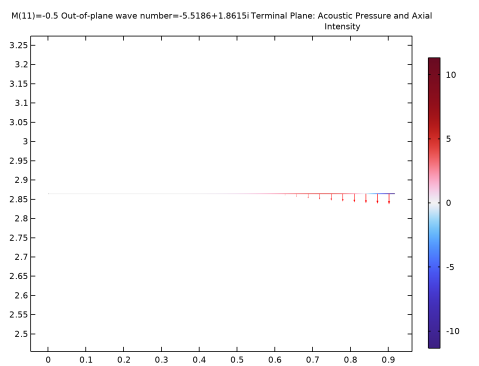
When setting up the Port boundary conditions, it is necessary to know which modes are outgoing and incident. Simply knowing the sign of the computed out-of-plane wave number is not enough when a background flow and impedance is present and when higher order azimuthal modes are analyzed. In this case, it is necessary to plot the axial intensity vector or compute its integral to identify the propagation directions. This is done by modifying the next default plot, here at the source plane.
Results
Source Plane: Acoustic Pressure and Axial Intensity
1
In the Settings window for 2D Plot Group, type Source Plane: Acoustic Pressure and Axial Intensity in the Label text field.
2
Click to expand the Selection section. From the Geometric entity level list, choose Boundary.
3
From the Selection list, choose Source Plane.
4
Select the Apply to dataset edges checkbox.
5
Click to expand the Title section. From the Title type list, choose Label.
Arrow Line 1
1
Right-click Source Plane: Acoustic Pressure and Axial Intensity and choose Arrow Line.
2
In the Settings window for Arrow Line, click Replace Expression in the upper-right corner of the Expression section. From the menu, choose Component 1 (comp1) > Linearized Potential Flow, Boundary Mode > Intensity > lpfbm.Ir,lpfbm.Iz - Intensity.
3
Locate the Expression section. In the R-component text field, type 0.
4
Locate the Arrow Positioning section. In the Number of arrows text field, type 30.
5
Locate the Coloring and Style section. From the Arrow length list, choose Logarithmic.
Source Plane: Acoustic Pressure and Axial Intensity
1
In the Model Builder window, click Source Plane: Acoustic Pressure and Axial Intensity.
2
In the Source Plane: Acoustic Pressure and Axial Intensity toolbar, click  Plot.
3
Click the  Zoom Extents button in the Graphics toolbar.
Revolution 2D 1
1
In the Model Builder window, under Results > Datasets click Revolution 2D 1.
2
In the Settings window for Revolution 2D, click to expand the Revolution Layers section.
3
From the Number of layers list, choose Fine.
The Azimuthal mode number option can be used when evaluating the dependent variable (the velocity potential). However, here we will evaluate the pressure. The azimuthal component will be added manually in the plot, using the defined phi variable.
Source Plane: Acoustic Pressure, 3D (lpfbm)
1
In the Model Builder window, under Results click Acoustic Pressure, 3D (lpfbm).
2
In the Settings window for 3D Plot Group, type Source Plane: Acoustic Pressure, 3D (lpfbm) in the Label text field.
3
Click to expand the Title section. From the Title type list, choose Label.
Surface 2
1
Right-click Source Plane: Acoustic Pressure, 3D (lpfbm) and choose Surface.
2
In the Settings window for Surface, locate the Data section.
3
From the Dataset list, choose Revolution 2D.
4
Locate the Expression section. In the Expression text field, type 1.
5
Locate the Coloring and Style section. From the Coloring list, choose Uniform.
6
From the Color list, choose Gray.
Selection 1
1
Right-click Surface 2 and choose Selection.
2
Click in the Graphics window and then press Ctrl+A to select both domains.
3
In the Settings window for Selection, locate the Revolution Selection section.
4
Clear the Evaluate the start cap checkbox.
5
Clear the Evaluate the end cap checkbox.
Transparency 1
1
In the Model Builder window, right-click Surface 2 and choose Transparency.
2
In the Settings window for Transparency, locate the Transparency section.
3
Find the Transparency subsection. Set the Transparency value to 0.2.
Surface
1
In the Model Builder window, under Results > Source Plane: Acoustic Pressure, 3D (lpfbm) click Surface.
2
In the Settings window for Surface, locate the Expression section.
3
In the Expression text field, type lpfbm.p*exp(-i*m*rev2phi).
Source Plane: Acoustic Pressure, 3D (lpfbm)
1
In the Model Builder window, click Source Plane: Acoustic Pressure, 3D (lpfbm).
2
In the Settings window for 3D Plot Group, locate the Data section.
3
From the Out-of-plane wave number list, choose -23.541+0.97289i.
4
In the Source Plane: Acoustic Pressure, 3D (lpfbm) toolbar, click  Plot.
This plot shows the first radial mode used to excite the system.
Next, set up a plot that shows the mode shapes at the source plane. To identify the propagation direction, the integral of the axial intensity over the boundary is computed. If it is negative (-1), the propagation is in the -z direction, and vice versa if it is positive (1).
Source Plane: Mode Shapes, M = 0
1
In the Results toolbar, click  1D Plot Group.
2
In the Settings window for 1D Plot Group, type Source Plane: Mode Shapes, M = 0 in the Label text field.
3
Locate the Data section. From the Dataset list, choose Study 2 - Source Plane Modes/Parametric Solutions 1 (sol3).
4
From the Parameter selection (M) list, choose First.
5
Click to expand the Title section. From the Title type list, choose Label.
6
Locate the Legend section. From the Position list, choose Upper left.
Line Graph 1
1
Right-click Source Plane: Mode Shapes, M = 0 and choose Line Graph.
2
In the Settings window for Line Graph, locate the Selection section.
3
From the Selection list, choose Source Plane.
4
Locate the y-Axis Data section. In the Expression text field, type phi_sp.
5
Locate the x-Axis Data section. From the Parameter list, choose Expression.
6
In the Expression text field, type r.
7
Click to expand the Legends section. Select the Show legends checkbox.
8
From the Legends list, choose Evaluated.
9
In the Legend text field, type kz = eval(lpfbm.kz), z-dir = eval(if(intop_sp(lpfbm.Iz)>0,1,-1)).
10
In the Source Plane: Mode Shapes, M = 0 toolbar, click  Plot.
Source Plane: Mode Shapes, M = -0.5
1
In the Model Builder window, right-click Source Plane: Mode Shapes, M = 0 and choose Duplicate.
2
In the Settings window for 1D Plot Group, type Source Plane: Mode Shapes, M = -0.5 in the Label text field.
3
Locate the Data section. From the Parameter selection (M) list, choose Last.
4
In the Source Plane: Mode Shapes, M = -0.5 toolbar, click  Plot.
Source Plane: Wave Numbers (real,imag)
1
In the Results toolbar, click  1D Plot Group.
2
In the Settings window for 1D Plot Group, type Source Plane: Wave Numbers (real,imag) in the Label text field.
3
Locate the Data section. From the Dataset list, choose Study 2 - Source Plane Modes/Parametric Solutions 1 (sol3).
4
Click to expand the Title section. From the Title type list, choose Label.
5
Locate the Plot Settings section.
6
Select the x-axis label checkbox. In the associated text field, type real(kz).
7
Select the y-axis label checkbox. In the associated text field, type imag(kz).
8
Locate the Legend section. In the Number of columns text field, type 2.
Global 1
1
Right-click Source Plane: Wave Numbers (real,imag) and choose Global.
2
In the Settings window for Global, locate the y-Axis Data section.
3
4
Locate the x-Axis Data section. From the Axis source data list, choose Inner solutions.
5
From the Parameter list, choose Expression.
6
In the Expression text field, type real(lpfbm.kn).
7
Click to expand the Coloring and Style section. Find the Line style subsection. From the Line list, choose None.
8
Find the Line markers subsection. From the Marker list, choose Point.
Filter 1
1
Right-click Global 1 and choose Filter.
2
In the Settings window for Filter, locate the Point Selection section.
3
In the Logical expression for inclusion text field, type intop_sp(lpfbm.Iz)>0.
Global 2
1
In the Model Builder window, under Results > Source Plane: Wave Numbers (real,imag) right-click Global 1 and choose Duplicate.
2
In the Settings window for Global, locate the Coloring and Style section.
3
From the Color list, choose Cycle (reset).
4
Find the Line markers subsection. From the Marker list, choose Circle.
Filter 1
1
In the Model Builder window, expand the Global 2 node, then click Filter 1.
2
In the Settings window for Filter, locate the Point Selection section.
3
In the Logical expression for inclusion text field, type intop_sp(lpfbm.Iz)<0.
4
In the Source Plane: Wave Numbers (real,imag) toolbar, click  Plot.
This plot shows the dynamics of the wave number in the complex plane for an increasing flow. The incident and outgoing modes have different symbols.
Now, proceed and set up the same analysis for the terminal plane, including study and results, as discussed above.
Add Study
1
In the Home toolbar, click  Add Study to open the Add Study window.
2
Go to the Add Study window.
3
Find the Physics interfaces in study subsection. In the table, clear the Solve checkboxes for Compressible Potential Flow (cpf), Linearized Potential Flow, Boundary Mode (lpfbm), and Linearized Potential Flow, Frequency Domain (lpff).
4
Find the Studies subsection. In the Select Study tree, select Preset Studies for Selected Physics Interfaces > Mode Analysis.
5
Click the Add Study button in the window toolbar.
Study 3 - Terminal Plane Modes
In the Settings window for Study, type Study 3 - Terminal Plane Modes in the Label text field.
Parametric Sweep
1
In the Study toolbar, click  Parametric Sweep.
2
In the Settings window for Parametric Sweep, locate the Study Settings section.
3
4
Step 1: Mode Analysis
1
In the Model Builder window, click Step 1: Mode Analysis.
2
In the Settings window for Mode Analysis, locate the Study Settings section.
3
In the Mode analysis frequency text field, type f.
4
From the Mode search method list, choose Rectangle.
5
In the Approximate number of modes text field, type 10.
6
In the Maximum number of modes text field, type 20.
7
Find the Rectangle search region subsection. In the Smallest real part (Out-of-plane wave number) text field, type -1.1*k0max_abs.
8
In the Largest real part (Out-of-plane wave number) text field, type 1.1*k0max_abs.
9
In the Smallest imaginary part (Out-of-plane wave number) text field, type -10.
10
In the Largest imaginary part (Out-of-plane wave number) text field, type 10.
11
Click to expand the Values of Dependent Variables section. Find the Values of variables not solved for subsection. From the Settings list, choose User controlled.
12
From the Method list, choose Solution.
13
From the Study list, choose Study 1 - Background Flow, Stationary.
14
From the Solution list, choose Solution 1 (sol1).
15
In the Study toolbar, click  Compute.
Results
Terminal Plane: Acoustic Pressure and Axial Intensity
1
In the Settings window for 2D Plot Group, type Terminal Plane: Acoustic Pressure and Axial Intensity in the Label text field.
2
Click to expand the Selection section. From the Geometric entity level list, choose Boundary.
3
From the Selection list, choose Terminal Plane.
4
Select the Apply to dataset edges checkbox.
5
Click to expand the Title section. From the Title type list, choose Label.
Arrow Line 1
1
Right-click Terminal Plane: Acoustic Pressure and Axial Intensity and choose Arrow Line.
2
In the Settings window for Arrow Line, click Replace Expression in the upper-right corner of the Expression section. From the menu, choose Component 1 (comp1) > Linearized Potential Flow, Boundary Mode 2 > Intensity > lpfbm2.Ir,lpfbm2.Iz - Intensity.
3
Locate the Expression section. In the R-component text field, type 0.
4
Locate the Arrow Positioning section. In the Number of arrows text field, type 30.
5
Locate the Coloring and Style section. From the Arrow length list, choose Logarithmic.
Terminal Plane: Acoustic Pressure and Axial Intensity
1
In the Model Builder window, click Terminal Plane: Acoustic Pressure and Axial Intensity.
2
In the Terminal Plane: Acoustic Pressure and Axial Intensity toolbar, click  Plot.
3
Click the  Zoom Extents button in the Graphics toolbar.
Revolution 2D 2
1
In the Model Builder window, under Results > Datasets click Revolution 2D 2.
2
In the Settings window for Revolution 2D, click to expand the Revolution Layers section.
3
From the Number of layers list, choose Fine.
Terminal Plane: Acoustic Pressure, 3D (lpfbm2)
1
In the Model Builder window, under Results click Acoustic Pressure, 3D (lpfbm2).
2
In the Settings window for 3D Plot Group, type Terminal Plane: Acoustic Pressure, 3D (lpfbm2) in the Label text field.
3
Click to expand the Title section. From the Title type list, choose Label.
Surface 2
1
Right-click Terminal Plane: Acoustic Pressure, 3D (lpfbm2) and choose Surface.
2
In the Settings window for Surface, locate the Data section.
3
From the Dataset list, choose Revolution 2D.
4
Locate the Expression section. In the Expression text field, type 1.
5
Locate the Coloring and Style section. From the Coloring list, choose Uniform.
6
From the Color list, choose Gray.
Selection 1
1
Right-click Surface 2 and choose Selection.
2
Click in the Graphics window and then press Ctrl+A to select both domains.
3
In the Settings window for Selection, locate the Revolution Selection section.
4
Clear the Evaluate the start cap checkbox.
5
Clear the Evaluate the end cap checkbox.
Transparency 1
1
In the Model Builder window, right-click Surface 2 and choose Transparency.
2
In the Settings window for Transparency, locate the Transparency section.
3
Find the Transparency subsection. Set the Transparency value to 0.2.
Surface
1
In the Model Builder window, under Results > Terminal Plane: Acoustic Pressure, 3D (lpfbm2) click Surface.
2
In the Settings window for Surface, locate the Expression section.
3
In the Expression text field, type lpfbm2.p*exp(-i*m*rev3phi).
4
In the Terminal Plane: Acoustic Pressure, 3D (lpfbm2) toolbar, click  Plot.
Terminal Plane: Mode Shapes, M = 0
1
In the Results toolbar, click  1D Plot Group.
2
In the Settings window for 1D Plot Group, type Terminal Plane: Mode Shapes, M = 0 in the Label text field.
3
Locate the Data section. From the Dataset list, choose Study 3 - Terminal Plane Modes/Parametric Solutions 2 (sol16).
4
From the Parameter selection (M) list, choose First.
5
Click to expand the Title section. From the Title type list, choose Label.
6
Locate the Legend section. From the Position list, choose Upper left.
Line Graph 1
1
Right-click Terminal Plane: Mode Shapes, M = 0 and choose Line Graph.
2
In the Settings window for Line Graph, locate the Selection section.
3
From the Selection list, choose Terminal Plane.
4
Locate the y-Axis Data section. In the Expression text field, type phi_tp.
5
Locate the x-Axis Data section. From the Parameter list, choose Expression.
6
In the Expression text field, type r.
7
Click to expand the Legends section. Select the Show legends checkbox.
8
From the Legends list, choose Evaluated.
9
In the Legend text field, type kz = eval(lpfbm2.kz), z-dir = eval(if(intop_tp(lpfbm2.Iz)>0,1,-1)).
10
In the Terminal Plane: Mode Shapes, M = 0 toolbar, click  Plot.
Terminal Plane: Mode Shapes, M = -0.5
1
In the Model Builder window, right-click Terminal Plane: Mode Shapes, M = 0 and choose Duplicate.
2
In the Settings window for 1D Plot Group, type Terminal Plane: Mode Shapes, M = -0.5 in the Label text field.
3
Locate the Data section. From the Parameter selection (M) list, choose Last.
4
In the Terminal Plane: Mode Shapes, M = -0.5 toolbar, click  Plot.
Terminal Plane: Wave Numbers (real,imag)
1
In the Results toolbar, click  1D Plot Group.
2
In the Settings window for 1D Plot Group, type Terminal Plane: Wave Numbers (real,imag) in the Label text field.
3
Locate the Data section. From the Dataset list, choose Study 3 - Terminal Plane Modes/Parametric Solutions 2 (sol16).
4
Click to expand the Title section. From the Title type list, choose Label.
5
Locate the Plot Settings section.
6
Select the x-axis label checkbox. In the associated text field, type real(kz).
7
Select the y-axis label checkbox. In the associated text field, type imag(kz).
8
Locate the Legend section. In the Number of columns text field, type 2.
Global 1
1
Right-click Terminal Plane: Wave Numbers (real,imag) and choose Global.
2
In the Settings window for Global, locate the y-Axis Data section.
3
4
Locate the x-Axis Data section. From the Axis source data list, choose Inner solutions.
5
From the Parameter list, choose Expression.
6
In the Expression text field, type real(lpfbm2.kn).
7
Click to expand the Coloring and Style section. Find the Line style subsection. From the Line list, choose None.
8
Find the Line markers subsection. From the Marker list, choose Point.
Filter 1
1
Right-click Global 1 and choose Filter.
2
In the Settings window for Filter, locate the Point Selection section.
3
In the Logical expression for inclusion text field, type intop_tp(lpfbm2.Iz)>0.
Global 2
1
In the Model Builder window, under Results > Terminal Plane: Wave Numbers (real,imag) right-click Global 1 and choose Duplicate.
2
In the Settings window for Global, locate the Coloring and Style section.
3
From the Color list, choose Cycle (reset).
4
Find the Line markers subsection. From the Marker list, choose Circle.
Filter 1
1
In the Model Builder window, expand the Global 2 node, then click Filter 1.
2
In the Settings window for Filter, locate the Point Selection section.
3
In the Logical expression for inclusion text field, type intop_tp(lpfbm2.Iz)<0.
4
In the Terminal Plane: Wave Numbers (real,imag) toolbar, click  Plot.
Finally, set up the physics and boundary conditions for the Linearized Potential Flow, Frequency Domain physics interface. Of particular importance is the set up of the Port conditions. The ports are divided into those applied at the source and terminal planes. To reference the mode shapes and wave numbers, the withsol() operator is used. Using the setval() and setind() statements, it is possible to pick the desired mode.
Linearized Potential Flow, Frequency Domain (lpff)
1
In the Model Builder window, under Component 1 (comp1) click Linearized Potential Flow, Frequency Domain (lpff).
2
In the Settings window for Linearized Potential Flow, Frequency Domain, locate the Linearized Potential Flow Equation Settings section.
3
In the m text field, type m.
4
Locate the Global Port Settings section. From the Mode shape normalization list, choose Power normalization.
Multiphysics
Background Potential Flow Coupling 1 (pfc1)
In the Physics toolbar, click  Multiphysics Couplings and choose Global > Background Potential Flow Coupling.
Linearized Potential Flow, Frequency Domain (lpff)
Impedance 1
1
In the Physics toolbar, click  Boundaries and choose Impedance.
2
3
In the Settings window for Impedance, locate the Impedance section.
4
In the Zn text field, type Zw.
Source Plane
1
In the Model Builder window, right-click Linearized Potential Flow, Frequency Domain (lpff) and choose Node Group.
2
In the Settings window for Group, type Source Plane in the Label text field.
Port 1
1
In the Physics toolbar, click  Boundaries and choose Port.
The two outgoing modes (propagating in the negative z direction) have index number 4 and 5, as can be seen in the Source Plane: Mode Shapes, M = -0.5 plot. The other outgoing mode, that is solved for, has index number 3. This mode is a convected evanescent mode. This is more clearly seen in the Source Plane: Wave Numbers (real,imag) plot, where the mode appears.
2
In the Settings window for Port, locate the Boundary Selection section.
3
From the Selection list, choose Source Plane.
4
Locate the Port Outgoing Mode Settings section. In the ϕnout text field, type withsol('sol3',phi_sp,setval(M,-0.5),setind(lambda,5)).
5
In the knout text field, type withsol('sol3',lpfbm.kn,setval(M,-0.5),setind(lambda,5)).
6
Locate the Port Incident Mode Settings section. From the Incident wave excitation at this port list, choose On.
7
In the ϕnin text field, type withsol('sol3',phi_sp,setval(M,-0.5),setind(lambda,1)).
8
In the knin text field, type withsol('sol3',lpfbm.kn,setval(M,-0.5),setind(lambda,1)).
9
From the Define incident wave list, choose Mode scale.
10
In the Sin text field, type 1.
Port 2
1
In the Physics toolbar, click  Boundaries and choose Port.
2
In the Settings window for Port, locate the Boundary Selection section.
3
From the Selection list, choose Source Plane.
4
Locate the Port Outgoing Mode Settings section. In the ϕnout text field, type withsol('sol3',phi_sp,setval(M,-0.5),setind(lambda,4)).
5
In the knout text field, type withsol('sol3',lpfbm.kn,setval(M,-0.5),setind(lambda,4)).
Terminal Plane
1
Right-click Linearized Potential Flow, Frequency Domain (lpff) and choose Node Group.
2
In the Settings window for Group, type Terminal Plane in the Label text field.
Port 3
1
In the Physics toolbar, click  Boundaries and choose Port.
2
In the Settings window for Port, locate the Boundary Selection section.
3
From the Selection list, choose Terminal Plane.
4
Locate the Port Outgoing Mode Settings section. In the ϕnout text field, type withsol('sol16',phi_tp,setval(M,-0.5),setind(lambda,3)).
5
In the knout text field, type withsol('sol16',lpfbm2.kn,setval(M,-0.5),setind(lambda,3)).
Port 4
1
In the Physics toolbar, click  Boundaries and choose Port.
2
In the Settings window for Port, locate the Boundary Selection section.
3
From the Selection list, choose Terminal Plane.
4
Locate the Port Outgoing Mode Settings section. In the ϕnout text field, type withsol('sol16',phi_tp,setval(M,-0.5),setind(lambda,4)).
5
In the knout text field, type withsol('sol16',lpfbm2.kn,setval(M,-0.5),setind(lambda,4)).
Solve the frequency domain model for the flow (M = -0.5) cases with liner (finite impedance). Then analyze the results.
Add Study
1
In the Home toolbar, click  Add Study to open the Add Study window.
2
Go to the Add Study window.
3
Find the Physics interfaces in study subsection. In the table, clear the Solve checkboxes for Compressible Potential Flow (cpf), Linearized Potential Flow, Boundary Mode (lpfbm), and Linearized Potential Flow, Boundary Mode 2 (lpfbm2).
4
Find the Studies subsection. In the Select Study tree, select General Studies > Frequency Domain.
5
Click the Add Study button in the window toolbar.
Study 4 - Frequency Domain (M = -0.5, lined)
In the Settings window for Study, type Study 4 - Frequency Domain (M = -0.5, lined) in the Label text field.
Step 1: Frequency Domain
1
In the Model Builder window, under Study 4 - Frequency Domain (M = -0.5, lined) click Step 1: Frequency Domain.
2
In the Settings window for Frequency Domain, locate the Study Settings section.
3
In the Frequencies text field, type f.
4
Click to expand the Values of Dependent Variables section. Find the Values of variables not solved for subsection. From the Settings list, choose User controlled.
5
From the Method list, choose Solution.
6
From the Study list, choose Study 1 - Background Flow, Stationary.
7
From the Parameter value (M) list, choose Last.
8
In the Model Builder window, click Study 4 - Frequency Domain (M = -0.5, lined).
9
In the Settings window for Study, locate the Study Settings section.
10
Clear the Generate default plots checkbox.
11
In the Study toolbar, click  Compute.
Results
Normalized Pressure: M = -0.5, lined
1
In the Results toolbar, click  2D Plot Group.
2
In the Settings window for 2D Plot Group, type Normalized Pressure: M = -0.5, lined in the Label text field.
3
Locate the Data section. From the Dataset list, choose Study 4 - Frequency Domain (M = -0.5, lined)/Solution 28 (sol28).
4
Click to expand the Selection section. From the Geometric entity level list, choose Domain.
5
6
Select the Apply to dataset edges checkbox.
7
Click to expand the Title section. From the Title type list, choose Label.
Contour 1
1
Right-click Normalized Pressure: M = -0.5, lined and choose Contour.
2
In the Settings window for Contour, locate the Expression section.
3
In the Expression text field, type pabsn.
4
Locate the Levels section. From the Entry method list, choose Levels.
5
In the Levels text field, type 0.0001 0.001 0.01 0.02 0.04 0.06 0.1 0.2 0.3 0.4 0.5 0.6 0.7 0.8 0.9.
6
Locate the Coloring and Style section. From the Contour type list, choose Filled.
7
From the Scale list, choose Logarithmic.
8
In the Normalized Pressure: M = -0.5, lined toolbar, click  Plot.
Contour 2
1
Right-click Contour 1 and choose Duplicate.
2
In the Settings window for Contour, locate the Coloring and Style section.
3
From the Contour type list, choose Line.
4
From the Coloring list, choose Uniform.
5
From the Color list, choose Black.
6
Clear the Color legend checkbox.
Normalized Pressure: M = -0.5, lined
1
In the Model Builder window, click Normalized Pressure: M = -0.5, lined.
2
In the Normalized Pressure: M = -0.5, lined toolbar, click  Plot.
3
Click the  Zoom Extents button in the Graphics toolbar.
Intensity
1
In the Results toolbar, click  2D Plot Group.
2
In the Settings window for 2D Plot Group, type Intensity in the Label text field.
3
Locate the Data section. From the Dataset list, choose Study 4 - Frequency Domain (M = -0.5, lined)/Solution 28 (sol28).
Surface 1
1
Right-click Intensity and choose Surface.
2
In the Settings window for Surface, locate the Expression section.
3
In the Expression text field, type lpff.I_mag.
Intensity
1
In the Model Builder window, click Intensity.
2
In the Settings window for 2D Plot Group, click to expand the Selection section.
3
From the Geometric entity level list, choose Domain.
4
5
Select the Apply to dataset edges checkbox.
Arrow Surface 1
1
Right-click Intensity and choose Arrow Surface.
2
In the Settings window for Arrow Surface, click Replace Expression in the upper-right corner of the Expression section. From the menu, choose Component 1 (comp1) > Linearized Potential Flow, Frequency Domain > Intensity > lpff.Ir,lpff.Iz - Intensity.
3
Locate the Coloring and Style section. From the Arrow length list, choose Logarithmic.
4
From the Color list, choose White.
5
In the Intensity toolbar, click  Plot.
6
Click the  Zoom Extents button in the Graphics toolbar.
Finally, create an evaluation group for computing the attenuation of the propagating mode.
Evaluation Group: Attenuation
1
In the Results toolbar, click  Evaluation Group.
2
In the Settings window for Evaluation Group, type Evaluation Group: Attenuation in the Label text field.
3
Locate the Data section. From the Dataset list, choose None.
Global Evaluation 1
1
Right-click Evaluation Group: Attenuation and choose Global Evaluation.
2
In the Settings window for Global Evaluation, locate the Data section.
3
From the Dataset list, choose Study 4 - Frequency Domain (M = -0.5, lined)/Solution 28 (sol28).
4
Locate the Expressions section. In the table, enter the following settings:
5
In the Evaluation Group: Attenuation toolbar, click  Evaluate.