PDF

Anisotropic Porous Absorber
Introduction
This model demonstrates how to model the absorption of an anisotropic porous material. The porous material is modeled with both poroelastic and poroacoustic waves. Comparing the two methods shows that it can be important to use the Poroelastic Waves interface when the poroelastic material has eigenfrequencies in the frequency range of interest.
Model Definition
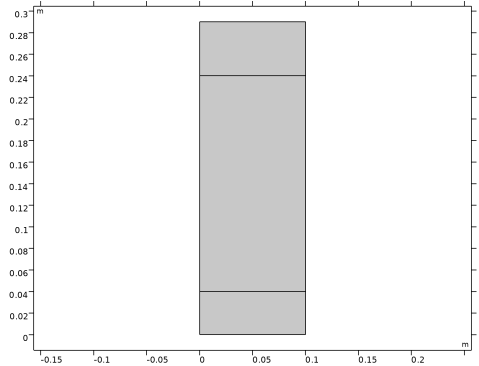
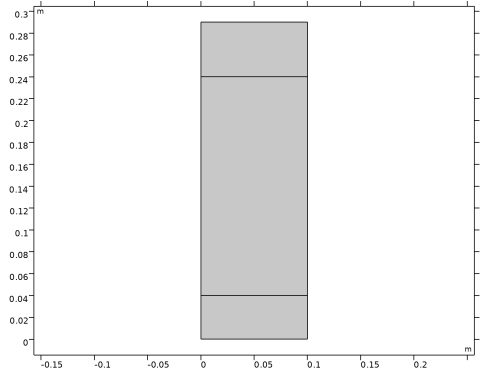
Figure 1 depicts the geometry of the modeled system in which an incident sound field, with incident angle θ, hits an anisotropic porous absorber.
We only model an absorber section of width W and use periodic Floquet boundary conditions on the left and right boundaries. The anisotropic porous material is 4 cm thick with a fixed wall at the bottom boundary. At the top, there is a perfectly matched layer (PML) domain to model an infinitely large air domain.
Figure 1: Model geometry with periodic condition at the right and left and a PML layer at the top.
Two components with the same geometry are created to compare two different methods of modeling the anisotropic porous material. The first method is using the Anisotropic Poroacoustics feature in Pressure Acoustics, Frequency Domain interface using a Johnson–Champoux–Allard (JCA) model. The second method uses the Poroelastic Waves interface with an Anisotropic Poroelastic Material feature with a Biot–Allard poroelastic model.
The anisotropic porous material used in the model is a generic anisotropic foam.
Results and Discussion
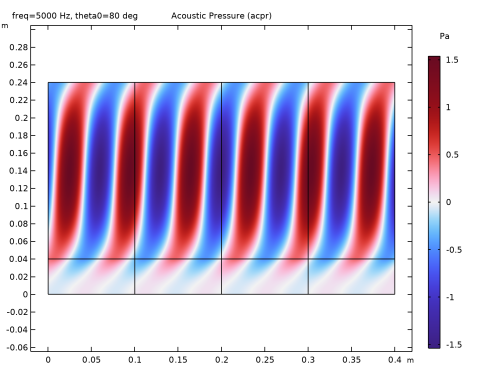
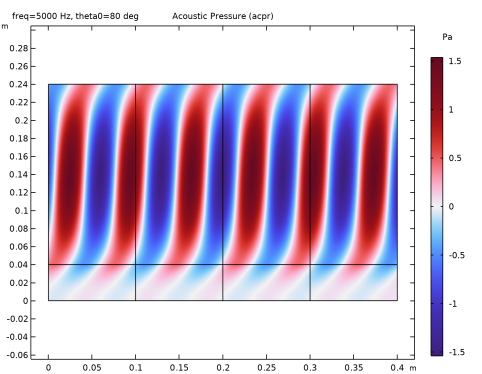
Figure 2 shows the acoustic field at 5000 Hz and an incident angle of 80 degrees. An Array dataset has been used to extend the solution to a width of four times the modeling domain. The pressure is shown for the model using poroacoustics for the porous material.
Figure 2: The acoustic pressure at 5000 Hz and an incident angle of 80 degrees.
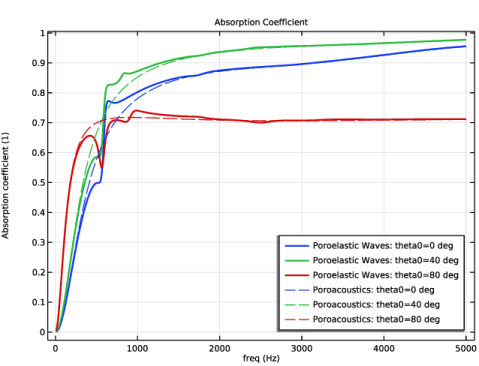
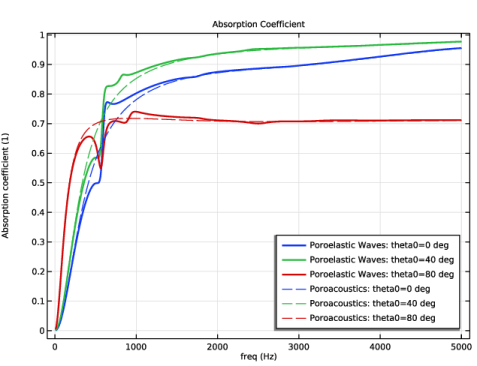
Figure 3 shows the absorption coefficient for three different incident angles — 0, 40, and 80 degrees — and for both the poroacoustic model (dashed) and the poroelastic model (solid). The absorption spectra from the poroacoustic model are smooth and do not include the effects of resonances in the poroelastic material. These effects are included in the poroelastic models, which results in resonance effects around 500–1000 Hz. The main resonance around 580 Hz is the first compressional eigenmode of the anisotropic poroelastic structure. For the two nonzero incident angles there are also traces of an eigenmode around 950 Hz. This mode cannot be actuated by an acoustic field with a 0 degree incident angle and thus does not affect the absorption spectrum for this case.
Figure 3: The absorption coefficient for three incident angles and for poroacoustics (dashed line) and poroelastic waves (solid lines).
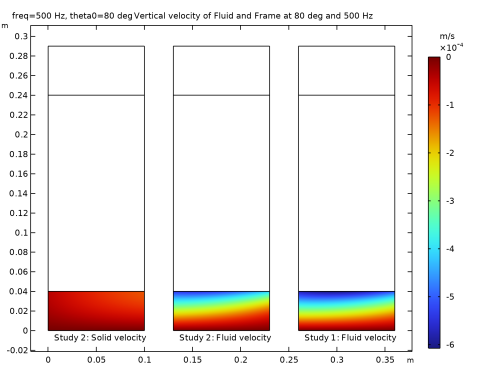
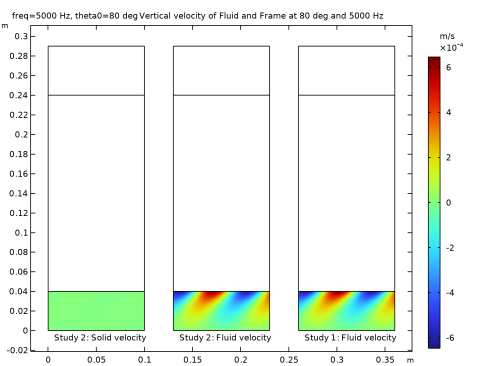
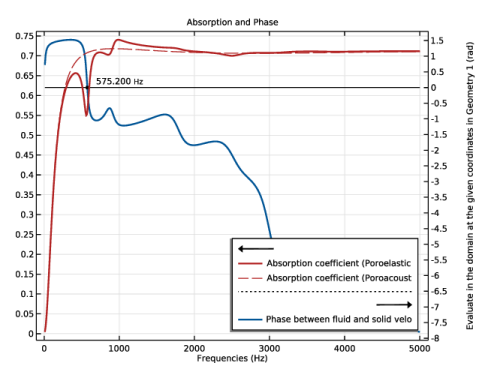
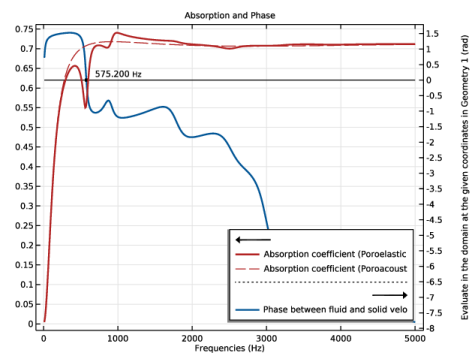
When the acoustic frequency is close to a resonance it affects the viscous absorption because the relative velocity between the air and structure in the poroelastic material is affected. It can both reduce the absorption when the air and structure are moving in phase and increase the absorption when they are moving out of phase. This is demonstrated in Figure 4, where the absorption coefficient is plotted together with the phase difference between the fluid and frame motion in the porous material.
Figure 4: Left y-axis: The absorption coefficients for poroacoustic (dashed) and poroelastic (solid) waves. Right y-axis: the phase between the fluid and frame motion in the poroelastic material.
Application Library path: Acoustics_Module/Building_and_Room_Acoustics/anisotropic_porous_absorber
Modeling Instructions
From the File menu, choose New.
New
In the New window, click  Model Wizard.
Model Wizard
1
In the Model Wizard window, click  2D.
The first component will have the anisotropic poroacoustics defined in Pressure Acoustics, Frequency Domain (acpr), which corresponds to the fluid moving while the frame of the porous material is fixed. A second component, to be added later, will compare this case with using a Poroelastic Waves (pelw) interface, which includes the movement of the frame.
2
In the Select Physics tree, select Acoustics > Pressure Acoustics > Pressure Acoustics, Frequency Domain (acpr).
3
Click Add.
4
Click  Study.
5
In the Select Study tree, select General Studies > Frequency Domain.
6
Global Definitions
Parameters 1
1
In the Model Builder window, under Global Definitions click Parameters 1.
2
In the Settings window for Parameters, locate the Parameters section.
3
Click  Load from File.
4
Geometry 1
The simple geometry to be created for this model corresponds to an air domain followed by the porous material. A perfectly matched layer is added on top of the air domain.
Rectangle 1 (r1)
1
In the Geometry toolbar, click  Rectangle.
2
In the Settings window for Rectangle, locate the Size and Shape section.
3
In the Width text field, type W.
4
In the Height text field, type H+Hair+Hpml.
5
Click to expand the Layers section. In the table, enter the following settings:
Form Union (fin)
1
In the Geometry toolbar, click  Build All.
2
Click the  Zoom Extents button in the Graphics toolbar.
3
In the Model Builder window, click Form Union (fin).
Definitions
Variables 1
1
In the Model Builder window, expand the Component 1 (comp1) > Definitions node.
2
Right-click Definitions and choose Variables.
3
In the Settings window for Variables, locate the Variables section.
4
Click  Load from File.
5
Integration 1 (intop1)
1
In the Definitions toolbar, click  Nonlocal Couplings and choose Integration.
2
In the Settings window for Integration, locate the Source Selection section.
3
From the Geometric entity level list, choose Point.
4
5
In the Operator name text field, type intop_pnt.
Average 1 (aveop1)
1
In the Definitions toolbar, click  Nonlocal Couplings and choose Average.
2
In the Settings window for Average, locate the Source Selection section.
3
From the Geometric entity level list, choose Boundary.
4
5
In the Operator name text field, type aveop_bnd.
Integration 2 (intop2)
1
In the Definitions toolbar, click  Nonlocal Couplings and choose Integration.
2
In the Settings window for Integration, locate the Source Selection section.
3
From the Geometric entity level list, choose Boundary.
4
5
In the Operator name text field, type intop_bnd.
Perfectly Matched Layer 1 (pml1)
1
In the Definitions toolbar, click  Perfectly Matched Layer.
2
3
In the Settings window for Perfectly Matched Layer, locate the Scaling section.
4
In the PML scaling factor text field, type 1/cos(theta0).
5
In the PML scaling curvature parameter text field, type 3.
Add Material
1
In the Materials toolbar, click  Add Material to open the Add Material window.
2
Go to the Add Material window.
3
In the tree, select Built-in > Air.
4
Click the Add to Component button in the window toolbar.
5
In the Materials toolbar, click  Add Material to close the Add Material window.
Materials
Porous Material
1
In the Model Builder window, under Component 1 (comp1) right-click Materials and choose Blank Material.
2
In the Settings window for Material, type Porous Material in the Label text field.
3
Click to expand the Material Properties section. In the Material properties tree, select Basic Properties > Porosity.
4
Click  Add to Material.
5
Locate the Material Contents section. In the table, enter the following settings:
6
Locate the Material Properties section. In the Material properties tree, select Acoustics > Poroacoustics Model.
7
Click  Add to Material.
8
Locate the Material Contents section. In the table, enter the following settings:
Pressure Acoustics, Frequency Domain (acpr)
Background Pressure Field 1
1
In the Physics toolbar, click  Domains and choose Background Pressure Field.
2
3
In the Settings window for Background Pressure Field, locate the Background Pressure Field section.
4
In the p0 text field, type 1.
5
From the c list, choose From material.
6
Specify the ek vector as
7
Select the Calculate background and scattered field intensity checkbox.
8
From the ρ list, choose From material.
Periodic Condition 1
1
In the Physics toolbar, click  Boundaries and choose Periodic Condition.
2
3
In the Settings window for Periodic Condition, locate the Periodicity Settings section.
4
From the Type of periodicity list, choose Floquet periodicity.
5
Specify the kF vector as
Periodic Condition 2
1
In the Physics toolbar, click  Boundaries and choose Periodic Condition.
2
3
In the Settings window for Periodic Condition, locate the Periodicity Settings section.
4
From the Type of periodicity list, choose Floquet periodicity.
5
Specify the kF vector as
Periodic Condition 3
1
In the Physics toolbar, click  Boundaries and choose Periodic Condition.
2
3
In the Settings window for Periodic Condition, locate the Periodicity Settings section.
4
From the Type of periodicity list, choose Floquet periodicity.
5
Specify the kF vector as
Anisotropic Poroacoustics 1
1
In the Physics toolbar, click  Domains and choose Anisotropic Poroacoustics.
2
3
In the Settings window for Anisotropic Poroacoustics, locate the Fluid Properties section.
4
From the Fluid material list, choose Air (mat1).
5
Locate the Porous Matrix Properties section. From the Porous elastic material list, choose Porous Material (mat2).
Mesh 1
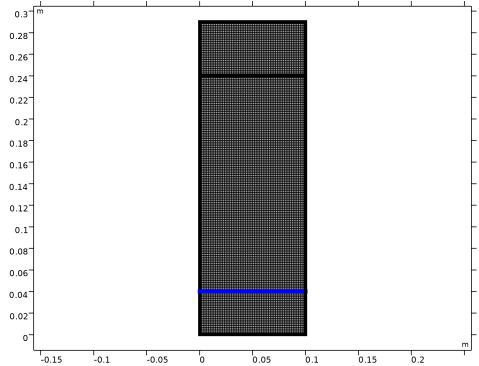
Next, set up the mesh manually, starting by adding the mesh components.
Mapped 1
In the Mesh toolbar, click  Mapped.
Size
1
In the Model Builder window, click Size.
2
In the Settings window for Size, locate the Element Size section.
3
Click the Custom button.
4
Locate the Element Size Parameters section. In the Maximum element size text field, type H/24.
5
In the Minimum element size text field, type H/24.
Boundary Layers 1
1
In the Mesh toolbar, click  Boundary Layers.
2
In the Settings window for Boundary Layers, locate the Domain Selection section.
3
From the Geometric entity level list, choose Domain.
4
5
Click to expand the Transition section. Clear the Smooth transition to interior mesh checkbox.
Boundary Layer Properties
1
In the Model Builder window, click Boundary Layer Properties.
2
3
In the Settings window for Boundary Layer Properties, locate the Layers section.
4
In the Number of layers text field, type 1.
5
Click  Build All.
Study 1 - Poroacoustics Waves
1
In the Model Builder window, click Study 1.
2
In the Settings window for Study, type Study 1 - Poroacoustics Waves in the Label text field.
Turn off the generation of default plots. If turned on the default plots for each physics interface will be generated.
3
Locate the Study Settings section. Clear the Generate default plots checkbox.
Step 1: Frequency Domain
1
In the Model Builder window, under Study 1 - Poroacoustics Waves click Step 1: Frequency Domain.
2
In the Settings window for Frequency Domain, locate the Study Settings section.
3
Click  Range.
4
In the Range dialog, type 10 in the Start text field.
5
In the Step text field, type 10.
6
In the Stop text field, type 5000.
7
Click Add.
8
In the Settings window for Frequency Domain, click to expand the Study Extensions section.
9
Select the Auxiliary sweep checkbox.
10
11
12
In the Study toolbar, click  Compute.
Component 1 (comp1)
In the Model Builder window, right-click Component 1 (comp1) and choose Copy.
Component 2 (comp2)
In the Model Builder window, right-click the root node and choose Paste Multiple Items.
Artificial Domains, Component 2 (comp2), Definitions (comp2), Geometry 1, Materials, Mesh 1, Pressure Acoustics, Frequency Domain (acpr2)
In the Messages from Paste dialog, click OK.
Definitions (comp2)
Variables 1
1
In the Model Builder window, under Component 2 (comp2) > Definitions click Variables 1.
2
In the Settings window for Variables, locate the Variables section.
3
Materials
Porous Material (mat4)
1
In the Model Builder window, under Component 2 (comp2) > Materials click Porous Material (mat4).
2
Pressure Acoustics, Frequency Domain (acpr2)
Anisotropic Poroacoustics 1
1
In the Model Builder window, expand the Component 2 (comp2) > Pressure Acoustics, Frequency Domain (acpr2) node.
2
Right-click Component 2 (comp2) > Pressure Acoustics, Frequency Domain (acpr2) > Anisotropic Poroacoustics 1 and choose Delete.
Periodic Condition 3
1
Right-click Periodic Condition 3 and choose Delete.
2
In the Model Builder window, click Pressure Acoustics, Frequency Domain (acpr2).
3
Add Physics
1
In the Physics toolbar, click  Add Physics to open the Add Physics window.
2
Go to the Add Physics window.
3
In the tree, select Acoustics > Elastic Waves > Poroelastic Waves (pelw).
4
Click the Add to Component 2 button in the window toolbar.
5
In the Physics toolbar, click  Add Physics to close the Add Physics window.
Poroelastic Waves (pelw)
Select Domain 1 only.
Poroelastic Material 1
1
In the Model Builder window, under Component 2 (comp2) > Poroelastic Waves (pelw) click Poroelastic Material 1.
2
In the Settings window for Poroelastic Material, locate the Porous Matrix Properties section.
3
From the Specify list, choose Young’s modulus and shear modulus.
4
Locate the Fluid Properties section. From the Fluid material list, choose Air (mat3).
Anisotropic Poroelastic Material 1
1
In the Physics toolbar, click  Domains and choose Anisotropic Poroelastic Material.
2
3
In the Settings window for Anisotropic Poroelastic Material, locate the Porous Matrix Properties section.
4
From the Porous model list, choose Drained matrix, orthotropic.
5
Locate the Fluid Properties section. From the Fluid material list, choose Air (mat3).
In this case, you need both Fixed Constraint and Impervious Layer because both the fluid and the frame are fixed to the bottom.
Fixed Constraint 1
1
In the Physics toolbar, click  Boundaries and choose Fixed Constraint.
2
Impervious Layer 2
1
In the Physics toolbar, click  Boundaries and choose Impervious Layer.
2
Periodic Condition 1
1
In the Physics toolbar, click  Boundaries and choose Periodic Condition.
2
3
In the Settings window for Periodic Condition, locate the Periodicity Settings section.
4
From the Type of periodicity list, choose Floquet periodicity.
5
Specify the kF vector as
Materials
Porous Material (mat4)
1
In the Model Builder window, under Component 2 (comp2) > Materials click Porous Material (mat4).
2
In the Settings window for Material, locate the Material Contents section.
3
Multiphysics
Acoustic–Porous Boundary 1 (apb1)
1
In the Physics toolbar, click  Multiphysics Couplings and choose Boundary > Acoustic–Porous Boundary.
2
Mesh 1
In the Model Builder window, under Component 2 (comp2) right-click Mesh 1 and choose Build All.
Add Study
1
In the Study toolbar, click  Add Study to open the Add Study window.
2
Go to the Add Study window.
3
Find the Studies subsection. In the Select Study tree, select General Studies > Frequency Domain.
4
Click the Add Study button in the window toolbar.
5
In the Study toolbar, click  Add Study to close the Add Study window.
Study 2
Step 1: Frequency Domain
1
In the Settings window for Frequency Domain, locate the Study Settings section.
2
Click  Range.
3
In the Range dialog, type 10 in the Start text field.
4
In the Step text field, type 10.
5
In the Stop text field, type 5000.
6
Click Add.
7
In the Settings window for Frequency Domain, locate the Physics and Variables Selection section.
8
In the Solve for column of the table, clear the checkbox for Component 1 (comp1).
9
Locate the Study Extensions section. Select the Auxiliary sweep checkbox.
10
11
12
In the Model Builder window, click Study 2.
13
In the Settings window for Study, locate the Study Settings section.
14
Clear the Generate default plots checkbox.
15
In the Label text field, type Study 2 - Poroelastic Waves.
16
In the Study toolbar, click  Compute.
Results
In the Model Builder window, expand the Results node.
Study 2 - Poroelastic Waves/Solution 2 (2) (sol2)
1
In the Model Builder window, expand the Results > Datasets node.
2
Right-click Results > Datasets > Study 2 - Poroelastic Waves/Solution 2 (2) (sol2) and choose Delete.
Array 2D 1
1
In the Results toolbar, click  More Datasets and choose Array 2D.
2
In the Settings window for Array 2D, locate the Array Size section.
3
In the X size text field, type 4.
4
Click to expand the Advanced section. Select the Floquet–Bloch periodicity checkbox.
5
Find the Wave vector subsection. In the X text field, type kx.
6
In the Y text field, type ky.
Selection
1
Right-click Array 2D 1 and choose Selection.
2
In the Settings window for Selection, locate the Geometric Entity Selection section.
3
From the Geometric entity level list, choose Domain.
4
Study 1 - Poroacoustics Waves/Solution 1 (4) (sol1)
In the Results toolbar, click  More Datasets and choose Solution.
Selection
1
In the Results toolbar, click  Attributes and choose Selection.
2
In the Settings window for Selection, locate the Geometric Entity Selection section.
3
From the Geometric entity level list, choose Domain.
4
Acoustic Pressure (acpr)
1
In the Results toolbar, click  2D Plot Group.
2
In the Settings window for 2D Plot Group, type Acoustic Pressure (acpr) in the Label text field.
3
Locate the Data section. From the Dataset list, choose Array 2D 1.
4
Click to expand the Title section. From the Title type list, choose Label.
5
Locate the Color Legend section. Select the Show units checkbox.
Surface 1
1
In the Acoustic Pressure (acpr) toolbar, click  Surface.
2
In the Settings window for Surface, locate the Coloring and Style section.
3
From the Scale list, choose Linear.
4
In the Acoustic Pressure (acpr) toolbar, click  Plot.
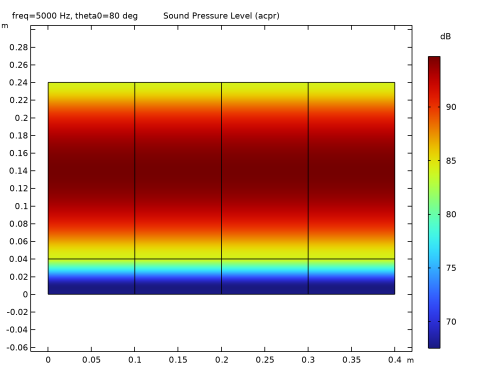
Sound Pressure Level (acpr)
1
In the Model Builder window, right-click Acoustic Pressure (acpr) and choose Duplicate.
2
In the Model Builder window, click Acoustic Pressure (acpr) 1.
3
In the Settings window for 2D Plot Group, type Sound Pressure Level (acpr) in the Label text field.
Surface 1
1
In the Model Builder window, click Surface 1.
2
In the Settings window for Surface, locate the Expression section.
3
In the Expression text field, type acpr.Lp_t.
4
Locate the Coloring and Style section. From the Color table list, choose Rainbow.
5
In the Sound Pressure Level (acpr) toolbar, click  Plot.
Absorption Coefficient
1
In the Results toolbar, click  1D Plot Group.
2
In the Settings window for 1D Plot Group, type Absorption Coefficient in the Label text field.
3
Click to expand the Title section. From the Title type list, choose Label.
4
Locate the Data section. From the Dataset list, choose Study 2 - Poroelastic Waves/Solution 2 (sol2).
5
Locate the Legend section. From the Position list, choose Lower right.
Global 1
1
In the Absorption Coefficient toolbar, click  Global.
2
In the Settings window for Global, locate the y-Axis Data section.
3
4
Locate the x-Axis Data section. From the Axis source data list, choose freq.
5
Click to expand the Coloring and Style section. From the Width list, choose 2.
6
Click to expand the Legends section. Find the Include subsection. Clear the Description checkbox.
7
Find the Prefix and suffix subsection. In the Prefix text field, type Poroelastic Waves: .
Absorption Coefficient
In the Absorption Coefficient toolbar, click  Global.
Global 2
1
In the Settings window for Global, locate the Data section.
2
From the Dataset list, choose Study 1 - Poroacoustics Waves/Solution 1 (1) (sol1).
3
Locate the y-Axis Data section. In the table, enter the following settings:
4
Locate the x-Axis Data section. From the Axis source data list, choose freq.
5
Locate the Coloring and Style section. Find the Line style subsection. From the Line list, choose Dashed.
6
From the Color list, choose Cycle (reset).
7
Locate the Legends section. Find the Include subsection. Clear the Description checkbox.
8
Find the Prefix and suffix subsection. In the Prefix text field, type Poroacoustics: .
9
In the Absorption Coefficient toolbar, click  Plot.
Vertical velocity of Fluid and Frame at 80 deg and 500 Hz
1
In the Home toolbar, click  Add Plot Group and choose 2D Plot Group.
2
In the Settings window for 2D Plot Group, type Vertical velocity of Fluid and Frame at 80 deg and 500 Hz in the Label text field.
3
Locate the Data section. From the Dataset list, choose Study 2 - Poroelastic Waves/Solution 2 (sol2).
4
From the Parameter value (freq (Hz)) list, choose 500.
5
Locate the Title section. From the Title type list, choose Label.
6
Locate the Color Legend section. Select the Show units checkbox.
7
Click to expand the Plot Array section. From the Array type list, choose Linear.
Surface 1
1
In the Vertical velocity of Fluid and Frame at 80 deg and 500 Hz toolbar, click  Surface.
2
In the Settings window for Surface, locate the Expression section.
3
In the Expression text field, type pelw.iomega*v.
4
Locate the Coloring and Style section. From the Color table list, choose Rainbow.
5
From the Scale list, choose Linear.
Vertical velocity of Fluid and Frame at 80 deg and 500 Hz
In the Vertical velocity of Fluid and Frame at 80 deg and 500 Hz toolbar, click  Surface.
Surface 2
1
In the Settings window for Surface, locate the Expression section.
2
In the Expression text field, type pelw.v_tY.
3
Click to expand the Inherit Style section. From the Plot list, choose Surface 1.
Vertical velocity of Fluid and Frame at 80 deg and 500 Hz
In the Vertical velocity of Fluid and Frame at 80 deg and 500 Hz toolbar, click  Surface.
Surface 3
1
In the Settings window for Surface, locate the Data section.
2
From the Dataset list, choose Study 1 - Poroacoustics Waves/Solution 1 (4) (sol1).
3
From the Parameter value (freq (Hz)) list, choose 500.
4
Locate the Expression section. In the Expression text field, type acpr.vy.
5
Locate the Inherit Style section. From the Plot list, choose Surface 1.
Annotation 1
1
In the Model Builder window, right-click Vertical velocity of Fluid and Frame at 80 deg and 500 Hz and choose Annotation.
2
In the Settings window for Annotation, locate the Annotation section.
3
In the Text text field, type Study 2: Solid velocity.
4
Locate the Coloring and Style section. Clear the Show point checkbox.
5
Click to expand the Plot Array section. Select the Belongs to array checkbox.
6
Select the Manual indexing checkbox.
Annotation 2
1
Right-click Annotation 1 and choose Duplicate.
2
In the Settings window for Annotation, locate the Plot Array section.
3
In the Index text field, type 1.
4
Locate the Annotation section. In the Text text field, type Study 2: Fluid velocity.
Annotation 3
1
Right-click Annotation 2 and choose Duplicate.
2
In the Settings window for Annotation, locate the Annotation section.
3
In the Text text field, type Study 1: Fluid velocity.
4
Locate the Plot Array section. In the Index text field, type 2.
5
In the Vertical velocity of Fluid and Frame at 80 deg and 500 Hz toolbar, click  Plot.
Vertical velocity of Fluid and Frame at 80 deg and 5000 Hz
1
In the Model Builder window, right-click Vertical velocity of Fluid and Frame at 80 deg and 500 Hz and choose Duplicate.
2
In the Settings window for 2D Plot Group, type Vertical velocity of Fluid and Frame at 80 deg and 5000 Hz in the Label text field.
3
Locate the Data section. From the Parameter value (freq (Hz)) list, choose 5000.
Surface 3
1
In the Model Builder window, expand the Vertical velocity of Fluid and Frame at 80 deg and 5000 Hz node, then click Surface 3.
2
In the Settings window for Surface, locate the Data section.
3
From the Parameter value (freq (Hz)) list, choose 5000.
4
In the Vertical velocity of Fluid and Frame at 80 deg and 5000 Hz toolbar, click  Plot.
Absorption and Phase
1
In the Results toolbar, click  1D Plot Group.
2
In the Settings window for 1D Plot Group, type Absorption and Phase in the Label text field.
3
Locate the Data section. From the Dataset list, choose Study 2 - Poroelastic Waves/Solution 2 (sol2).
4
From the Parameter selection (theta0) list, choose From list.
5
In the Parameter values (theta0 (deg)) list box, select 80.
6
Locate the Title section. From the Title type list, choose Label.
7
Locate the Plot Settings section.
8
Select the x-axis label checkbox. In the associated text field, type Frequencies (Hz).
9
Select the Two y-axes checkbox.
10
Locate the Legend section. From the Position list, choose Lower right.
Global 1
1
In the Absorption and Phase toolbar, click  Global.
2
In the Settings window for Global, locate the y-Axis section.
3
Select the Plot on secondary y-axis checkbox.
4
Locate the y-Axis Data section. In the table, enter the following settings:
5
Select the Unwrap phase checkbox.
6
Locate the x-Axis Data section. From the Axis source data list, choose freq.
7
Locate the Legends section. Find the Include subsection. Clear the Solution checkbox.
8
Locate the Coloring and Style section. From the Color list, choose Custom.
9
Click Define custom colors.
10
11
Click Add to custom colors.
12
Click Show color palette only or OK on the cross-platform desktop.
13
From the Width list, choose 2.
14
Locate the Legends section. From the Legends list, choose Manual.
15
Graph Marker 1
1
Right-click Global 1 and choose Graph Marker.
2
In the Settings window for Graph Marker, locate the Display section.
3
From the Display mode list, choose Line intersection.
4
From the Line type list, choose Horizontal.
5
In the y-coordinates text field, type 0.
6
Select the Show lines checkbox.
7
Locate the Text Format section. Select the Include unit checkbox.
Absorption and Phase
In the Absorption and Phase toolbar, click  Global.
Global 2
1
In the Settings window for Global, locate the y-Axis Data section.
2
3
Locate the x-Axis Data section. From the Axis source data list, choose freq.
4
Locate the Legends section. Find the Include subsection. Clear the Solution checkbox.
5
Locate the Coloring and Style section. From the Color list, choose Custom.
6
Click Define custom colors.
7
8
Click Add to custom colors.
9
Click Show color palette only or OK on the cross-platform desktop.
10
From the Width list, choose 2.
Global 3
1
Right-click Results > Absorption and Phase > Global 2 and choose Duplicate.
2
In the Settings window for Global, locate the Data section.
3
From the Dataset list, choose Study 1 - Poroacoustics Waves/Solution 1 (1) (sol1).
4
From the Parameter selection (theta0) list, choose From list.
5
In the Parameter values (theta0 (deg)) list box, select 80.
6
Locate the y-Axis Data section. In the table, enter the following settings:
7
Locate the Coloring and Style section. From the Width list, choose 1.
8
Find the Line style subsection. From the Line list, choose Dashed.
9
In the Absorption and Phase toolbar, click  Plot.
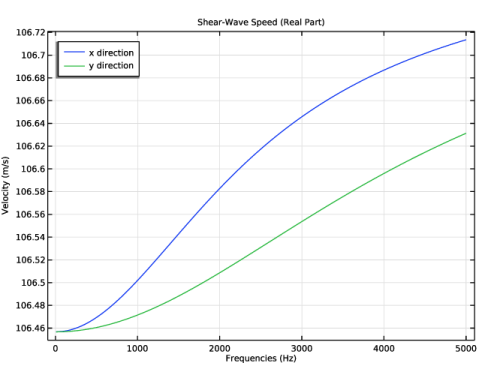
Shear-Wave Speed (Real Part)
1
In the Home toolbar, click  Add Plot Group and choose 1D Plot Group.
2
In the Settings window for 1D Plot Group, type Shear-Wave Speed (Real Part) in the Label text field.
3
Locate the Title section. From the Title type list, choose Label.
4
Locate the Data section. From the Dataset list, choose Study 2 - Poroelastic Waves/Solution 2 (sol2).
5
From the Parameter selection (theta0) list, choose From list.
6
In the Parameter values (theta0 (deg)) list box, select 80.
7
Locate the Legend section. From the Position list, choose Upper left.
Point Graph 1
1
Right-click Shear-Wave Speed (Real Part) and choose Point Graph.
2
3
In the Settings window for Point Graph, locate the y-Axis Data section.
4
In the Expression text field, type pelw.apm1.cs_poroXX.
5
Locate the x-Axis Data section. From the Axis source data list, choose freq.
6
Click to expand the Legends section. Select the Show legends checkbox.
7
From the Legends list, choose Manual.
8
Shear-Wave Speed (Real Part)
In the Shear-Wave Speed (Real Part) toolbar, click  Point Graph.
Point Graph 2
1
2
In the Settings window for Point Graph, locate the y-Axis Data section.
3
In the Expression text field, type pelw.apm1.cs_poroYY.
4
Locate the x-Axis Data section. From the Axis source data list, choose freq.
5
Locate the Legends section. Select the Show legends checkbox.
6
From the Legends list, choose Manual.
7
Shear-Wave Speed (Real Part)
1
In the Model Builder window, click Shear-Wave Speed (Real Part).
2
In the Settings window for 1D Plot Group, locate the Plot Settings section.
3
Select the x-axis label checkbox. In the associated text field, type Frequencies (Hz).
4
Select the y-axis label checkbox. In the associated text field, type Velocity (m/s).
5
In the Shear-Wave Speed (Real Part) toolbar, click  Plot.
Shear-Wave Speed (Real Part) 1
Right-click Shear-Wave Speed (Real Part) and choose Duplicate.
Point Graph 1
1
In the Model Builder window, expand the Shear-Wave Speed (Real Part) 1 node, then click Point Graph 1.
2
In the Settings window for Point Graph, locate the y-Axis Data section.
3
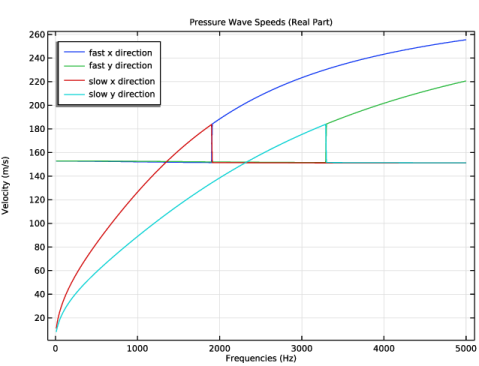
In the Expression text field, type pelw.apm1.cp_fastXX.
4
Locate the Legends section. In the table, enter the following settings:
Point Graph 2
1
In the Model Builder window, click Point Graph 2.
2
In the Settings window for Point Graph, locate the y-Axis Data section.
3
In the Expression text field, type pelw.apm1.cp_fastYY.
4
Locate the Legends section. In the table, enter the following settings:
Point Graph 1, Point Graph 2
1
In the Model Builder window, under Results > Shear-Wave Speed (Real Part) 1, Ctrl-click to select Point Graph 1 and Point Graph 2.
2
Pressure Wave Speeds (Real Part)
In the Settings window for 1D Plot Group, type Pressure Wave Speeds (Real Part) in the Label text field.
Point Graph 3, Point Graph 4
1
In the Model Builder window, under Results > Pressure Wave Speeds (Real Part), Ctrl-click to select Point Graph 3 and Point Graph 4.
2
In the Settings window for Point Graph, locate the y-Axis Data section.
3
In the Expression text field, type pelw.apm1.cp_slowXX.
4
Locate the Legends section. In the table, enter the following settings:
Point Graph 4
1
In the Model Builder window, click Point Graph 4.
2
In the Settings window for Point Graph, locate the y-Axis Data section.
3
In the Expression text field, type pelw.apm1.cp_slowYY.
4
Locate the Legends section. In the table, enter the following settings:
5
In the Pressure Wave Speeds (Real Part) toolbar, click  Plot.