PDF

Thin Low Permittivity Gap Comparison
Introduction
The thin low permittivity gap boundary condition is meant to approximate a thin layer of material with low relative permittivity compared to its surroundings, and is available for electrostatic field modeling. This example compares the thin low permittivity gap boundary condition to a full-fidelity model and discusses the range of applicability of this boundary condition.
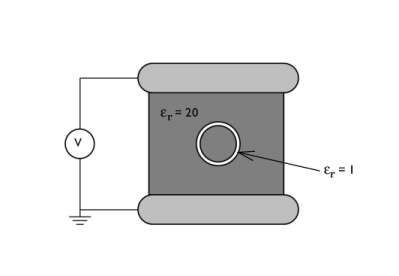
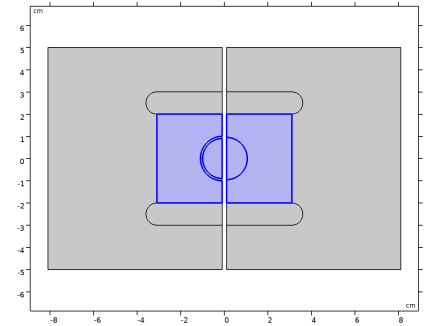
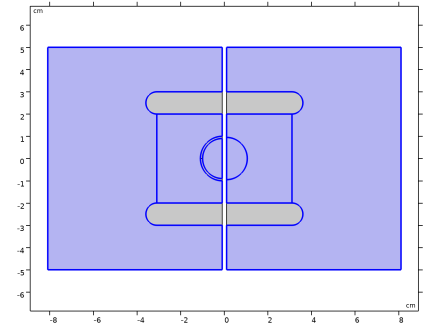
Figure 1: A two-dimensional parallel plate capacitor with a high dielectric between the plates. A thin circular gap in the high dielectric distorts the electric field.
Model Definition
The situation being modeled is shown in Figure 1. Two parallel plates have a high dielectric material (relative permittivity εr = 20) in between them, and have a voltage difference applied to them, forming a capacitor. Inside of this dielectric material, there is a 1 mm circular gap with lower permittivity (εr = 1) and an outer diameter of 1 cm.
The thin gap is modeled in two different ways: first by using a full fidelity model that includes the thickness of the wall, and then by using the thin low permittivity gap boundary condition. The two models are separate, but are modeled simultaneously for comparison.
The location of the thin low permittivity gap condition is at the centerline, midway between the inner and outer radii of the gap in the full fidelity model. Note that when using the thin low permittivity gap condition, the total volume of the surrounding material is slightly larger, since the thickness of the wall is not being explicitly modeled.
Results and Discussion
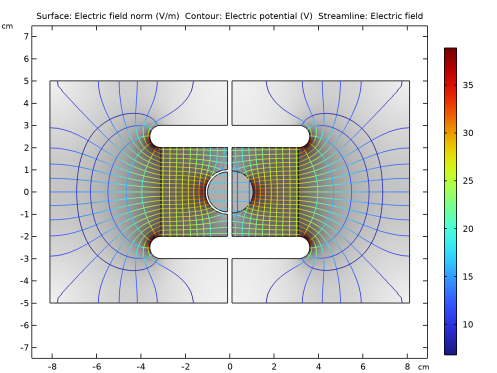
The electric field and isolines of the voltage are plotted in Figure 2. The field lines can be observed to deform around the inclusion. The solution for the model using the thin low permittivity gap condition agrees well with the one in the full fidelity model.
The thin low permittivity gap boundary condition can be used in cases where the thickness of the boundary being approximated is much smaller than the characteristic size of the model domain, and when the relative permittivity of the gap region is lower than the surrounding medium. When this boundary condition is used, the number of mesh elements is much smaller, saving solution time and memory.
Figure 2: Isolines of the voltage field and streamlines of the electric field are plotted. The lines are colored according to the strength of the electric field, and the background grayscale plot is of the electric field norm. The full fidelity (left) and thin low permittivity gap (right) solutions are almost identical.
Application Library path: ACDC_Module/Introductory_Electrostatics/thin_low_permittivity_gap_comparison
Modeling Instructions
From the File menu, choose New.
New
In the New window, click  Model Wizard.
Model Wizard
1
In the Model Wizard window, click  2D.
2
In the Select Physics tree, select AC/DC > Electric Fields and Currents > Electrostatics (es).
3
Click Add.
4
Click  Study.
5
In the Select Study tree, select General Studies > Stationary.
6
Geometry 1
1
In the Model Builder window, under Component 1 (comp1) click Geometry 1.
2
In the Settings window for Geometry, locate the Units section.
3
From the Length unit list, choose cm.
Global Definitions
Parameters 1
1
In the Model Builder window, under Global Definitions click Parameters 1.
2
In the Settings window for Parameters, locate the Parameters section.
3
Geometry 1
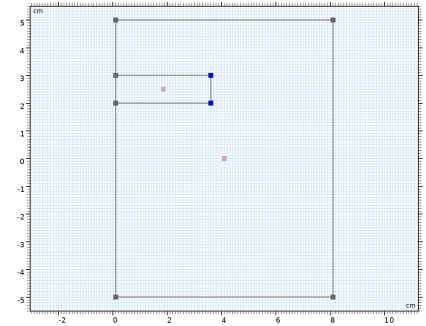
Rectangle 1 (r1)
1
In the Geometry toolbar, click  Rectangle.
2
In the Settings window for Rectangle, locate the Size and Shape section.
3
In the Width text field, type 8.
4
In the Height text field, type 10.
5
Locate the Position section. In the x text field, type 0.1.
6
In the y text field, type -5.
Rectangle 2 (r2)
1
In the Geometry toolbar, click  Rectangle.
2
In the Settings window for Rectangle, locate the Size and Shape section.
3
In the Width text field, type 3.5.
4
Locate the Position section. In the x text field, type 0.1.
5
In the y text field, type 2.
Fillet 1 (fil1)
1
In the Geometry toolbar, click  Fillet.
2
On the object r2, select Points 2 and 3 only.
3
In the Settings window for Fillet, locate the Radius section.
4
In the Radius text field, type 0.5.
Copy 1 (copy1)
1
In the Geometry toolbar, click  Transforms and choose Copy.
2
3
In the Settings window for Copy, locate the Displacement section.
4
In the y text field, type -5.
Rectangle 3 (r3)
1
In the Geometry toolbar, click  Rectangle.
2
In the Settings window for Rectangle, locate the Size and Shape section.
3
In the Width text field, type 3.
4
In the Height text field, type 4.
5
Locate the Position section. In the x text field, type 0.1.
6
In the y text field, type -2.
Mirror 1 (mir1)
1
In the Geometry toolbar, click  Transforms and choose Mirror.
2
Click in the Graphics window and then press Ctrl+A to select all objects.
3
In the Settings window for Mirror, locate the Input section.
4
Select the Keep input objects checkbox.
5
Click  Build Selected.
6
Click the  Zoom Extents button in the Graphics toolbar.
Circle 1 (c1)
1
In the Geometry toolbar, click  Circle.
2
In the Settings window for Circle, locate the Size and Shape section.
3
In the Radius text field, type 0.95.
4
In the Sector angle text field, type 180.
5
Locate the Position section. In the x text field, type 0.1.
6
Locate the Rotation Angle section. In the Rotation text field, type -90.
Circle 2 (c2)
1
In the Geometry toolbar, click  Circle.
2
In the Settings window for Circle, locate the Size and Shape section.
3
In the Sector angle text field, type 180.
4
Locate the Position section. In the x text field, type -0.1.
5
Locate the Rotation Angle section. In the Rotation text field, type 90.
6
Click to expand the Layers section. In the table, enter the following settings:
7
Click  Build All Objects.
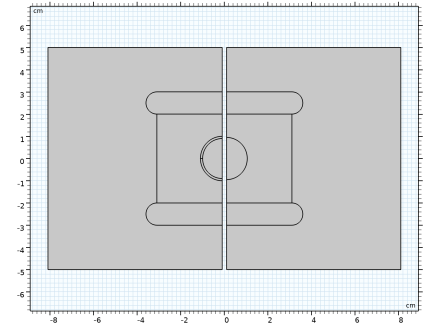
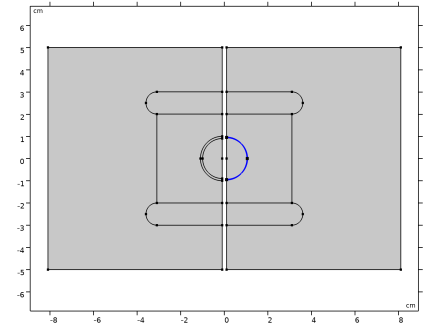
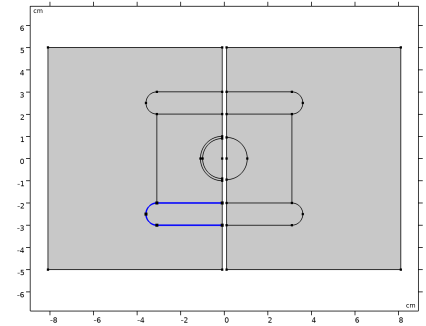
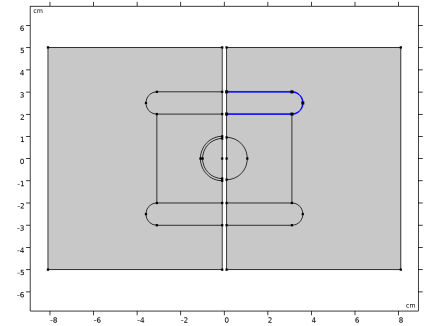
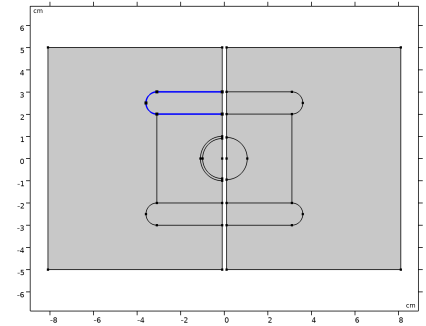
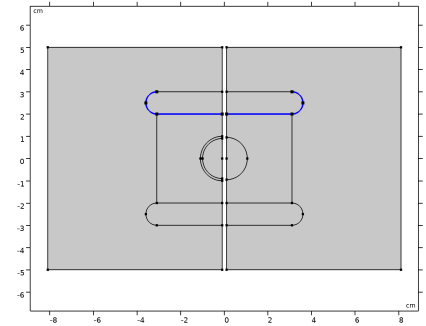
The geometry on the left side describes the full fidelity model. The geometry on the right side replaces the thin layer with a boundary in order to use the Thin Low Permittivity Gap feature.
Definitions
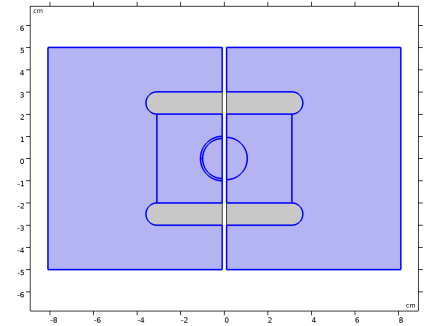
Create a set of selections before setting up the physics. First, create a selection for the high dielectric material domain between two parallel plates.
High dielectric
1
In the Definitions toolbar, click  Explicit.
2
3
In the Settings window for Explicit, type High dielectric in the Label text field.
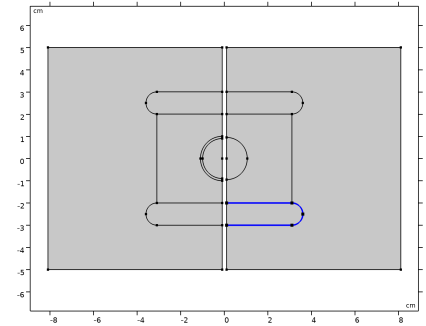
Add a selection for the thin low permittivity gap boundaries.
Thin low permittivity gap
1
In the Definitions toolbar, click  Explicit.
2
In the Settings window for Explicit, locate the Input Entities section.
3
From the Geometric entity level list, choose Boundary.
4
5
In the Label text field, type Thin low permittivity gap.
Add a selection for the model domain.
Model domain
1
In the Definitions toolbar, click  Explicit.
2
3
In the Settings window for Explicit, type Model domain in the Label text field.
Now, add the physics features needed for the two sides of the model.
Electrostatics (es)
Charge Conservation in Solids 1
1
In the Physics toolbar, click  Domains and choose Charge Conservation in Solids.
2
3
In the Model Builder window, click Electrostatics (es).
4
In the Settings window for Electrostatics, locate the Domain Selection section.
5
From the Selection list, choose Model domain.
Ground 1
1
In the Physics toolbar, click  Boundaries and choose Ground.
2
Ground 2
1
In the Physics toolbar, click  Boundaries and choose Ground.
2
Boundary Terminal 1
1
In the Physics toolbar, click  Boundaries and choose Boundary Terminal.
2
3
In the Settings window for Boundary Terminal, locate the Terminal section.
4
From the Terminal type list, choose Voltage.
5
In the V0 text field, type V0.
Boundary Terminal 2
1
In the Physics toolbar, click  Boundaries and choose Boundary Terminal.
2
3
In the Settings window for Boundary Terminal, locate the Terminal section.
4
From the Terminal type list, choose Voltage.
5
In the V0 text field, type V0.
Thin Low Permittivity Gap 1
1
In the Physics toolbar, click  Boundaries and choose Thin Low Permittivity Gap.
2
In the Settings window for Thin Low Permittivity Gap, locate the Boundary Selection section.
3
From the Selection list, choose Thin low permittivity gap.
4
Locate the Thin Low Permittivity Gap section. In the ds text field, type 1[mm].
Materials
Material 1 (mat1)
1
In the Model Builder window, under Component 1 (comp1) right-click Materials and choose Blank Material.
2
In the Settings window for Material, locate the Geometric Entity Selection section.
3
From the Selection list, choose High dielectric.
4
Locate the Material Contents section. In the table, enter the following settings:
Material 2 (mat2)
1
Right-click Materials and choose Blank Material.
2
In the Settings window for Material, locate the Geometric Entity Selection section.
3
From the Geometric entity level list, choose Boundary.
4
From the Selection list, choose Thin low permittivity gap.
5
Locate the Material Contents section. In the table, enter the following settings:
Mesh 1
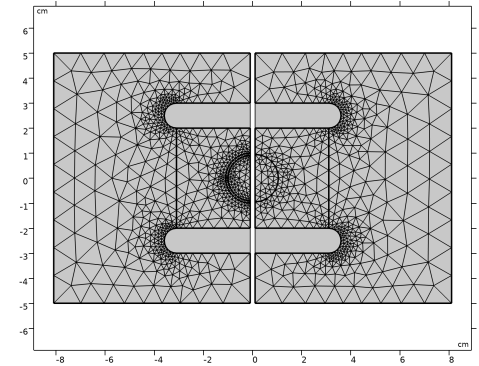
In the Model Builder window, under Component 1 (comp1) right-click Mesh 1 and choose Build All.
Study 1
1
In the Model Builder window, click Study 1.
2
In the Settings window for Study, locate the Study Settings section.
3
Clear the Generate default plots checkbox.
4
In the Study toolbar, click  Compute.
Begin the result analysis by suppressing the domain of the wall of the inclusion, which is not of interest.
Results
In the Model Builder window, expand the Results node.
Study 1/Solution 1 (sol1)
In the Model Builder window, expand the Results > Datasets node, then click Study 1/Solution 1 (sol1).
Selection
1
In the Results toolbar, click  Attributes and choose Selection.
2
In the Settings window for Selection, locate the Geometric Entity Selection section.
3
From the Geometric entity level list, choose Domain.
4
Create a custom plot to show the direction and norm of the electric field.
Electric Field (es)
1
In the Results toolbar, click  2D Plot Group.
2
In the Settings window for 2D Plot Group, type Electric Field (es) in the Label text field.
Surface 1
1
Right-click Electric Field (es) and choose Surface.
2
In the Settings window for Surface, click Replace Expression in the upper-right corner of the Expression section. From the menu, choose Component 1 (comp1) > Electrostatics > Electric > es.normE - Electric field norm - V/m.
3
Locate the Coloring and Style section. From the Color table list, choose GrayPrint.
4
Clear the Color legend checkbox.
5
From the Color table transformation list, choose Reverse.
Electric Field (es)
Next, add a contour plot showing the electric potential.
Contour 1
1
In the Model Builder window, right-click Electric Field (es) and choose Contour.
2
In the Settings window for Contour, locate the Levels section.
3
In the Total levels text field, type 21.
Color Expression 1
1
Right-click Contour 1 and choose Color Expression.
2
In the Settings window for Color Expression, click Replace Expression in the upper-right corner of the Expression section. From the menu, choose Component 1 (comp1) > Electrostatics > Electric > es.normE - Electric field norm - V/m.
3
Locate the Coloring and Style section. Clear the Color legend checkbox.
Electric Field (es)
Then, add a streamline plot of the electric field.
Streamline 1
1
In the Model Builder window, right-click Electric Field (es) and choose Streamline.
2
3
In the Settings window for Streamline, locate the Streamline Positioning section.
4
In the Number text field, type 30.
Color Expression 1
1
Right-click Streamline 1 and choose Color Expression.
2
In the Settings window for Color Expression, click Replace Expression in the upper-right corner of the Expression section. From the menu, choose Component 1 (comp1) > Electrostatics > Electric > es.normE - Electric field norm - V/m.
3
Click the  Zoom Extents button in the Graphics toolbar.
Compare the plot with Figure 2.
Finish the result analysis by evaluating the capacitance of the system.
Global Evaluation 1
1
In the Results toolbar, click  Global Evaluation.
2
In the Settings window for Global Evaluation, locate the Expressions section.
3
4
Click  Evaluate.
Global Evaluation 2
1
In the Results toolbar, click  Global Evaluation.
2
In the Settings window for Global Evaluation, locate the Expressions section.
3
4
Clicknext to  Evaluate, then choose Table 1 - Global Evaluation 1.
The capacitance should be about 120 pF in both cases.