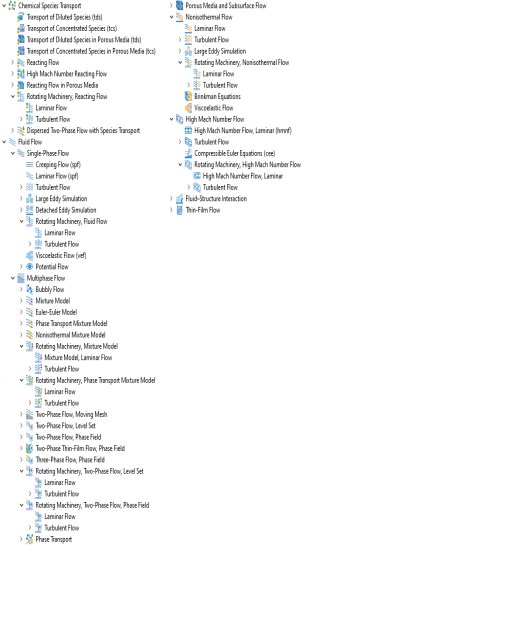
The Rotating Machinery, Laminar Flow interface (

) is used primarily for modeling flows of low to intermediate Reynolds numbers. This physics interface solves the Navier–Stokes equations for incompressible (default), weakly compressible and compressible flow (up to Mach 0.3). The physics interface is also capable of simulating non-Newtonian fluid flow.
The Rotating Machinery, Turbulent Flow interfaces (

) are used to model flow at high Reynolds numbers. These physics interfaces solve the Reynolds-averaged Navier–Stokes (RANS) equations for the averaged velocity field and averaged pressure. The different physics interfaces in this branch have different models for the turbulent viscosity. There are several turbulence models available — two algebraic turbulence models, the Algebraic yPlus and L-VEL models, and seven transport-equation models, including a standard
k-
ε model, the Realizable
k-
ε model, a
k-
ω model, a SST model, a low Reynolds number
k-
ε model, the Spalart–Allmaras model, and the v2-f model. Similarly to the Rotating Machinery, Laminar Flow interface, compressibility is set to incompressible by default.
The Algebraic yPlus and L-VEL turbulence models are so-called enhanced viscosity models. A turbulent viscosity is computed from the local distance to the nearest wall. For this reason, the algebraic turbulence models are best suited for internal flows, such as in electronic cooling applications. Algebraic turbulence models are computationally economical, and more robust but, in general, less accurate than transport-equation models. Among the transport-equation turbulence models, the standard k-
ε model is the most widely used turbulence model because it is often a good compromise between accuracy and computational cost (memory and CPU time). The Realizable
k-
ε model is similar to the standard
k-
ε model but has built-in realizability constraints, resulting in improved performance for certain flows, such as turbulent jets. The
k-
ω model is an alternative to the standard
k-
ε model and often gives more accurate results, especially in recirculation regions and close to solid walls. However, the
k-
ω model is also less robust than the standard
k-
ε model. The SST model combines the robustness of the
k-
ε model with the accuracy of the
k-
ω model, making it applicable to a wide variety of turbulent flows. The low Reynolds number
k-
ε model is more accurate than the standard
k-
ε model, especially close to walls, but requires higher resolution in the near-wall region. The Spalart-Allmaras model is specifically designed for aerodynamic applications, such as flow around wing profiles, but is also widely used in other applications due to its high robustness and decent accuracy. In the v2-f model, the turbulent viscosity is based on the wall-normal velocity fluctuations, whereby wall blockage effects and low Reynolds number effects are captured separately. The v2-f model also includes nonlocal effects of the fluctuating pressure on the turbulent fields.
The Rotating Machinery, Mixture Model interfaces (

) combine the functionality of the Rotating Machinery, Fluid Flow and Mixture Model interfaces. The interfaces are designed to study the flow of a two-phase mixture, consisting of a continuous phase and a dispersed phase, in rotating and stationary domains. Both phases are assumed to be incompressible. The dispersed phase can be bubbles, liquid droplets, or solid particles, which are assumed to always travel with their terminal velocity through the continuous phase. Physics interfaces for both laminar flow and turbulent flow are available. For turbulent flow the Reynolds-averaged Navier–Stokes (RANS) version of the mixture model equations are solved, and all the turbulent models available for the Rotating Machinery, Fluid Flow interfaces are also available.
The Rotating Machinery, Two-Phase Flow, Level Set interfaces (

) combine the functionality of the Rotating Machinery, Fluid Flow and Level Set interfaces. These multiphysics interfaces are used to track the interface between two immiscible fluids in geometries with one or more rotating parts. Wetted Wall and Interior Wetted Wall multiphysics features are available for boundaries along which the interface between the two fluids is expected to slide. Physics interfaces for both laminar flow and turbulent flow are available. For turbulent flow the Reynolds-averaged Navier–Stokes (RANS) equation is solved, and all the turbulent models for the Rotating Machinery, Fluid Flow interfaces are available.
The Rotating Machinery, Two-Phase Flow, Phase Field interfaces (

) combine the functionality of the Rotating Machinery, Fluid Flow and Phase Field interfaces. These multiphysics interfaces are used to track the interface between two immiscible fluids in geometries with one or more rotating parts. Physics interfaces for both laminar flow and turbulent flow are available. For turbulent flow the Reynolds-averaged Navier–Stokes (RANS) equation is solved, and all the turbulent models for the Rotating Machinery, Fluid Flow interfaces are available.
The Rotating Machinery, Nonisothermal Flow, Laminar Flow interface (

) is used primarily to model laminar flow where the temperature and flow fields have to be coupled, such as in an externally heated mixer. This multiphysics interface has predefined functionality for coupling heat transfer in fluids and solids. The weakly compressible option is selected by default for the Rotating Machinery Nonisothermal flow interfaces.
The Rotating Machinery, Nonisothermal Flow, Turbulent Flow interfaces (

) solve the Reynolds-averaged Navier–Stokes (RANS) equations together with the equations for heat transfer in fluids and in solids. There is support for all the fluid-flow turbulence models - the Algebraic yPlus model, the L-VEL model, the standard
k-
ε model, the Realizable
k-
ε model, the
k-
ω model, the SST model, a low Reynolds number
k-
ε model, the Spalart-Allmaras model, and the v2-f model.
The Rotating Machinery, High-Mach Number Flow interface (

) is used primarily to model gas flows where one or more of the boundaries rotate in a periodic fashion and the velocity magnitude is comparable to the speed of sound in the gas; that is, it flows in the transonic and supersonic range.
The Rotating Machinery, High-Mach Number Flow, Turbulent interfaces (

) solve the Reynolds-averaged Navier–Stokes (RANS) equations together with the equation for heat transfer in fluids. There is support for the standard
k-
ε model, the Realizable
k-
ε model, the
k-
ω model, the SST model, a low Reynolds number
k-
ε model, the Spalart-Allmaras model, and the v2-f model.
The Rotating Machinery, Reacting Flow interfaces (

) combine the functionality of the Rotating Machinery, Fluid Flow and Transport of Concentrated Species interfaces. The mass and momentum transport in a rotating reacting fluid can be modeled from a single physics interface, and the couplings between the velocity field and mixture density are set up automatically. Physics interfaces for both laminar flow and turbulent flow using the Reynolds-averaged Navier–Stokes (RANS) equations are available. There is support for the following turbulence models - the standard
k-
ε model, the
k-
ω model, the SST model, and the low Reynolds number
k-
ε model.
|
|
|
|
|
|
 Chemical Species Transport Chemical Species Transport |
|
|
 Rotating Machinery, Reacting Flow Rotating Machinery, Reacting Flow |
|
|
|
|
|
|
|
|
|
 Turbulent Flow Turbulent Flow |
|
|
|
|
|
|
|
|
|
|
|
|
|
|
|
|
|
|
|
|
|
|
|
|
|
|
|
|
 Fluid Flow Fluid Flow |
|
|
 Single-Phase Flow Single-Phase Flow |
|
|
 Rotating Machinery, Fluid Flow Rotating Machinery, Fluid Flow |
|
|
|
|
|
|
|
|
|
|
|
|
|
|
|
|
|
|
|
|
|
|
|
|
|
|
|
|
|
|
|
|
|
|
|
|
|
|
|
|
|
|
|
|
|
|
|
|
|
|
|
|
|
|
|
|
|
|
|
|
|
|
|
|
|
|
|
|
|
|
|
|
 Potential Flow Potential Flow |
|
|
|
|
|
|
|
|
|
|
|
|
|
|
|
|
 Rotating Machinery, Mixture Model Rotating Machinery, Mixture Model |
|
|
|
|
|
|
|
|
|
|
|
|
|
|
|
|
|
|
|
|
|
|
|
|
|
|
|
|
|
|
|
|
|
|
|
|
|
|
|
|
|
|
|
|
|
|
|
|
|
|
|
|
|
|
|
|
|
|
|
|
|
|
|
|
|
|
|
|
|
|
|
|
 Rotating Machinery, Phase Transport Mixture Model Rotating Machinery, Phase Transport Mixture Model |
|
|
|
|
|
|
|
|
|
|
|
|
|
|
|
|
|
|
|
|
|
|
|
|
|
|
|
|
|
|
|
|
|
|
|
|
|
|
|
|
|
|
|
|
|
|
|
|
|
|
|
|
|
|
|
|
|
|
|
|
|
|
|
|
|
|
|
|
|
|
|
|
 Rotating Machinery, Two-Phase Flow, Level Set Rotating Machinery, Two-Phase Flow, Level Set |
|
|
|
|
|
|
|
|
|
|
|
|
|
|
|
|
|
|
|
|
|
|
|
|
|
|
|
|
|
|
|
|
|
|
|
|
|
|
|
|
|
|
|
|
|
|
|
|
|
|
|
|
|
|
|
|
|
|
|
|
|
|
|
|
|
|
|
|
|
|
|
|
 Rotating Machinery, Two-Phase Flow, Phase Field Rotating Machinery, Two-Phase Flow, Phase Field |
|
|
|
|
|
|
|
|
|
|
|
|
|
|
|
|
|
|
|
|
|
|
|
|
|
|
|
|
|
|
|
|
|
|
|
|
|
|
|
|
|
|
|
|
|
|
|
|
|
|
|
|
|
|
|
|
|
|
|
|
|
|
|
|
|
|
|
|
|
|
|
|
 Rotating Machinery, Nonisothermal Flow Rotating Machinery, Nonisothermal Flow |
|
|
|
|
|
|
|
|
|
|
|
|
|
|
|
|
|
|
|
|
|
|
|
|
|
|
|
|
|
|
|
|
|
|
|
|
|
|
|
|
|
|
|
|
|
|
|
|
|
|
|
|
|
|
|
|
|
|
|
|
|
|
|
|
|
|
|
|
|
|
|
|
 Rotating Machinery, High Mach Number Flow Rotating Machinery, High Mach Number Flow |
|
|
|
|
|
|
|
|
|
|
|
|
|
|
|
|
|
|
|
|
|
|
|
|
|
|
|
|
|
|
|
|
|
|
|
|
|
|
|
|
|
|
|
|
|
|
|
|
|
|
|
|
|
|
|
|
|
|
|
|
|
|
|
|
|
|
|
|
|
|