In the Microfluidics Module, The Transport of Diluted Species Interface (

) and
The Transport of Diluted Species in Porous Media Interface (

) are available for modeling the transport of chemical species and ions. The assumption in these physics interfaces is that one component, a solvent, is present in excess (typically more than 90 mol%). This means that the mixture properties, such as density and viscosity, are independent of concentration. To model concentrated species, the Chemical Reaction Engineering Module is recommended in addition to the Microfluidics Module.
By default the Transport of Diluted Species interface accounts for the diffusion of species by Fick’s law and convection due to bulk fluid flow (see Figure 2-3). The fluid velocity field can be coupled from another physics interface (for example, Laminar Flow) by means of a domain level model input. The migration of ionic species in an electric field can also be added by selecting the appropriate checkbox in the Settings window for the physics interface — in this case an additional Electrostatics interface is usually coupled into the problem by an additional model input.
Chemical reactions can be added to the physics interface at the domain level by the Reactions node, which requires the Chemical Reaction Engineering Module. This allows you to specify expressions for the consumption or production of species in terms of their concentration, the concentration of other species, and other model parameters, such as the temperature.
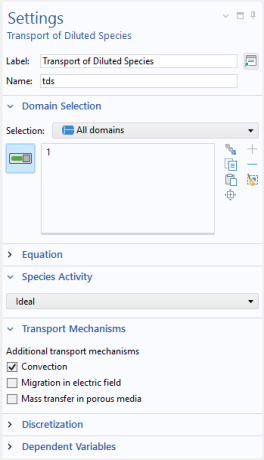
For some laminar flow problems it can be useful to change the settings for the dilute species transport stabilization. To do this, click the Show More Options button (

) and select
Stabilization in the
Show More Options dialog. A
Consistent stabilization section is now visible in the Transport of Diluted species settings, and in some cases it can be desirable to change the settings for the crosswind diffusion. By default the
Crosswind diffusion type is set to
Do Carmo and Galeão. This type of crosswind diffusion reduces undershoot and overshoot to a minimum but can in rare cases give equations systems that are difficult to fully converge. The alternative option,
Codina is less diffusive and so should be used if the species transport is highly convective, or if convergence problems occur. This option can result in more undershoot and overshoot and is also less effective for anisotropic meshes.
For both consistent stabilization methods, the Equation residual can also be changed.
Approximate residual is the default setting and it means that derivatives of the diffusion tensor components are neglected. This setting is usually accurate enough and is faster to compute. If required, select
Full residual instead.