where ρ is the density,
g is the body force acceleration,
L is the characteristic length, and
σ is the surface tension coefficient. The density can refer to a density difference when considering buoyancy.
where μ is the viscosity,
v is the characteristic velocity of the problem, and
σ is the surface tension coefficient.
Models the Navier–Stokes equations without the contribution of the inertia term. This is often referred to as Stokes flow and is appropriate for use when viscous flow is dominant, such as in very small channels or microfluidic applications.
where Kσ is the surface conductivity and
KB is the bulk conductivity. For low Dukhin numbers, surface conductivities can be neglected when modeling electrokinetic flows.
Fluid flow in a narrow channel produced by the movement of the electric double layer (EDL) along the channel boundary under the influence of an applied electric field. Also, fluid flow through a membrane under the influence of an applied electric field. See also
electric double layer.
The electrowetting effect describes the change in solid-electrolyte contact angle that occurs when a potential difference is applied between the solid and the electrolyte.
A form of electrowetting in which a thin insulating layer separates the conducting solid surface from the electrolyte.
The flow of gas molecules through a geometry which is much smaller than the mean free path (Knudsen number, Kn > 10). In the free molecular flow regime the gas molecules collide with the walls of the geometry much more frequently than they collide with themselves.
The Laplace number, La, (also known as the Surataman number,
Su) relates the inertial and surface tension forces to the viscous forces. It is used to describe the breakup of liquid jets and sheets: at high Laplace and low Reynolds numbers the Rayleigh Instability occurs, at low Laplace and high Reynolds numbers atomization occurs. The Laplace number is given by
where ρ is the fluid density,
σ is the surface tension coefficient,
L is the characteristic length scale of the problem, and
μ is the viscosity. The Laplace number is directly related to the Ohnesorge number,
Oh, through the equation
La = 1/
Oh2.
Ratio of the convective speed, v, to the speed of sound in the medium,
a. The Mach number,
Ma, is defined by the equation
where σ is the surface tension coefficient,
T is the absolute temperature (
ΔT is the characteristic temperature difference),
L is the characteristic length, and
α is the thermal diffusivity
(α = κ/(ρcp)), where
cp is the heat capacity at constant pressure,
κ is the thermal conductivity, and
ρ is the density of the fluid.
where ρ is the fluid density,
σ is the surface tension coefficient,
L is the characteristic length scale of the problem, and
μ is the viscosity. The Ohnesorge number is directly related to the Laplace number,
La, through the equation
Oh = 1/
La1/2.
where v is the convective velocity,
L is the flow length scale, and
D is the diffusion constant.
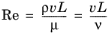
A dimensionless number classifying how laminar or turbulent a flow is. The Reynolds number Re is a measure of the relative magnitude of the flow’s viscous and inertial forces. It is defined by the following equation where
ρ is the fluid density,
μ is the dynamic viscosity,
ν is its kinematic viscosity,
v is a velocity characteristic to the flow, and
L is a length scale characteristic to the flow.
Fluid flow that occurs when the Knudsen number,
Kn, is in the range 0.01 <
Kn < 0.1. As a result of rarefaction effects in the
Knudsen layer the no slip boundary condition fails. The flow outside the Knudsen layer can be represented by the continuum Navier–Stokes equations provided that an appropriate slip boundary condition is used for the fluid flow and the correct temperature jump boundary condition is applied at the interface.
Fluid flow that occurs when the Knudsen number,
Kn, is in the range 0.1 <
Kn < 10. In this regime the flow is so rarefied that continuum equations break down completely. However collisions between the molecules are still important, so free molecular flow is not applicable.
where ρ is the density of the fluid,
v is the characteristic velocity of the flow,
L is the characteristic length scale, and
σ is the surface tension coefficient.