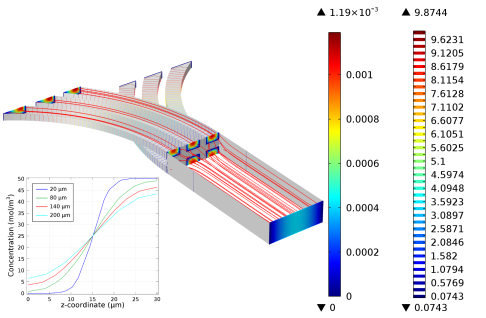
The Reynolds number (Re), which characterizes the ratio of these two forces, is typically low, so the flow is usually laminar (Re < 1000). In many cases the creeping (Stokes) flow regime applies (Re « 1). Laminar and creeping flows make mixing particularly difficult, so mass transport is often diffusion limited. The diffusion time scales as L2, but even in microfluidic systems diffusion is often a slow process. This has implications for chemical transport within microfluidic systems. The figure below shows flow in a device designed to enhance the mixing of two fluids in a lamella flow. Pressure contours are shown on the walls of the mixer, and the velocity magnitude is shown at the inlets and outlets of the mixer as well as at the point where the two sets of channels (carrying different fluids) converge. Streamlines (in red) are also plotted. The inset shows the concentration of a diffusing species present in only one of the fluids. It is plotted along vertical lines located progressively further down the center of the mixer.
Flow through porous media can also occur on microscale geometries. Because the permeability of a porous media scales as L2 (where L is the average pore radius) the flow is often friction dominated when the pore size is in the micron range and Darcy’s law can be used. For intermediate flows this module also provides a physics interface to model flows where the Brinkman equation is appropriate.
As the length scale of the flow becomes comparable to intermolecular length scale, more complex kinetic effects become important. For gases, the ratio of the molecular mean free path to the flow geometry size is given by the Knudsen number (Kn). Clearly,
Kn scales as 1/L. For
Kn < 0.01, fluid flow is usually well described by the Navier–Stokes equations with no-slip boundary conditions. In the slip-flow regime (0.01
< Kn < 0.1), appropriate slip boundary conditions can be used with the Navier–Stokes equations to describe the flow away from the boundary. The Microfluidics Module includes a physics interface to deal with these slightly rarefied gas flows: the Slip Flow interface. For more highly rarefied flows, the Molecular Flow Module should be used.