Thermal Expansion
It is well known that different metallurgical phases occupy different volumes at a given temperature. For example, when austenite transforms into martensite, the thermal contraction due to cooling is accompanied by a volumetric expansion when the martensite begins to form. There are two formulations for computing thermal strains in the compound material. The strain based formulation uses a phase fraction weighted sum of the thermal strains of each phase. The density based formulation uses the change in density during temperature changes and phase transformations.
Strain Based Formulation
In the strain based formulation, the thermal strain of the compound material is given by
In this equation, the thermal strains of the individual phases are computed using a secant thermal expansion model, requiring a coefficient of thermal expansion and a strain volume reference temperature for each phase.
Consider the simple case where phase 1 transforms into phase 2. In 1D, the thermal strain is
where α(T) and Tref are the secant coefficient of thermal expansion and strain volume reference temperature, for the respective phases I and II. Figure 3-8 shows the thermal strain. For simplicity, the coefficients of thermal expansion for the two phases in the figure are constant (but different). In the figure, a fictitious phase transformation has been used to illustrate when phase I transforms completely into phase II as the temperature is lowered. No separate volumetric term is required to model this type of phase transformation strain, as it is included in the definition of the thermal expansion itself.
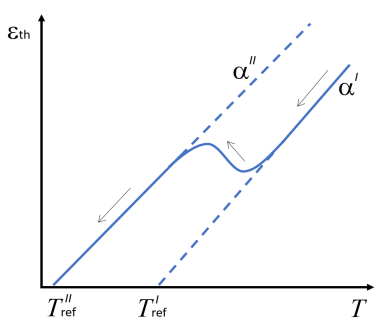
Figure 3-8: The strain based formulation for thermal strains.
Density Based Formulation
Instead of expressing thermal strain contributions from each phase separately, this formulation uses the temperature-dependent densities and the evolving phase composition to express a volumetric strain. To compute a reference density, the initial phase composition and the densities evaluated at their respective volume reference temperature are used. The evolving thermal volumetric strain is then given by
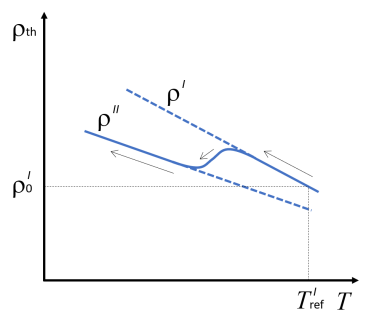
Consider, as in the previous section, a case of two phases, where one transforms into the other as the temperature decreases. Initially, this fictitious material consists entirely of phase I. The volume reference temperature for phase I is equal to the initial temperature, so that the thermal strain is zero at this temperature. As the temperature decreases, the density of the compound material is exactly equal to the evolving density of phase I. As the phase transformation takes place, the compound material density changes both with temperature and the changing phase composition. Finally, phase I has transformed fully into phase II, and the compound material density becomes identical to the density of phase II on further reduction in temperature, see Figure 3-9.

Figure 3-9: The density based formulation for thermal strains.