Steel Quenching
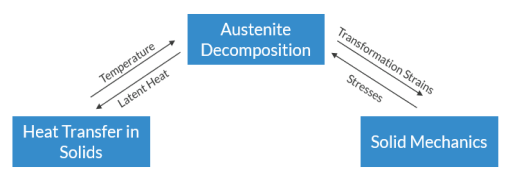
The Steel Quenching multiphysics interface combines the Austenite Decomposition interface with the Heat Transfer in Solids and the Solid Mechanics interfaces. It can be used to study heat treatment processes by which steel parts, which have been heated to a fully austenitic state, are quenched. The multiphysics interface couples the constituent interfaces so that effects of latent heat and phase transformation strains can be included in the analysis. Phase compositions, distortions, and residual stresses can be computed using the Steel Quenching multiphysics interface.
Figure 2-4
shows how this information is passed to, and from, the Austenite Decomposition interface. Note that, for example, material properties used in Solid Mechanics can be temperature dependent, and that plastic dissipation can act as a heat source in Heat Transfer in Solids (this is not shown in
Figure 2-4
). The Steel Quenching multiphysics interface uses the
Phase Transformation Latent Heat
multiphysics coupling and the
Phase Transformation Strain
multiphysics coupling.
Figure 2-4:
The constituent interfaces of the Steel Quenching multiphysics interface.
For an example how to use the Steel Quenching interface, see
Carburization and Quenching of a Steel Gear
: Application Library path
Metal_Processing_Module/Steel_Quenching/carburization_and_quenching_of_a_steel_gear
.