Thin-Film Damping
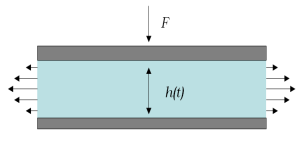
In many MEMS devices a released structure moves relative to the substrate, compressing or shearing a thin layer of gas between the two structures. The fluid film can be the dominant form of damping for the moving microstructure. If the film is compressed by a structure moving perpendicular to its plane, this type of damping is usually referred to as squeeze-film damping. Damping induced by motion of the structure parallel to the plane in which the fluid flows is called slide-film damping.
Figure 2-2: Diagram showing a circumstance in which squeeze-film damping applies.
It is often convenient to model the film using the Reynolds equation — enabling the 3D gas layer to be modeled on a 2D surface. The Reynolds equation applies for isothermal flows of a thin film in which the film height, h, is much less than a typical lateral dimension of the device, L. It must also be possible to neglect inertial flow effects in comparison to the viscous effects (for MEMS devices, this assumption is reasonable below MHz frequencies). Additionally, the curvature of the reference surface is neglected.
For isothermal, ideal gases the Reynolds equation can be simplified, leading to a modified Reynolds equation, formulated in the pressure only (the full Reynolds equation is formulated using both the pressure and the density). COMSOL Multiphysics includes both forms of the Reynolds equations in the Thin-Film Flow interfaces, and it is possible to switch between them using the Equation Type setting. Both forms of the equations include squeeze-film damping and slide-film damping.
The Thin-Film Flow interfaces are available as standalone physics interfaces that can be manually coupled to, for example, the physics interfaces in the Structural Mechanics branch. Thin-Film Damping has also been added as a boundary condition to the structural mechanics physics interfaces — these include Solid Mechanics, Piezoelectricity, Electromechanics, and Joule Heating and Thermal Expansion. The boundary condition automatically couples the damping forces to the model.
For gas damping, especially in vacuum packaged devices, the Knudsen number for the thin film gap is an important parameter to consider. This is the ratio of the gas mean free path to the gap height. Below Knudsen numbers of 0.01 it is necessary to use a slip boundary condition for the fluid by specifying a characteristic slip length. As the Knudsen number decreases further additional rarefaction effects need to be accounted for. These can be included empirically in the Reynolds equation using models that require the mean free path and the tangential momentum accommodation coefficient (TMAC) to be specified. The TMAC is a measure of the mean fractional loss of tangential momentum of the gas molecules on collision with the walls — typical values for various gas surface combinations are available in Ref. 1 (see Table 6 in this reference).
In the CFD Module User’s Guide: