Results
Displacement (solid)
1
Much of the structure has essentially zero movement in this initial study. To facilitate results analysis, add a selection to the solution, so that only the domains of interest are displayed in the plots.
Datasets
In the Model Builder window, expand the Results > Datasets node , then click Study 1/Solution 1 (sol1) .
Selection
1
2
3
4
Displacement (solid)
1
2
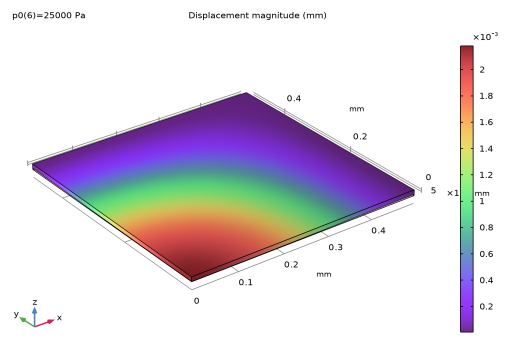
The plot now shows the displacement of the diaphragm only, which, as expected, is maximum in the center of the sensor.
Next, plot the electric potential in an xy-oriented plane between the sensor diaphragm and the ground plane.
Electric Potential (es)
1
2
-
-
-
-
3
-
-
Selection 1
1
2
3
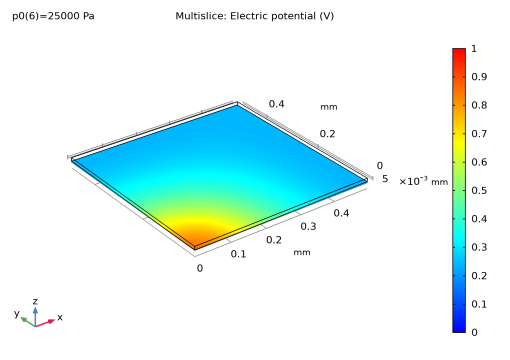
Due to the deformation of the diaphragm the potential is nonuniformly distributed in the plane, which cuts through the cavity at a constant height.
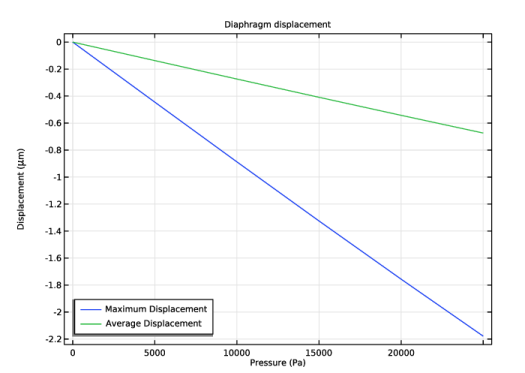
Next, the deformation of the diaphragm is plotted as a function of the pressure difference across it. Both the average and the maximum displacements are plotted.
1D Plot Group 5
1
2
Global 1
Use the point integration and surface average operators defined earlier to evaluate the displacement at the midpoint of the membrane and the average displacement.
1
intop1(w)
aveop1(w)
1D Plot Group 5
1
2
-
-
In the Title text field, enter Diaphragm Displacement.
3
-
-
4
5
In the Label text field enter Diaphragm Displacement vs Pressure.
6
At an applied pressure of 10 kPa the diaphragm displacement in the center is 0.89 μm. The average displacement of the diaphragm is 0.27 μm. These values are in good agreement with the approximate model given in Practical MEMS (maximum displacement 0.93 μm, average displacement 0.27 μm).
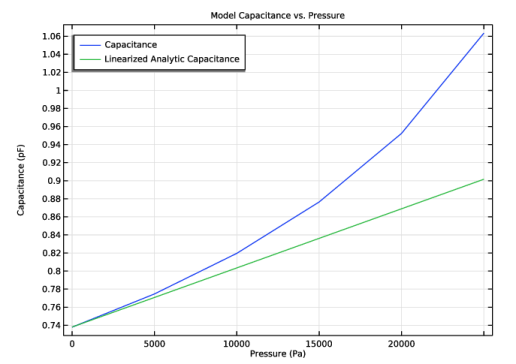
Now plot the sensor capacitance as a function of the applied pressure. If the switched capacitor amplifier described in Practical MEMS is used to produce the output, the sensor output or transfer function is directly proportional to the change in capacitance.
1D Plot Group 6
1
2
Since the terminal boundary condition was used for the underside of the diaphragm, COMSOL Multiphysics automatically computes its capacitance with respect to ground. The value of the capacitance is available as a variable in result analysis.
3
Next, compare the computed capacitance with the small displacement, linearized analytic expression derived in Practical MEMS.
4
5
6
-
-
In the Title text area, enter Model Capacitance vs Pressure.
7
-
-
8
9
In the Label text field enter Model Capacitance vs Pressure.
10
The capacitance of the sensor increases with applied pressure. The gradient of the curve plotted gives a useful measure of the response of the device. At the origin the response of the model (1/4 of the whole sensor) is 7.3×10⁻⁶ pF/Pa, compared to the simple analytical response of 6.5×10⁻⁶ pF/Pa. The response for the whole sensor is therefore 29×10-6 pF/Pa compared to the analytic value of 26×10-6 pF/Pa. With the measurement circuit proposed in Practical MEMS this corresponds to a sensor transfer function of 29 μV/Pa for the COMSOL Multiphysics model and 26 μV/Pa for the simple analytic model. The response is nonlinear, so that at 20 kPa the model output is 14×10-6 pF/Pa (device output 57 pF/Pa).
Next, add thermal expansion to the model, to assess the effects of packaging stresses on the device performance.